Hidden for over 100,000 years, this unexpected discovery rewrites a key chapter in our history, and reveals a lost world beneath the sand.

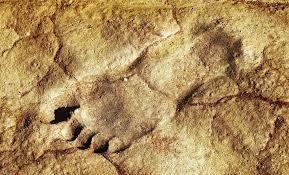
Across a wind-swept basin in Saudi Arabia’s Nefud Desert, a now-vanished lake once attracted wildlife during a brief climatic window more than 100,000 years ago. Among the tracks of ancient elephants and camels, scientists recently identified something less expected: a set of fossilised footprints distinct in shape and form.
The site, remote and difficult to access, had long been overlooked. But a field survey in 2017 revealed preserved impressions in the sediment, hinting at the brief passage of humans through what is now an arid, inhospitable landscape.

No tools were recovered. No bones. Just a series of prints—ephemeral and fragmentary—yet dating back far earlier than previously confirmed human presence in the region. The implications reach well beyond the Arabian Peninsula.
Earliest Direct Evidence of Humans in Arabia
The site, named Alathar (Arabic for “the trace”), lies within the western Nefud Desert. Researchers found seven fossilised human footprints embedded in what was once the edge of a shallow freshwater lake. Dating methods using optically stimulated luminescence place the surrounding sediments at around 115,000 years ago, within the last interglacial period, when climate conditions temporarily shifted to wetter, more temperate states.
The team, led by researchers from Saudi Arabia, the UK and Australia, determined that the tracks were anatomically consistent with early Homo sapiens, based on both their morphology and known regional fossil records.

“Seven hominin footprints were confidently identified,” the authors stated, “and given the fossil and archaeological evidence for the spread of H. sapiens into the Levant and Arabia during [130,000–80,000 years ago] and absence of Homo neanderthalensis from the Levant at that time, we argue that H. sapiens was responsible for the tracks at Alathar.”
These prints now represent the oldest known direct evidence of humans on the Arabian Peninsula. Their presence confirms that Homo sapiens reached inland Arabia significantly earlier than previously documented by fossils or tools.
No Signs of Settlement, but a Window Into Behaviour
Alathar does not appear to have been a settlement. Researchers found no stone tools, no signs of fire, and no modifications on nearby animal bones. The evidence points to a brief visit, likely related to the need for water. “The lack of archaeological evidence suggests that the Alathar lake was only briefly visited by people,” the study reports. “These findings indicate that transient lakeshore use by humans during a dry period of the last interglacial was likely primarily tied to the need for potable water.”

Dozens of other animal tracks were recorded in the same sediment layer. These included prints from elephants, camelids, equids and bovids, suggesting a biologically rich area that may have functioned as a seasonal gathering point for migratory species. The human and animal prints were preserved rapidly, likely within hours or days, before being covered by additional sediment layers.
Preservation of such prints is rare. Experimental studies referenced by the researchers note that human footprints in wet environments lose identifiable details within two days and often disappear within four. The pristine state of the Alathar tracks indicates rapid burial, allowing for exceptional fossilisation conditions.
Environmental Corridor During a Climatic Shift
The Alathar prints were created during a relatively humid period in Arabia’s climatic history, part of the broader last interglacial, which spanned roughly 129,000 to 71,000 years ago. During this time, rainfall patterns shifted, and desert regions like the Nefud briefly supported freshwater lakes, savannah-like vegetation and large mammals.

This period likely created ecological corridors that connected Africa, the Levant and South Asia, allowing early humans to move across regions that today are nearly uninhabitable. Previous theories often suggested that Arabia was either bypassed or only briefly traversed during human expansion. The Alathar discovery, along with other emerging palaeoenvironmental data, suggests that humans may have repeatedly entered and occupied parts of Arabia during favourable climate intervals.
A 2021 study in Nature also points to a series of now-vanished lakes and rivers across the peninsula that could have supported early human migration. The study highlights that “green windows” in Arabia may have opened and closed multiple times during the late Pleistocene.
Dynamic Environment With Shared Resources
Footprints offer a kind of evidence not typically available from bones or tools. They capture a direct, momentary record of presence—revealing not only that humans were there, but that they moved, paused, and likely interacted with the landscape and its wildlife. Their spatial layout, proximity to animal tracks, and sedimentary context help build a more detailed behavioural picture.
The Alathar prints stand apart as a rare example of such evidence. They occur in isolation, with no apparent overlap from subsequent human activity. Researchers suggest the site may represent one of the last visits before environmental conditions changed again, possibly pushing humans to move on.
NOTE – This article was originally published in Daily Galaxy and can be viewed here