For as long as history goes by, the practice of agriculture has been the bedrock of any human society or civilization. Ancient records prove that people looked for pastures & grasslands to settle down any village, city, or nation. Farming as a social practice has its footprints embedded deep in the human psyche & it is a necessary practice for the survival of all human race.(HEALING WOUNDS)
Agriculture & climate change
As new & more stable machinery was introduced in agriculture, the way we looked at our fields change. The holistic bond between a man & his land was severed & we got so engaged with the word profit that we ignored the warning nature tried to give us in the background.
That same ideology has led mankind to the current situation. The ideology of exploitation & regular abuse of natural resources. Owing to that now we face the worst of the situation, fields are barren, water poisoned, leaves covered in smoke.
Now it’s high time to heal the wounds we inflicted upon our nature & ecosystem & amid the revolutionary ideas that propagated on a huge scale, one idea, in particular, became a potential weapon to fight off against climate change & to restore the natural order so that we may move towards a sustainable future.
Regenerative farming & its principles:
It’s a common knowledge that all the creatures are dependent upon the land we stand upon, everything is interconnected to each other with land & water making up the nucleus of this ecosystem.
Regenerative farming deals with repairing the same land & water-based ecosystem which in turn would curd the high emission rates of carbon & other pollutants into the atmosphere.
Some of the major principles of regenerative farming are:
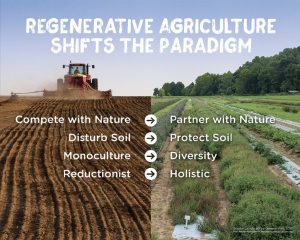
- Improving the soil condition.
- Working with the entire ecosystem
- Stop the exploitation of the industrial based agriculture system
- Improve the entire agro system
- Make farming sustainable
- Reverse the damage done to the ecosystem
- Preserve the land & water resources
- Protect the present surviving biodiversity & bringing it back to its former glory
- Along with everything else, maintaining the current food demand & supply chain so that no food shortages occur.
These principles may seem easy & good on paper but believe it they are not at all easy with the current damage being done to the system.
Practical approach towards regenerative farming
There are a lot of practices that are covered under the banner of this type of agriculture but out of all those, three stand out on their own, they are:
- No-till farming: it is known that the top 1 inch of soil contains most of its nutritional value, & would take from 100 to 500 years to form completely.

The practice of no-till farming is done to preserve that same upper layer & the mini-ecosystem inside of it. Regenerative practices shorten that 500 years into 5 to 10 depending upon the level of damage & local conditions. No tilling of field is done to prepare the ground for cultivation but nature is allowed to take its course & speed is increased not by chemicals but by increasing the organic component of soil.
- Regenerative grazing: cattle breeding & herding when done repeatedly disrupts the natural cycle of growth & destruction of a particular land. Regenerative grazing keeps in mind to prevent overgrazing so that the land may have a healthy chance to recover the soil quality. Instead, cattle stock is moved in a specific periodic interval from one patch to another to increase the biowaste intake of soil to increase its nutrient content.
- Agroforestry: the most revolutionary & most complex of all practices. For this one needs to recreate near forest-like conditions to create an ecologically balanced local atmosphere. Food forest emerged as a new concept where all the seven layers of forest namely,
Root layer
Ground cover layer
Herb layer
Shrub layer
Low trees layer
High trees layer
& vine layer
Are included in the production of food or medicines or are helpful in one form or another.
- Biochar: a reemerging technique in which organic matter undergoes pyrolysis in limited or no oxygen to form a carbon-rich component called biochar.
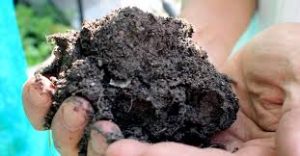
It then further helps in adding organic content to the soil, increasing productivity. It resembles charcoal but due to its processing, it containing near to zero harmful substances & a more purified version of carbon used indirectly repairing or maintaining soil & can also be presented as an alternative to burning crop residue in India.
Case studies: profiting through regenerative farming
A no. of farmers as well as agro-industries have shifted their approach towards making a profit. The current situation has arisen awareness in masses thus shifting them towards a regenerative type of agriculture. Some of those same cases are-
- Balbo group: one such agro group is this one. They shifted & developed their green harvesters with less pressurized tires to reduce excessive compaction. It cuts & shreds the by-product simultaneously to return it to the soil. With this solution, the requirement of mechanical irrigation was eliminated along with that of chemical inputs. A total of 20% of production increase was recorded due to this shift.
- Jed franklin: a farmer from south Australia shifted his approach towards maintaining the local ecosystem by growing organic cereals to preserve wild & natural habitat. This has resulted in a maintained local ecosystem with a 32% decrease in chemical stimulants cost & 17% growth from last year.
Read Also : Targeted Ecosystem Restoration Can Protect Climate, Biodiversity,https://greenstories.co.in/protect-climate/
Global impact: saving the ecosystem, saving the future
With time, the regenerative method of practicing agriculture is getting more mainstream & is expanding its roots into the psyche of everyday farmers. The global goal of regenerative farming is to first contain the damage done to the ecosystem & gradually repair it so that future generations can live with wase in terms of resources & lifestyle.
With each day, more & more farmers are getting attracted to regenerative practices & are following in one way or another. Despite this growth, the main cause of confusion in the community is related to crop production value but it has been clarified that the quantity of yield will not be compromised in any sense or form giving farmers the much-needed assurance.
Sustainability is now becoming a global goal as people are getting familiarised with the reality & the future this reality will make if nothing is changed. As governments are taking the organic market more & more seriously, the schemes for such practices seem to live in a new light of hope. In any case, government support is an absolute necessity when it comes to make & maintain any new ecosystem.
Australia has emerged as global trendsetters when it comes to the introduction of sustainable farm practices closely followed by South Asia, the USA & Europe. Although the initial number is merely a fraction of the overall industry, it presents a hope that small steps taken by humanity will result in a much better future.
Regenerative farming is a lot different from the ongoing conventional modes as it takes care of the soil & land thus reinstating the holistic relation between a human & his/her land.
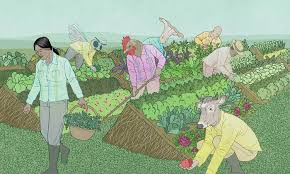
It helps in preserving the ongoing profit margins without harming the natural order to the present extent & hence it creates as many relationships as possible in the present ecosystem so that mutual trust can be regenerated between all the species & humankind can progress in a more progressive & sustainable manner.
Tags: #agriculture, #agriculturelife, #agro, #claas, #farm, #farmer, #farmers, #farming, #farminglife, #farmingsimulator, #farmlife, #fendt, #fs, #getgreengetgrowing, #gngagritech, #greenstories, #harvest, #johndeere, #landwirtschaft, #ls, #nature, #newholland, #organic, #Tractor, #tractors