
Farmers should develop ethanol instead of conventional crops, according to Union Minister Nitin Gadkari, since it will increase profitability and offer green fuel to the economy. According to the Union Minister for Road Transport and Highways, the country presently spends Rs 8 lakh crore on gasoline imports each year, with the figure expected to rise to Rs 250 crore in the coming future.
_______________________________________________________________________
Read Also : Climate science is supporting lawsuits that could help save the world
________________________________________________________________________
“Today’s farmers provide us with foodgrains. They should, however, begin to give energy. The government presently spends Rs 8 lakh crore on fuel imports each year, with the figure potentially rising to Rs 25 lakh crore in the future. Farmers will not commit suicide if such a large sum is given to them “Gadkari said. Traditional crops will not be lucrative, therefore farmers should focus on ethanol production instead, he noted.
According to the minister, the Centre has directed the use of 10% biomass instead of coal in energy production, which would enable farmers earn up to Rs 8 lakh per acre of land in only two years if they plant bamboo similarly to sugarcane.
Gadkari was addressing at the Phoenix Eicher Institute of Driving Training and Research in Latur, which he founded. This is the state’s first institute to train drivers, and it’s run on a public-private partnership model or PPP model.
According to the minister, the country is lacking approximately 22 lakh drivers.
“In Europe, drivers are only allowed to work for eight hours at a time.. In India, however, they travel for 12 to 16 hours in temperatures as high as 48 degrees Celsius, with no air conditioning in the trucks “he stated
Every year, about 1.5 lakh individuals die in accidents in the nation, with the bulk of the casualties being between the ages of 18 and 25, he added.
_______________________________________________________________________
Read Also : How Climate Change Is Derailing the World’s Lofty Carbon Offset Hopes
________________________________________________________________________
“If we want to decrease the amount of accidents, we must put in greater effort. The government has allocated Rs 15,000 crore through the Asian Development Bank and the World Bank to restore the country’s black spots (accident-prone locations) “Gadkari explained.
In the next five years, at least 80 taluka-level driver training colleges would be established across the nation, he said, adding that the measure will also benefit unemployed youngsters.
The minister went on to say that Indian businesses were ready to deliver flex engines to the Indian market. This will enhance the demand for ethanol while also benefiting the country’s farmers.
Gadkari also encouraged Anil Parab, the state transportation minister in Pune, to lead the way in introducing ethanol-powered auto-rickshaws. As environmental, social, and governance (ESG) ideas in sustainability gain traction throughout the world, the drive for energy efficiency and reduced emissions in transportation is intensifying. India’s economy is booming, and the country is the world’s fifth-largest manufacturer of light cars and third-largest producer of heavy vehicles.
Why Ethanol?
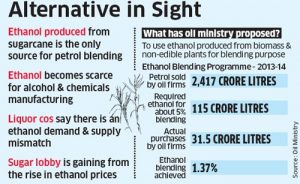
In an effort to tackle the sugar crisis, the government has decided to enhance ethanol production by making 10% blending with gasoline mandatory from October 2015 forward.
The petroleum ministry has made a decision in this respect after Prime Minister Narendra Modi stated in a recent meeting that increasing ethanol production in a significant scale is the long-term solution for cash-strapped sugar mills owing cane growers about Rs 14,000 crore.
____________________________________________________________________
Read Also : Most Polluted Major City on Earth – Delhi
________________________________________________________________________
At the moment, it is required to mix 5% ethanol with gasoline, although oil marketing companies (OMCs) can do as little as 2%. “Sugar mills would be required to increase ethanol supply starting in the 2015-16 marketing year to meet the demand of 230 crore litres for 10% combining with gasoline,” added a government official.
From the next year, OMCs would be required to acquire ethanol based on a 10% blending requirement, he added. Mills will be requested to increase ethanol output through the ‘B-heavy’ molasses pathway to assist cut sugar output by 1.5 million tonnes yearly, according to the official, in order to avoid surplus sugar stockpiles stacking up next year.
HOW WILL THE LOCAL GET BENEFITTED?
Normally, mills only make ethanol from ‘C’ (final-stage) molasses, a sugarcane by-product. “Given the substantial decline in sugar prices owing to surplus stocks in both domestic and international markets, it makes economic sense to produce more ethanol instead of sugar,” the official said.
Mills may make up to 48-49 cents per litre of ethanol. In the instance of sugar, they are unable to recoup their production costs because the ex-mill rate has suddenly dropped below $20 per kilogramme. Sugar companies have been slow to respond to the ethanol-blending scheme.
OMCs have been able to contract 82 crore litres of ethanol so far this year, compared to a demand of 133 crore litres for 5% blending. The country has a capacity to produce 450 million litres of ethanol, of which 240 million litres are produced by sugar mills and the remainder is produced independently.
Tags: #crops, #environmental, #farmer, #farming, #foodgrains, #getgreengetgrowing, #gngagritech, #greenstories, #plant, #social, #sugarcane