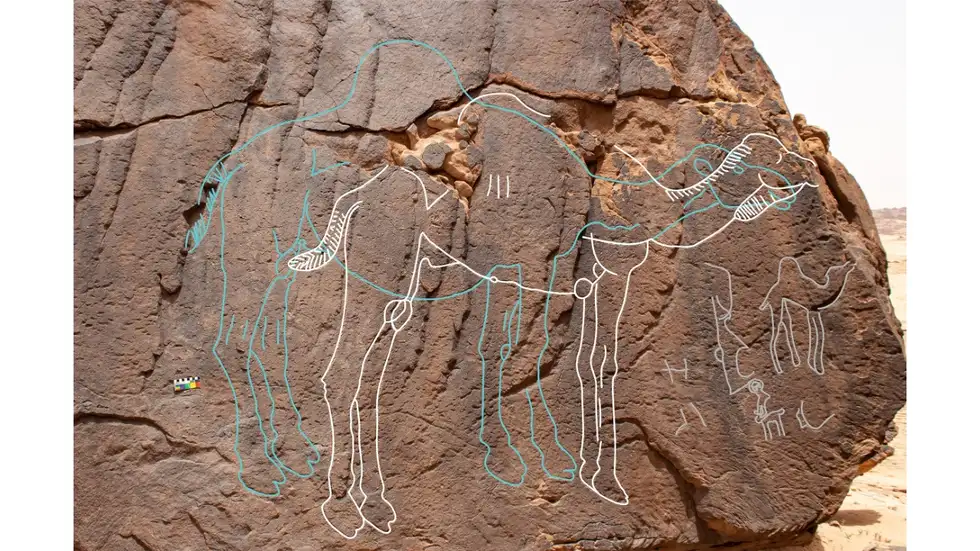
The vast deserts of Saudi Arabia hold not just stories of endless seas of sand and oil wells, but also hidden ancient art. Tragically, much of its artistry has been lost to erosion under the deathly stare of the region’s unforgiving, harsh climate.
But hope still blooms in some pockets of its seemingly endless desert. Now, archaeologists have stumbled upon these sparse yet stunning treasure troves of ancient rock art taking us back to the Neolithic period (10,000-4,000 BCE).
The enigmatic camel carvings are not confined to a single ancient art gallery, but spread throughout Northern Arabia. Some of them were found at the famous ‘Camel Site’, where rock art depicts life-sized, naturalistic camels and equids that are now long gone. Five years ago, another ‘parade of life-size camels’ was unearthed in Al-Jouf province.
________________________________________________________________________
Read Also: What climate change means for the future of coffee and other popular foods
________________________________________________________________________
However, the latest revelation is nothing short of extraordinary.
In the most recent effort, researchers uncovered the carvings of several dozen extinct camel species on a rocky outcropping, known as Sahout, along the southern fringes of the Nefud desert.
Remarkably, these carvings have managed to survive since they were nestled into crevices, nature’s very own protective vaults shielding them from the harsh climatic changes.
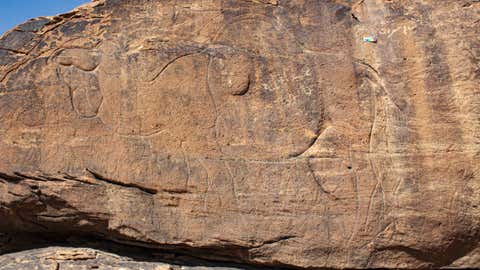
(Maria Guagnin/ https://doi.org/10.1016/j.ara.2023.100483)
Further probing revealed that these carvings were not made all at once, but in distinct layers, over different periods, and by varied groups of people — the transition of time can be gauged by the varied techniques and styles, some of which even go back as far as 8,000 years. Some images are also drawn over the carvings of domesticated sheep.
Moreover, this stone-age art was likely crafted with stone tools chiselled from chert — a tough sedimentary rock once used to make ancient tools and weapons. Of course, crafting such marvels must’ve taken immense time, patience and skill. Some of the artworks perhaps took up to two weeks to complete, the research states.
________________________________________________________________________
Read Also : The young ancient secret of BIOCHAR,
________________________________________________________________________
But what truly captures our imagination is the footprints of the community and its now lost culture that’s preserved in the ancient rock art. Researchers have evidence to believe all these impressive carvings were created by community effort and held immense significance for pastoral communities living in the region.
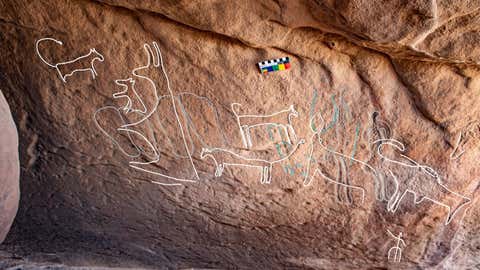
(Maria Guagnin/ https://doi.org/10.1016/j.ara.2023.100483)
It is also worth noting that the regional landscape might have looked quite different back then — somewhat closer to a savannah-like grassland instead of today’s barren desert.
Previous findings at the Camel Site have indicated that it could’ve been part of a broad pattern where groups frequently visited, like a seasonal or annual gathering, to establish and mark symbolic places. Perhaps the newly discovered engravings might have held similar cultural significance for our ancestors.
NOTE – This article was originally published in weather and can be viewed here