Once upon a time, 72 million years ago, the Pacific seas were terrorised by a giant monster, called the “blue dragon”.
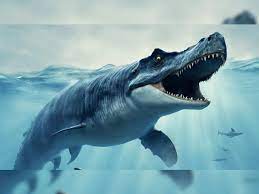
As per research published in the Journal of Systematic Paleontology, researchers have named the monster Wakayama Soryu, which means Blue Dragon.
The apex predator was a mosasaur, an extinct, large marine reptile from the Late Cretaceous period. It has been named after Japan’s Wakayama Prefecture where its fossil was found.
University of Cincinnati Associate Professor Takuya Konishi, along with a team of international co-authors, described the amazing discovery in the Palaeontology journal.
Explaining the name, Konishi in a statement on the University of Cincinnati website said: “In China, dragons make thunder and live in the sky. They became aquatic in Japanese mythology.”
_______________________________________________________________________
Read Also : Climate change: governments’ pledges put planet on ‘catastrophic pathway,’ warns UN
________________________________________________________________________
The nearly complete fossil of the mosasaur was discovered by co-author Akihiro Misaki back in 2006.
At the time, Misaki was looking for fossils of invertebrates called ammonites when he stumbled upon an intriguing dark fossil in the sandstone.
The Wakayama Soryu fossil specimen is the most complete skeleton of a mosasaur ever found in Japan or the northwestern Pacific, said Konishi.
“In this case, it was nearly the entire specimen, which was astounding,” said Konishi.
Wakayama Soryu: What it looked like
The apex predator, which haunted prehistoric waters, had unique features which made simple classification difficult.
As per researchers, it had a crocodile-like head and enormous paddle-shaped flippers. Its rear flippers were bigger than the front ones. Researchers speculate that “the large front fins might have helped with rapid manoeuvring, while its large rear fins might have provided pitch to dive or surface.”
_______________________________________________________________________
Read Also : Johnson tells UN it is time for humanity to ‘grow up’ on climate change
________________________________________________________________________
They also presume that, like other mosasaurs, the blue dragon’s tail would have generated powerful and fast acceleration as it hunted fish and was used for propulsion.
“It’s a question just how all five of these hydrodynamic surfaces were used. Which were for steering? Which for propulsion?” said Konishi.
“It opens a whole can of worms that challenges our understanding of how mosasaurs swim,” he remarked.
Konishi, who has been studying mosasaurs for 15 years, said that the apex predator had a nearly binocular vision which made it a lethal hunter. The monstrous creature also had a dorsal fin similar to the great white shark and was as big as the modern predator — more than five feet long.
NOTE – This article was originally published in wionews and can be viewed here
Tags: #bluedragon, #climate, #climatechange, #dragonmosasaur, #environment, #getgreengetgrowing, #gngagritech, #greenstories, #marine, #nature, #Pacificwaters, #weather