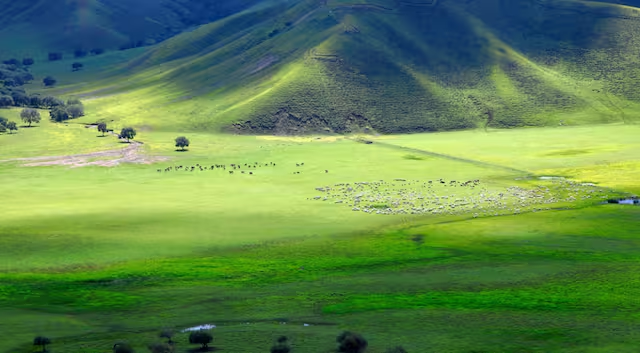

The landlocked country of Mongolia in East Asia was once an ocean which was created by an upwelling of boiling rock from the Earth’s crust more than 400 million years ago.
The ocean, after its creation by tearing of Earth’s crust, had survived for 115 million years.
This ocean’s geological history is likely to help researchers understand Wilson cycles and the process through which supercontinents break apart and eventually, join again.
A geoscientist at the National Spanish Research Council in Madrid and study co-author Daniel Pastor-Galan said that these are slow and broad-scale processes which move ahead by less than an inch every year.
“It’s telling us about processes in the earth that are not very easy to understand and that are also not very easy to see,” said Pastor-Galan, while speaking to Live Science.
Till now the breakup of the last supercontinent Pangea – which happened 250 million years ago – has been accurately reconstructed by the geoscientists.
________________________________________________________________________
Read Also : Eggs found to remove salt and microplastics from seawater
________________________________________________________________________
But before that, it was difficult to create an exact model of how the interaction between the mantle and the crust happened.
Volcanic rocks from the Devonian period found in Mongolia
The researchers, in the new study, were left intrigued by volcanic rocks in northwestern Mongolia, which belonged to the Devonian period (419 million to 359 million years ago).
The Devonian period refers to the “Age of the Fishes” when the oceans were dominated by the fish and plants started to spread on the land.
In that period, two major continents – Laurentia and Gondwana – existed along with a long stretch of microcontinents which eventually became Asia.
In a slow process, the microcontinents merged in a process known as accretion.
During the fieldwork in northwest Mongolia, the researchers discovered the Mongol-Okhotsk Ocean which had opened up in the region nearly 410 million and 415 million years ago.
Watch: Mongolia’s ruling party wins general elections
The volcanic rocks’ chemistry revealed that there was a mantle plume present, which is a stream of hot and buoyant mantle rock.
“Mantle plumes are usually involved in the first stage of the Wilson cycle: the breakup of continents and opening of the ocean, such as the Atlantic Ocean,” said study lead author Mingshuai Zhu, who is a professor of geology and geophysics at the Chinese Academy of Sciences, while speaking to Live Science.
The ocean had opened in the same spot where Mongolia exists which is a common way ocean life-cycles work, said Pastor-Galan.
“A good thing is that a hotspot is relatively stable so they keep on, for many millions of years, in the same place,” said Pastor-Galan.
NOTE – This article was originally published in wionews and can be viewed here
Tags: #atlanticocean, #climate, #earth, #environment, #fish, #getgreengetgrowing, #gngagritech, #greenstories, #land, #Mongolia, #nature, #ocean, #plants, #volcanicrocks