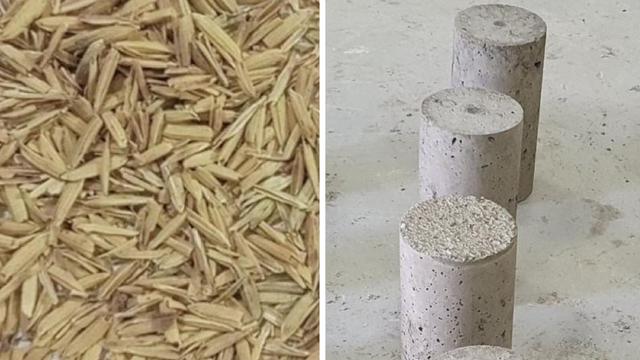
The study used AI to develop predictive models for RHA concrete strength, offering a faster, cost-effective alternative to traditional methods.

Researchers are looking at utilizing rice husk ash as a partial substitute for cement in the construction industry, aiming to find eco-friendly alternatives to traditional cement.
The group, which includes researchers from ten universities, claims that rice husk ash (RHA), which is high in silica, has a chemistry that makes it a suitable replacement for cement in concrete.
In order to develop prediction models for the compressive strength of rice husk ash (RHA) concrete, the study used machine learning (ML) approaches. Compared to traditional approaches, which are frequently costly and time-consuming, this strategy is more successful and economical.
“The aim of the study was to reduce the negative environmental impacts associated with the manufacturing of concrete. Environmentalists strongly believe cement must be replaced with a substance with a lower carbon footprint,” said a statement from one of the study’s participating members, the American University of Ras Al Khaimah (AURAK).
________________________________________________________________________
Read Also: The Adverse Ecological Impacts of Light Pollution: LEDs’ Role in Mitigation
________________________________________________________________________
AI optimizes concrete
The construction industry ranks as the second-largest consumer of plastic globally, contributing to over a third of greenhouse gas emissions associated with energy usage worldwide.
Concrete production, a significant contributor to carbon dioxide emissions, is coming under more scrutiny because of its effects on the environment. Cement, one of the main components of concrete, contributes significantly to these emissions.
Taking into consideration cement’s binding properties, the US Geological Survey (USGS) estimates that 4 billion tons of cement are produced annually worldwide, accounting for 7 percent of all CO2 emissions. More precisely, for every ton of cement produced, 0.9 tons of CO2 are released into the atmosphere.
Aiming to find a solution, the study harnessed artificial intelligence (AI) techniques to develop prediction models for the compressive strength of RHA concrete. ML techniques effectively build predictive models that map the link between input elements and response parameters, in contrast to conventional, expensive, and time-consuming methods.
The team claims the study offers insightful information to academics and builders, assisting them in estimating the compressive strength of RHA concrete.
In the second phase of the research, conducted exclusively at AURAK, the team investigated the laboratory effects of using RHA as a partial cement replacement. Concrete mixtures were created with 5 percent, 10 percent, and 15 percent RHA by weight. The strength and durability of these mixtures were evaluated in both fresh and hardened states at various ages.
________________________________________________________________________
Read Also: Impacts of Climate Change on Coral Reefs and the Marine Environment
________________________________________________________________________

Eco-friendly innovation
Test results indicate that introducing RHA to partially replace cement enhances numerous characteristics of concrete. Some of these are enhanced later-age compressive strength, abrasion resistance, and moisture barrier properties.
Moreover, it lowers drying shrinkage significantly which is a key determiner of durability. This research provides promise in developing more sustainable concrete with less damage to the environment
“The outcomes of the test results point to the viability of using RHA in concrete for the production of economical, durable, and environmentally friendly concrete mixtures. Such mixtures represent an important step in the direction of sustainable construction practices,” said Roz-Ud-Din Nassar, from the Department of Civil and Infrastructure Engineering, AURAK, and one of the authors of the paper, in a statement.
________________________________________________________________________
Read Also: Climate Change Around The World: A View From The UN Regional Commissions
________________________________________________________________________
In 2020, engineers from Heriot-Watt University in Scotland launched a startup called Kenoteq, introducing the K-Briq. The innovative brick comprises up to 90 percent of building waste, which avoids the need for burning in kilns. It emits just one-tenth of the carbon dioxide that conventional bricks do.
In 2023, scientists in Panama discovered an insulation material from rice husks. The scientists cut the rice husks into pieces, and cellulose was obtained from used newspapers. The researchers added Borax for fungal resistance and fire retardance while sticking all parts together with glue.
NOTE – This article was originally published in interestingengineering and can be viewed here