A pair of climate scientists at the Institute for Atmospheric and Climate Science ETH Zurich, working with a colleague from Stripe Inc., has found evidence suggesting that the only way to prevent the planet from continuing to grow warmer is to use 1000-year carbon sequestration strategies.
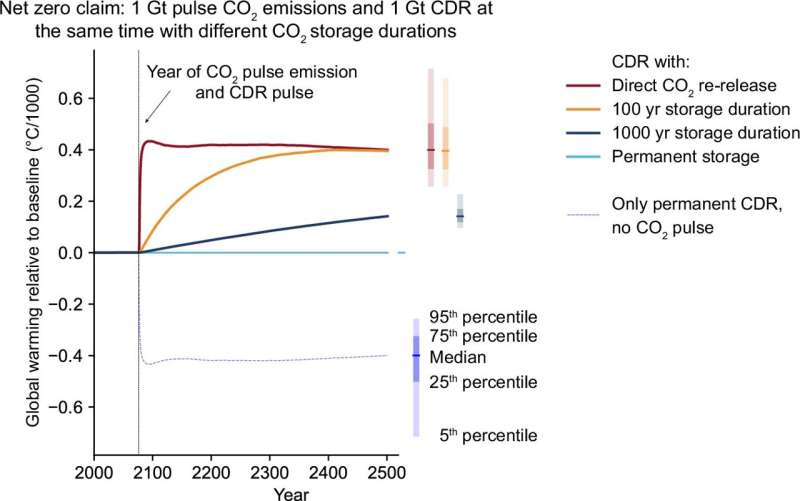
In their paper published in the journal Communications Earth & Environment, Cyril Brunner, Reto Knutti and Zeke Hausfather suggest their research has shown that short-term carbon sequestration strategies will lead to the release of captured carbon before the planet can recycle the carbon in the atmosphere naturally.
_______________________________________________________________________
Read Also : This Train Turns Methane From Human Waste Into Electricity As Eco-Friendly Fuel
________________________________________________________________________
Prior research has shown that there are many ways to sequester carbon pulled from the atmosphere, though they tend to fall into just two categories—natural and forced. Natural sequestration happens when plants pull carbon from the air and hold it until the plant dies. If the plant is long-lived, the carbon could be held for perhaps a hundred years.
Forced sequestration involves things like forcefully injecting CO₂ into underground rock formations or covering blocks of it with metal and dropping them into the ocean. Such methods are expected to prevent the carbon from reentering the atmosphere for at least a thousand years.
In this new effort, the research trio focused on a part of the goal set by the Intergovernmental Panel on Climate Change, to store carbon “durably.” They note that many schemes developed to meet this goal use the 100-year benchmark as a “durable” means of sequestration.
_______________________________________________________________________
Read Also : Scientists Discover First Methane Leak in Antarctica; Warn of Intense Warming Threat Over Icy…
________________________________________________________________________
Suspecting that such a definition is too lax, they ran a reduced-complexity climate model to estimate the likelihood of meeting climate change goals using such a benchmark. They found that the planet could see additional warming of 1.1°C by 2500. This is because much of the carbon that is sequestered in such a way would be released before carbon already in the atmosphere returns naturally to the ground.
The researchers also note that most 100-year efforts are natural based, which leaves them vulnerable. A single forest fire, they point out, can release tons of CO₂ back into the air. Because of that, they suggest that only strategies capable of storing carbon for a thousand years be used. Longer-term strategies, they note, have the advantage of holding onto the carbon for roughly the same length of time as it takes for carbon in the atmosphere to naturally make its way back to Earth.
NOTE – This article was originally published in phys and can be viewed here
Tags: #carbon, #climate, #climatechange, #climatecrisis, #climaterisk, #climatescientists, #CO2, #environment, #forest, #getgreengetgrowing, #gngagritech, #greenstories