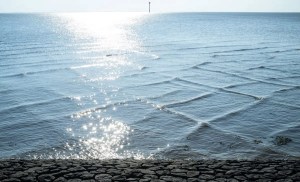
Square waves, also known as a cross sea, are caused by two interacting wave systems traveling at different speeds and trajectories.
This activity was examined by Dr. Silvio Davison from the Consiglio Nazionale delle Ricerche (CNR), Istituto di Scienze Marine (ISMAR) in Venice, Italy.
Understanding waves – the basics
Ocean waves are nature’s way of keeping the sea in constant motion. Wind blows across the surface, transferring its energy to the water and creating waves that can travel thousands of miles.
_______________________________________________________________________
Read Also : In cities around the world, living walls and green barriers could lift our moods…
________________________________________________________________________
The size and strength of a wave depend on three things: wind speed, how long the wind blows, and the distance it travels over open water (also called fetch). The longer and stronger these forces act, the bigger the waves get.
But not all waves come from the wind. Some, like tsunamis, are triggered by underwater earthquakes, volcanic eruptions, or landslides.
Then there are tidal waves, which are actually caused by the gravitational pull of the Moon and Sun, not wind or sudden underwater events.
Next we have rogue waves, which are are massive, unpredictable walls of water that seem to appear out of nowhere.
Rogue waves happen due to complex interactions between ocean currents, wind, and smaller waves merging at just the right moment. Some can reach over 100 feet (30 meters) tall, powerful enough to sink even large ships.
Finally, we have square waves, which is the reason that we’re all here right now.
Causes behind the grid
Ocean dynamics can sometimes lead to waves from separate storms merging at sharp angles. When that overlap happens, the surface arranges itself into a repeating, square-like shape.
This can vanish quickly if the wind shifts or if one wave set loses energy. On other occasions, the pattern remains long enough for unwary surfers or vessels to run into trouble.
Researchers have noted that such interactions are more common in open waters with multiple strong weather systems.
_______________________________________________________________________
Read Also : Top 10 Benefits of Living Green Walls or Vertical Gardens
________________________________________________________________________
Storm tracks crossing each other can spark chaotic wave fields that keep everyone on edge.
Impact on maritime travel
Large cross seas can reach heights of nearly 10 feet (3 meters), which is problematic for smaller boats. Faced with perpendicular waves, even a ship may roll unpredictably.
According to the European Space Agency, data collected between 1995 and 1999 showed that a large proportion of ship accidents occurred in cross seas. This highlights the threat posed by these shifting forces.
Sailors in these conditions report abrupt lurches and sudden veering. Cargo ships can also face cargo shifts when waves slam from two different angles.
Swimmers should avoid square waves
“Swimmers are at risk of being swept away, while boaters can experience navigational problems.” This note of caution from maritime observers is especially relevant in unpredictable waters.
Opposing currents make it hard for people to fight the pull toward deeper areas. Sections of the sea floor can slope in unexpected ways, which compounds the danger.
Checkered wave events have drawn attention in certain tourist destinations. In places where the phenomenon is less intense, onlookers sometimes gather to watch the spectacle.
A noteworthy location is Île de Ré, near France, where visitors sometimes ascend a lighthouse to see the square pattern. They might not recognize that, out in deeper waters, the same sight can be much more powerful.
Precautions and advice
Maritime authorities suggest that if a grid-like sea surface is spotted, smaller crafts should stay nearer to shore. Rapid changes can make it tough for seafarers to maneuver.
Some wave specialists recommend altering course to avoid perpendicular wave trains entirely, while others suggest that slowing down can minimize the stress on a vessel’s structure.
Swimmers are urged to exit the water if they notice conflicting currents. Strong swimmers often underestimate lateral pushes that can tire them quickly.
_______________________________________________________________________
Read Also : ‘Rooftop garden’ to enhance greenery at Golden Temple
________________________________________________________________________
New technology to study square waves
Scientists are examining ways to forecast cross seas more accurately. They hope better models will help shipping routes avoid high-risk zones.
Advanced radar networks are collecting data on wave heights, angles, and directions. These tools might enhance warnings about any abrupt formation of intersecting waves.
Some labs now rely on stereo camera systems to capture wide surface areas. This technology allows them to document the biggest crests in cross seas with more accuracy.
Digital simulations, like the High-Order Spectral method, add another layer of understanding. They reveal how separate swells interact in real time, helping experts refine safety recommendations.
Visually intriguing yet dangerous
Cross seas are visually intriguing yet dangerous for unaware travelers. They remind us that the ocean’s complexity sometimes slips under the radar.
Predicting the square waves calls for close attention to wind shifts and storm paths. Such vigilance may keep mariners and beachgoers out of harm’s way.
Researchers continue to emphasize caution when these wave patterns arise, especially in open oceans.
NOTE – This article was originally published in earth and can be viewed here