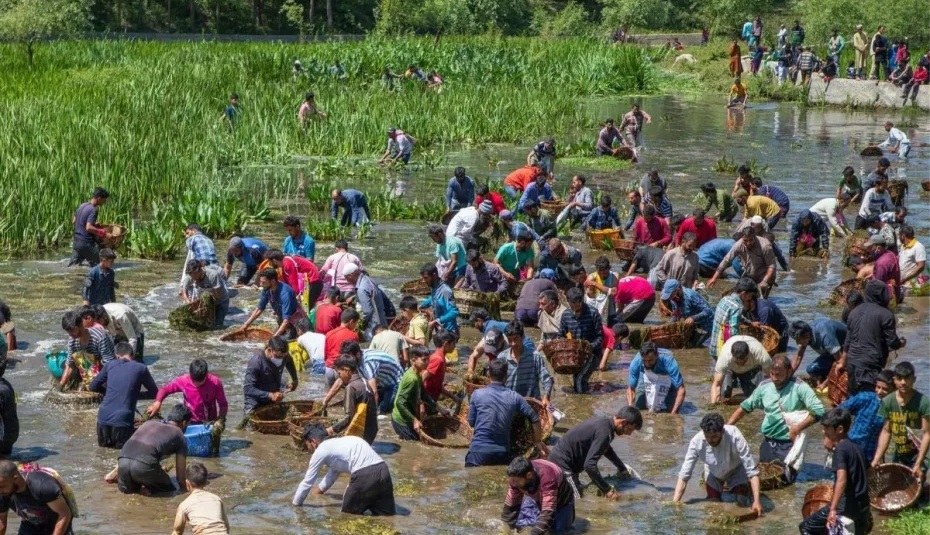
Each year, the people of Panzath in South Kashmir wade into their sacred spring. Not just to fish, but to restore their ecosystem, remember their ancestors and pass on centuries-old wisdom.

The sun was already hot by the time the villagers began to gather. It was a Sunday morning in mid-May, and the spring water shimmered under the sky in Panzath, a quiet village tucked into the hills of South Kashmir. But the heat didn’t matter. People were here for something that goes far beyond tradition.
Every year, around this time, Panzath comes alive with a rare blend of celebration, community labour and spiritual reflection. It’s called the Panzath Fish-cum-Dredging Festival, and for the locals, it’s much more than a day of fishing. It’s about caring for the earth and for each other.
They begin at the Panzathnag spring, a freshwater source that has fed the region for centuries. Men, teenagers, even small children, roll up their sleeves and step into the cold water. There are no machines. No loudspeakers. No formal uniforms or rules. Just hands, nets, and baskets.
________________________________________________________________________
Read Also: 20 Current Environmental Problems
________________________________________________________________________
The fishing is only half the job. With each movement, participants also clear silt, weeds and trash from the water. The effort helps keep the spring flowing smoothly and keeps the aquatic ecosystem alive.
Plastic waste and dead leaves are scooped out, while small fish dart between ankles. There’s a rhythm to the activity: a music made of splashes, laughter and the rustle of moving hands.
The spring doesn’t just serve Panzath. It nourishes surrounding villages too, making this festival a kind of communal insurance policy, renewed every year, powered not by money but by will.
Long before “sustainability” became a buzzword, Panzath was doing it the old-fashioned way: through collective action.
The story echoes a famous Kashmiri tale from the 9th century, when King Awantivarman’s engineer, Suya, cleaned the silted Jhelum River by throwing coins into it. The people rushed in after the coins, and ended up clearing the riverbed.
That story is still told today by environmentalists and historians. And now, in a modern-day mirror of it, villagers in Panzath volunteer not for gold, but for something far more lasting—clean water and shared heritage.
For years, the festival remained a silent affair, known only within the region. But then came smartphones, and with them, the world.
_______________________________________________________________________
Read Also : Climate Change, Cost Factor: Why it Takes Months to Subdue Some Wildfires
________________________________________________________________________
A few clips posted on social media showed villagers dancing in the stream, scooping fish from the current, smiling under the sun. The videos caught on. Soon, journalists, tourists, and curious onlookers started arriving.
The real turning point came when India’s Prime Minister mentioned the festival during his national radio program, Mann Ki Baat. He praised the people of Panzath for their environmental consciousness. For a village of just a few hundred homes, it was a surreal moment of recognition.
But what makes the day stand apart isn’t just what happens in the water.
As dusk begins to settle, the festival moves from the stream to the graveyard. Locals walk in small groups, carrying fresh flowers and cups of water. They visit the graves of their loved ones, sprinkling water over the earth and offering Fateha, a prayer for the dead.
The ritual is called Roohan Poush, and it gives the day a spiritual depth. After the physical cleansing of the spring, there is a quiet cleansing of the soul.
From the outside, it looks almost like a village fair. Children laugh as they try to catch fish with their hands. Grandfathers tell stories from their youth. Songs fill the air, and dances break out right in the middle of the stream.
________________________________________________________________________
Read Also : Urban Missions are important components of our response to climate change: Hardeep Puri
________________________________________________________________________
But beneath the joy is a deep sense of duty. Older generations teach younger ones not just how to fish, but why they fish, why the water must be clean, why the spring must stay alive, why it all matters.
There are no government schemes funding the event. No NGO banners or corporate sponsors. It’s driven entirely by the people. That’s what makes it powerful.
In a time when environmental news often brings despair—melting glaciers, choking rivers, vanishing forests—Panzath offers a rare kind of hope. It reminds us that not all solutions come from big conferences or billion-dollar budgets.
Sometimes, they come from a village that sings to its water.
NOTE – This article was originally published in kashmirobserver and can be viewed here