Earth’s massive eighth continent has just been confirmed—and it rewrites the map of our planet.
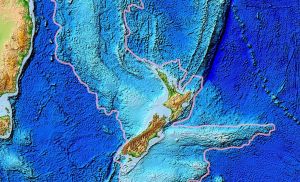
In a breakthrough backed by years of undersea exploration and advanced geological analysis, scientists have officially confirmed the location and structure of Zealandia, a massive sunken landmass long considered Earth’s hidden eighth continent. According to the peer-reviewed study Reconnaissance Basement Geology and Tectonics of North Zealandia published in the journal Tectonics by the American Geophysical Union, this submerged continent is now geologically mapped in unprecedented detail, revealing strong continental features spread across nearly 5 million square kilometers—roughly the size of India.
________________________________________________________________________
Read Also: Why we should regenerate and restore High Carbon Ecosystems!
________________________________________________________________________
Zealandia’s Tectonic Tale: A Continent Born of Gondwana
Zealandia’s geological roots trace back over 100 million years, when it was part of the ancient supercontinent Gondwana. As tectonic plates slowly shifted and split Gondwana into separate continents, Zealandia began to drift away from what is now Antarcticaand Australia. Roughly 85 million years ago, this drifting landmass became geologically isolated. Over millions of years, intense tectonic forces thinned Zealandia’s crust, eventually pulling most of the continent below the ocean’s surface. Today, only a sliver remains visible above sea level in regions such as New Zealand and New Caledonia.
This long, submerged existence has masked Zealandia from conventional continental classification—until now. Using dredged rock samples from the Fairway Ridge in the Coral Sea, Mortimer and his international team conducted high-precision U-Pb zircon dating, Rb-Sr, and Ar-Ar geochronology to decode the region’s complex history. The researchers confirmed that Zealandia hosts characteristic geological units of continental crust, not just oceanic crust fragments. “By dating these rocks and studying the magnetic anomalies they presented, we were able to map the major geological units across North Zealandia,” the researchers said.
Submerged Yet Significant: Geological Features Beneath the Waves
The study describes the recovery and analysis of a diverse array of seabed materials including basaltic lavas, pebbly to cobbly sandstones, mudstones, and bioclastic limestones. These rock types are typical of continental environments and offer a chronological tapestry of Zealandia’s geologic past. One notable sandstone sample showed a depositional age of around 95 million years, from the Late Cretaceous period. In contrast, volcanic pebbles embedded within these sandstones were dated back to theEarly Cretaceous, suggesting a long-lived magmatic history.
_______________________________________________________________________
Read Also :10 Health Benefits of Drinking Green Tea with Lemon
________________________________________________________________________
Additionally, basalt samples recovered from the seabed showed alkaline intraplate chemistry, and were dated to the Eocene epoch (~40–36 million years ago). These features indicate that Zealandia experienced episodes of rifting and volcanism long after its separation from other landmasses. The combination of magnetic anomalies and rock ages revealed geological patterns that mirror those seen on recognized continents. This structural coherence across Zealandia’s northern half offered strong evidence of its continental nature.
Mapping the Invisible: Magnetic Clues and Continental Boundaries
One of the most compelling aspects of this research lies in its integration of magnetic anomaly data with rock sample dating. By analyzing variations in the Earth’s magnetic field recorded in Zealandia’s crust, scientists were able to trace the outlines of ancient volcanic flows and structural provinces. These anomalies weren’t random—they formed organized patterns, aligning with the sampled rock ages and the locations of major geological fault zones.
_______________________________________________________________________
Read Also : Is green tea good for you?
________________________________________________________________________
This geophysical mapping allowed scientists to trace the Median Batholith, a Mesozoic-era magmatic arc associated with Gondwana, running through Zealandia’s buried crust. These findings place Zealandia on par with other continents in terms of geological complexity and tectonic history. “Zealandia’s underwater status in no way diminishes its geological significance,” stated a GNS Science researcher, reinforcing the view that continental classification should not be restricted by current sea level.
NOTE – This article was originally published in indiandefencereview and can be viewed here