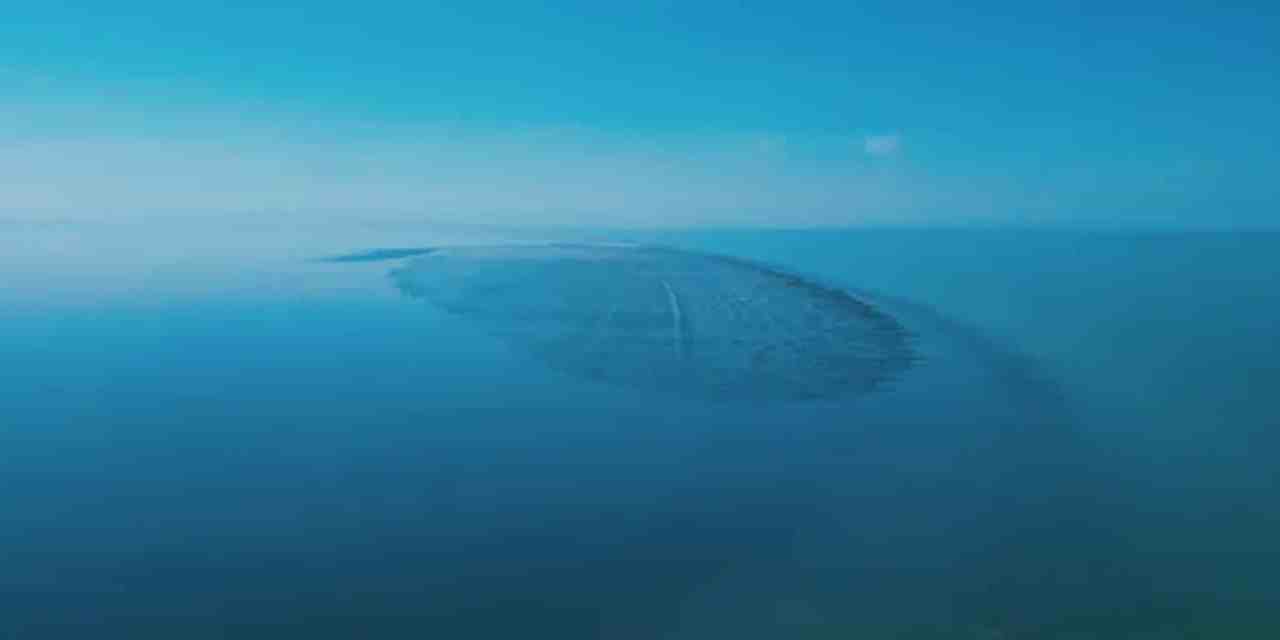
In a groundbreaking discovery, Russian scientists have confirmed the emergence of a new island in the northern region of the Caspian Sea. This unique phenomenon was first observed in satellite imagery in November 2024, with a research team from the Russian Academy of Sciences later confirming its existence. The Caspian Sea, the world’s largest inland body of water, has long been known for its fluctuating water levels, but this recent discovery has sparked interest in both the scientific community and beyond. According to reports from TASS, this island, still unnamed, emerged due to a significant drop in the Caspian’s water levels. However, the team has yet to land on the island, as weather and shallow water conditions have made exploration difficult.
________________________________________________________________________
Read Also : Soil carbon is a valuable resource, but all soil carbon is not created equal
________________________________________________________________________
Discovery and Characteristics of the New Island
The newly discovered island is located approximately 19 miles southwest of Maly Zhemchuzhny Island, marking it as a significant geographical feature in the northern part of the Caspian Sea. During the recent expedition, the team noted that the island’s surface was mostly flat, damp, and covered in sand ridges. Despite being only slightly elevated above the water, the island’s appearance marks a notable event in the dynamic environment of the Caspian Sea. Researchers explained that the island’s formation is directly tied to the Caspian Sea’s long-term fluctuations, which have caused similar landforms to emerge in the past, most recently in the 1930s and 1970s. The emergence of these islands is a part of natural cyclical processes.
The Role of Water Level Fluctuations
The Caspian Sea’s water levels have undergone significant fluctuations over the decades, influenced by various factors, including climate change and natural tectonic shifts. Stepan Podolyako, a senior researcher from the P. P. Shirshov Institute of Oceanology, elaborated that the appearance of new islands like this one is directly linked to these fluctuations in water levels. According to Podolyako, “The occurrence of new islands in the Caspian Sea is associated with cyclical processes of long-term fluctuations in the level of [these] landlocked waters.” As the water levels drop, landforms such as “awash islands” can emerge. These islands are created when seabed uplifts reach the surface during periods of low water levels, which may be exacerbated by changes in regional climate and tectonic movements.
_______________________________________________________________________
Read Also : Implementing Artificial Intelligence in Waste Management
________________________________________________________________________

A Brief Glimpse via Satellite and Drone Imagery
Researchers were first alerted to the possibility of a new island in November 2024 when satellite images showed a sand and sediment pile that breached the surface of the Caspian Sea. This natural formation, which had started to dry out, prompted scientists to investigate further. While the presence of the island remained uncertain at first, the team from the Russian Academy of Sciences eventually confirmed its existence with a closer inspection. However, despite their efforts, researchers were unable to land on the island due to both bad weather and the shallow waters around the formation. Drone photographs provided the first real view of the island’s size and its features. Though they were unable to land, the photographs revealed enough to confirm that the island was indeed a new and unique discovery.
_______________________________________________________________________
Read Also : Waste management a grave problem in Dharamsala
________________________________________________________________________
Environmental Factors Driving the Emergence
The water level fluctuations that lead to the formation of these islands are primarily driven by a combination of natural and anthropogenic factors. Climate change is one of the most prominent contributors to these fluctuations, as it affects the evaporation rates and water balance of the Caspian Sea. Podolyako noted that the Caspian’s water levels began to fall again around 2010 after a period of recovery in the late 20th century. This decline could have been intensified by changes in precipitation patterns and temperature, as well as increased evaporation due to global warming. Additionally, tectonic shifts in the region have played a part in altering the seabed and affecting water levels.
NOTE – This article was originally published in indiandefencereview and can be viewed here