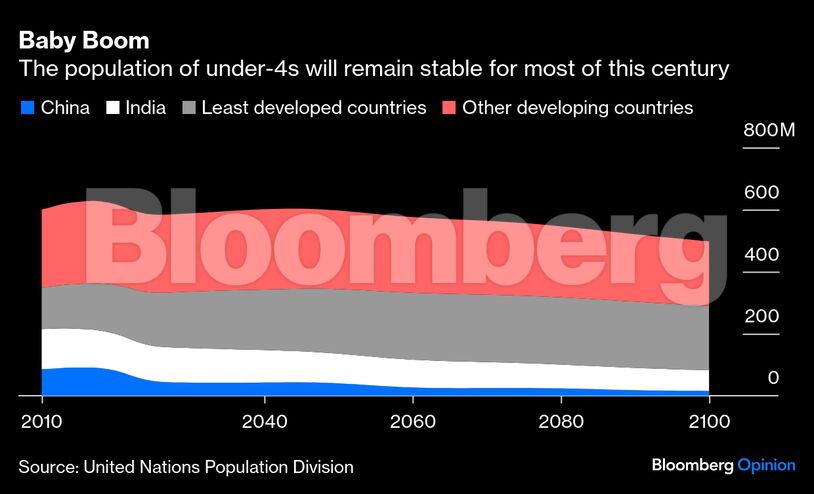
There’s more than half a billion people under the age of four in developing countries, and about a third of them suffer from stunting — short stature that’s associated with health, educational and economic problems in later life.

It’s every baby’s first food, and we can’t get enough of it. The world produces close to a billion metric tons of milk each year — more than all the wheat or rice we grow. That lead is set to widen over the coming decade, with dairy consumption expected to grow faster than any other agricultural commodity. On a rapidly warming planet, this poses a host of problems.
________________________________________________________________________________
Read Also: Most Polluted Major City on Earth – Delhi
________________________________________________________________________________
Consider demand. There’s more than half a billion people under the age of four in developing countries, and about a third of them suffer from stunting — short stature that’s associated with health, educational and economic problems in later life. Most could benefit from the policy first proposed by Scottish nutritionist John Boyd Orr in the 1920s: provision of dairy products to give them a more nutritionally rich diet.
That’s one of the main pillars of Indonesian President Prabowo Subianto’s newly introduced free-school meals program, as my colleague Daniel Moss has written. Similar programs have been set up in many states in India, as well as South Africa and Kenya.

Credit: Bloomberg
“>
In terms of human welfare, we should be welcoming this trend. Dairy products are relatively expensive, and we consume more of them as we rise above the most basic subsistence levels. If South Asia, Southeast Asia and sub-Saharan Africa are likely to see booming consumption over the coming decade, as the Organisation for Economic Co-operation and Development forecast last week, it’s largely a positive symptom of their long-awaited economic development.
________________________________________________________________________________
Read Also: How Climate Change Is Derailing the World’s Lofty Carbon Offset Hopes
________________________________________________________________________________
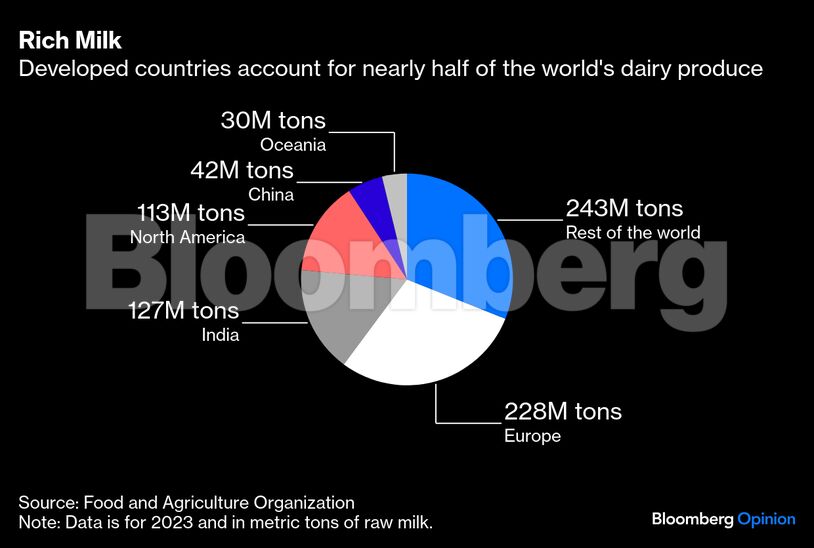
The problem comes when you start looking at supply. Milk is mostly being produced in the wrong places for the young stomachs that need it. More than 90% of children under four are in developing countries — but the same nations produce barely half of the world’s milk.
Europe alone represents a quarter of global output, and highly perishable dairy products aren’t much sold across borders. The total worldwide trade in whole milk powder or WMP, for instance — after a decade when China’s hunger for baby formula upended the global dairy industry — accounts for about 2% of raw milk. Even that limited commerce has been sufficient to upset local supply chains. In New Zealand, often likened to the Saudi Arabia of dairy thanks to its dominance in exports, demand from Southeast Asian importers drove WMP prices to a three-year high in May, while butter inflation is running above 50%.
_______________________________________________________________________
Read Also : Things You Can Do to Reduce Global Warming
________________________________________________________________________
Credit: Bloomberg
With trade providing only limited relief, we’re most likely to see shortages, as rising demand from developing countries is met with limited increases in supply. The world’s milk deficit will hit 30 million tons by 2030, the International Dairy Federation warned in April. The IFCN Dairy Research Network, a separate group, still sees a 10.5 million ton shortfall by the same date. That dairy drought will push prices beyond the reach of those who most need it.
Climate change makes all of this worse. Rising temperatures will mean it is even harder for tropical and subtropical countries to be self-sufficient: Extreme heat can cut milk production by as much as 10%, according to a study in the journal