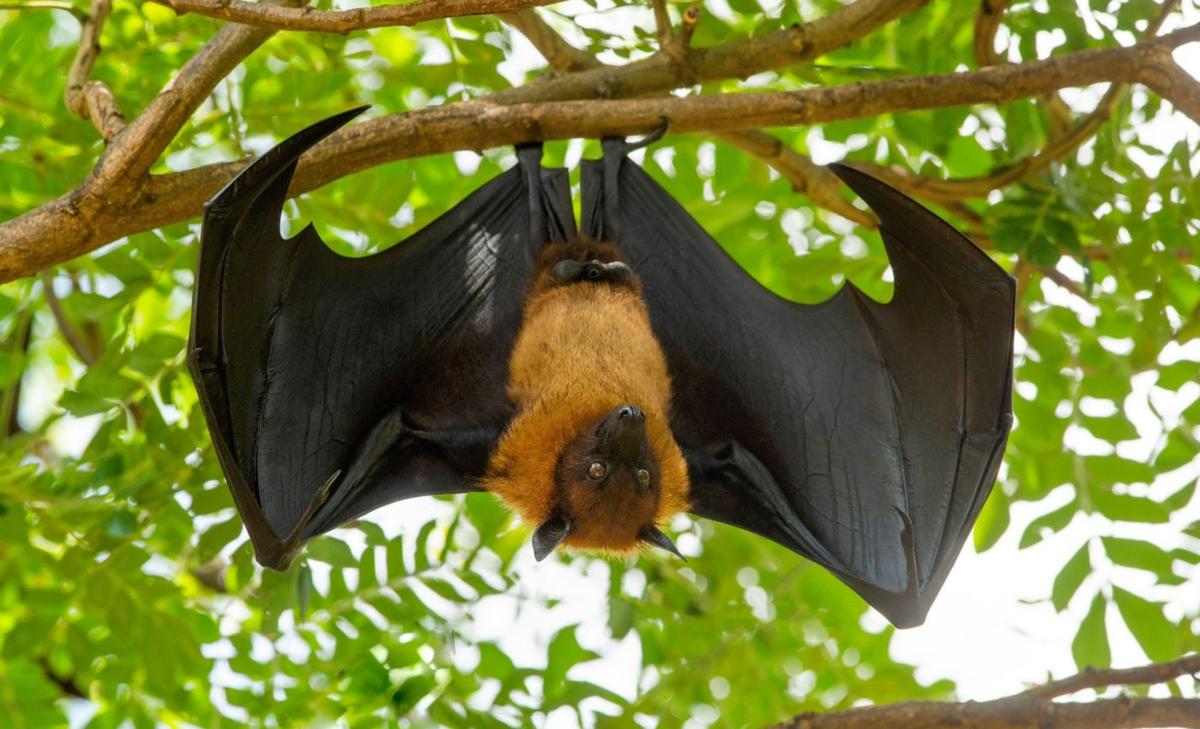
New research comparing bat and mouse embryos shows that the bat wing didn’t come from a brand-new cell type.
Instead, it formed by reusing the same genetic programs found in all mammalian limbs – but activated at a different time and place during development.
From hands to fins to wings
“We chose bats because they are an excellent example of phenotypic adaptation,” said co-author Stefan Mundlos, a researcher at the Max Planck Institute for Molecular Genetics. “The limbs are a beautiful model system to see how evolution produces different forms and functions,”
“Think of the limbs of a horse or the fins of a dolphin, or our hands or a wing. These are prime examples of how evolution takes one form and turns it into something completely different.”
At roughly 1,400 species, bats constitute the second‑most diverse order of mammals after rodents, colonizing every continent except Antarctica and the driest deserts.
Bat wings form from familiar cells
In their new work, Mundlos and colleagues collected embryos at the critical stage when a bat’s forelimb begins to diverge from a mouse’s into a flight organ.
Using whole‑genome sequencing and single‑cell RNA sequencing, the team catalogued gene activity in thousands of individual cells from both the anterior limb bud (future wing) and posterior limb bud (future leg) in bats and mice.
_______________________________________________________________________
Read Also : NGT bats for sustainable tourism policy on islands across country to check impact of climate change
________________________________________________________________________
The project united laboratories at the Max Planck Institute for Molecular Genetics, the Max Delbrück Center in Berlin, and Centro Andaluz de Biología del Desarrollo in Seville.
Single‑cell technology provides a high‑resolution snapshot of which genes are active in each cell as tissue forms.
Comparing species, however, is notoriously challenging, especially for non‑model organisms such as bats.
Evolution reused cells
“One of the biggest surprises for us was that all cell types and functions in the limb appear to be conserved between species,” said senior author Francisca M. Real, an expert in development and disease at Max Planck.
“Initially, we thought that this technology and analysis would provide clear insights into some bat‑unique cells forming the wings, since wings and mouse limbs are very different from each other.”
Instead, every cell type in a bat limb found its counterpart in a mouse limb; what differed was when and where particular genes turned on.
Later gene use drives flight
The chiropatagium – the delicate skin membrane spanning digits II through V – forms later in bat development.
The team showed that the cells building this membrane resemble proximal limb‑bud cells found in all mammals, but bats reactivate their gene program farther out along the growing limb and at a later stage.
The same genetic toolkit, deployed on a different schedule, yields an entirely new wing surface without creating new cells.
“The cells present in the proximal part of the limb are similar in identity to the cells that later form the wing,” said lead author Christian Feregrino. “This reflects how evolution works.”
Bat wings echo human hands
Because bat wings share the underlying bone layout of a human hand, they illustrate how modest tweaks in developmental timing – sometimes called heterochrony – can transform a limb into something entirely new.
The same principle likely shaped the stiff forelimbs of horses, the broad flippers of dolphins, and the dexterous hands that humans use to write, cook, and build.
By mapping the exact genetic switches that shift limb programs along both the spatial and temporal axes, scientists hope to uncover general rules that govern morphological innovation across the tree of life.
_______________________________________________________________________
Read Also : Research finds new species of king cobra
________________________________________________________________________
Bat wings built by timing
The study also provides an annotated catalog of bat limb cell states and regulatory elements.
This opens the door to identifying enhancers – non-coding DNA sequences that act like genetic dimmer switches – responsible for delayed, distal activation.
Identifying those elements could show whether similar regulatory changes exist in other animals that evolved gliding or flight membranes, like flying squirrels or sugar gliders.
It could also help scientists better understand congenital limb malformations in humans.
Evolution made flight with old tools
Bats rose to the skies not by inventing entirely new genes but by choreographing familiar ones in new ways.
Their wings demonstrate nature’s talent for editing an existing blueprint into fresh structures, underscoring Darwin’s insight that evolution works with what is already there.
As single‑cell technologies and comparative genomics mature, more secrets of evolutionary ingenuity are likely to emerge from the membranes that beat silently above our heads each night.
The study is published in the journal Nature Ecology & Evolution.
NOTE – This article was originally published in the Earth.com and can be viewed here