Glaciers are melting fast, and the consequences aren’t only about sea level or disappearing landscapes. Scientists are now warning that meltwater may also carry hidden genetic material that helps bacteria resist antibiotics.
If those genes spread downstream, they could quietly increase health risks in places that depend on glacier-fed water. The warning comes from a new review led by researchers at Lanzhou University.
The paper argues that glaciers can store antibiotic resistance genes for long periods and that climate-driven melting may turn this frozen archive into an active source of resistance moving into rivers and lakes.
Glaciers store hidden genes
For a long time, glaciers have been treated as remote, sealed-off environments. Cold. Nutrient-poor. Isolated. That image is part of why the new idea feels unsettling: the ice isn’t just frozen water, it’s also frozen biology.
“Glaciers have long been viewed as pristine and isolated environments,” said corresponding author Guannan Mao.
“Our review shows that they are also genetic archives that store antibiotic resistance, and climate-driven melting is turning these archives into active sources.”
The core message is not that glaciers are suddenly “polluted.” It’s that they preserve genetic material, including resistance genes, across long spans of time. When the ice melts, those genes can re-enter living ecosystems.
Resistance genes are ancient
Antibiotic resistance is often framed as a byproduct of modern medicine and industrial farming. That is a big part of the story, but not the whole story.
Many resistance genes are ancient and naturally occurring, because microbes have been competing with each other using antibiotic-like compounds for a very long time.
Glaciers can lock away microorganisms and their DNA under cold conditions for thousands of years, and sometimes far longer.
As temperatures rise, meltwater can release that material into freshwater systems that were not previously exposed to it, at least not in the same way or at the same scale.
Glaciers and resistance genes
The review pulls together findings from multiple glacier regions, including Antarctica, the Arctic, and the Tibetan Plateau. It notes that resistance levels in glaciers are generally lower than in heavily polluted environments.
Still, a wide range of resistance genes has been detected, including genes linked to antibiotics that matter in clinical care.
The concern becomes sharper once you follow the water. Glacier-fed rivers and lakes are not niche ecosystems. In many regions, they’re essential water sources for communities, agriculture, and wildlife.
“Glacier-fed rivers and lakes are essential water sources for millions of people,” Mao said. “Once resistance genes enter these connected systems, they can interact with modern bacteria, increasing the risk of spread through microbial communities.”
That interaction is the key worry. A resistance gene on its own is just information. The risk rises when it meets bacteria that can incorporate it and pass it along.
In microbial worlds, genes can move between organisms in ways that don’t require traditional reproduction, which is one reason resistance can spread so efficiently once conditions allow it.
From ice to rivers
One of the review’s main ideas is that glaciers, rivers, and lakes shouldn’t be treated as separate environments.
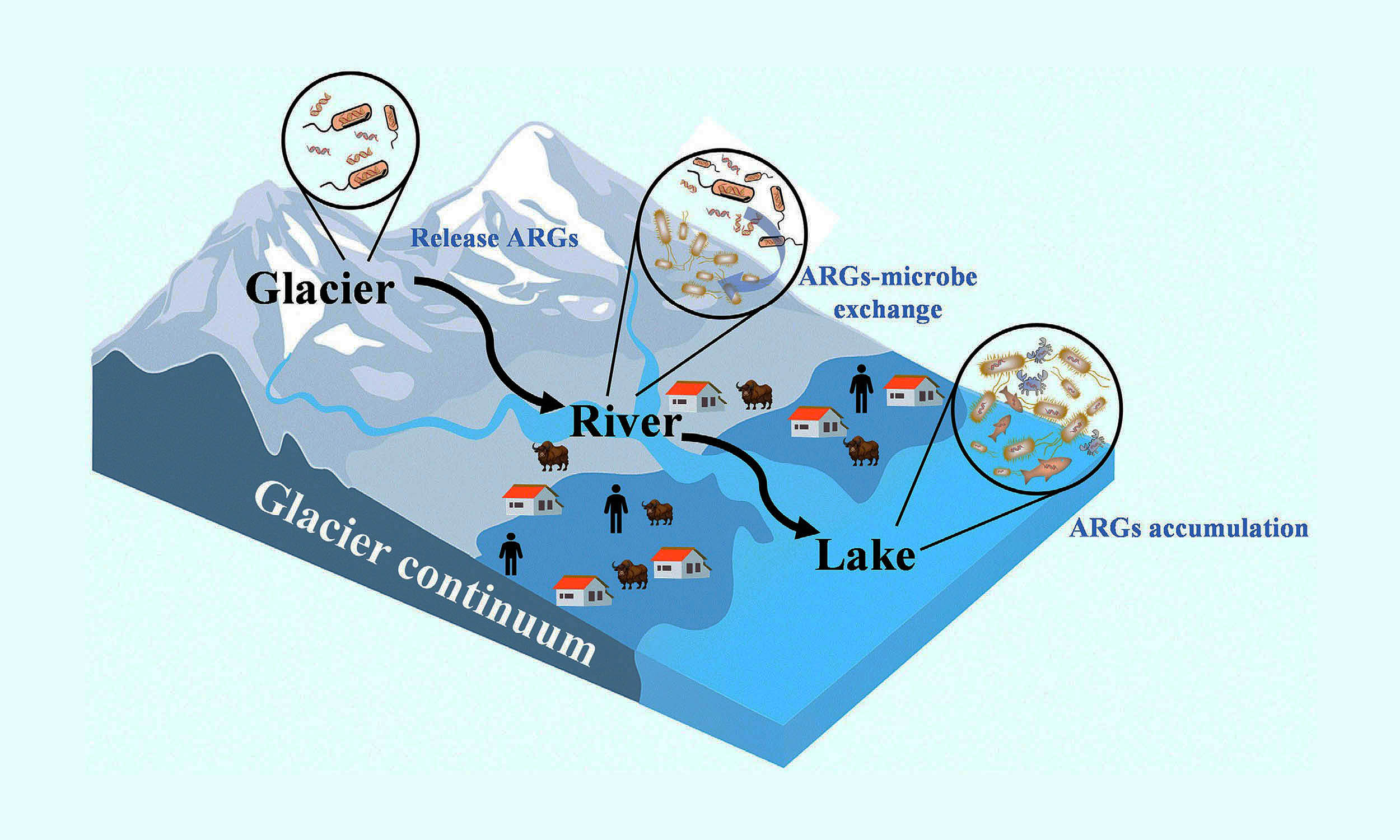
The authors introduce what they call the “glacier continuum,” meaning a linked chain where resistance genes can be transported, reshaped, and sometimes amplified as water moves downstream.
“Most previous studies have looked at individual habitats in isolation,” Mao said.
“That approach misses how resistance genes actually move through real landscapes. The glacier continuum allows us to understand where risks may increase and where intervention or monitoring is most needed.”
This is partly about biology and partly about geography. As meltwater flows away from the ice, environments often become warmer and richer in nutrients. That can support more microbial growth and more opportunities for gene exchange.
Rivers can become mixing zones, where microbes from different sources collide. Lakes can behave like storage basins, where genes accumulate and potentially travel through food webs.
When resistance meets virulence
The review also flags a more troubling possibility: resistance genes can coexist with virulence factors. Virulence factors are genetic traits that help bacteria cause disease.
The combination of resistance plus virulence is what makes certain infections especially hard to treat.
The authors don’t claim glaciers are creating “superbugs” on their own. But they argue that releasing resistance genes into active microbial communities could increase the odds that dangerous combinations emerge.
This is especially risky if those genes meet bacteria that already have disease-causing potential.
In that sense, glacier melt is not just a local environmental issue. It could become one more pathway through which the wider resistance problem evolves.
Human footprints in remote ice
The review also makes clear that climate is not the only force shaping what’s in glacier environments. Human activity can introduce modern resistance genes even into places that feel far removed from cities and hospitals.
Airborne pollution can travel long distances. Migratory birds can carry microbes across continents. Tourism and research stations can add additional pathways of exposure.
The review notes that resistance levels are higher in some Arctic settings than in Antarctica, which the authors link to stronger human influence in the Arctic.
This matters because it suggests a mixed archive. Some of what’s preserved may be ancient. Some may be relatively recent. Both can move downstream once melting accelerates.
________________________________________________________________________
Glaciers and antibiotic resistance
The authors argue that the best response starts with better tracking. They call for coordinated monitoring programs that follow resistance genes along the full glacier-to-river-to-lake pathway, using tools such as metagenomic sequencing.
They also push for early warning frameworks that assess ecological and health risks before resistance becomes entrenched in downstream systems.
“Climate change is reshaping microbial risks in ways we are only beginning to understand,” Mao said. “Recognizing glaciers as part of the global antibiotic resistance landscape is an important step toward protecting both environmental and human health.”
The review ultimately frames this as a One Health issue, where environmental change, ecosystem dynamics, and human health are tightly linked.
The ice is melting either way. The new question is whether we will notice what’s riding along with that meltwater in time to respond.
The study is published in the journal Biocontaminant.
NOTE – This article was originally published in Earth and can be viewed here