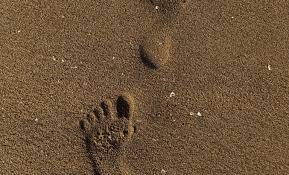
While exploring a quiet beach in northern Morocco, a team of scientists spotted what looked like ancient human footprints in the sand.

Eighty-five fossilized human footprints discovered on a beach in northern Morocco have been dated to around 90,000 years ago. Preserved in clay-rich sand, the tracks were made by a group of early Homo sapiens and represent the oldest known human trackway in North Africa and the southern Mediterranean.
In 2022, while surveying a coastal site near the northern tip of Morocco, a research team led by Mouncef Sedrati of the University of Southern Brittany stumbled upon a single footprint in the sand. Moments later, they found more. As they continued investigating, two complete trails emerged, revealing dozens of human impressions embedded in the beach surface.
85 Footprints, Five Walkers, One Ancient Journey
The trackways contain 85 human footprints, most likely left during a single brief event. According to the study published in Scientific Reports, analysis of foot size and depth allowed researchers to estimate that the tracks were made by at least five individuals, including children, adolescents, and adults.
“We took measurements on-site to determine the length and depth of the prints,” said Mouncef Sedrati.
These measurements helped the team infer the age and likely size of the people who walked there. The varying footprints suggest that this was a multigenerational group, moving together across the beach during a short window of low tide.

Preserved by Sand, Clay, and Tide
The site owes its remarkable state of preservation to a combination of geological and tidal factors. The beach lies on a rocky platform covered in clay-rich sediments, which, according to Sedrati, created the ideal surface for forming clear impressions. Once the group walked across the area, rapid tidal action buried the prints beneath layers of sand.

This natural process sealed the footprints away from erosion and surface disruption. The researchers credit the beach’s slope and the long reach of the tides for what they call “the final preservation of the footprints.”
“The exceptional thing is the position of the beach on a rocky platform that is covered in clay sediments,” he stated. “These sediments create good conditions to preserve the tracks on the sandbar while the tides rapidly buried the beach. That’s why the footprints are so well preserved here.”
________________________________________________________________________
A Race Against Erosion
Although the site remained undisturbed for tens of thousands of years, its stability is now in jeopardy. The rocky coastal platform on which the footprints rest is slowly collapsing, and researchers warn that the trackways could be permanently lost. In their study, the team described the site as vulnerable to ongoing erosion.
“The ongoing collapse of the rocky shore platform… could lead to its eventual demise,” they wrote.
The urgency to document and analyze the trackways has grown, with Sedrati noting their hope to uncover more about the group’s behavior and purpose on the beach before the site degrades further.
NOTE – This article was originally published in Daily Galaxy and can be viewed here