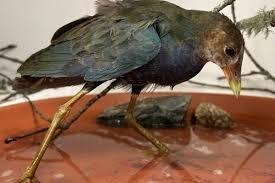

A fierce winter storm recently delivered an unexpected guest to a backyard in New Bedford, Massachusetts. Far from its usual southern wetlands, a purple gallinule found itself stranded in unfamiliar territory. Known scientifically as Porphyrio martinica, this striking bird is famous for its vivid plumage and its almost comically large feet.
Purple gallinules normally live in marshy environments stretching from the southeastern United States down through South America. Their long legs and oversized toes allow them to walk delicately across floating vegetation such as lily pads. In these wetlands they feed on seeds, aquatic plants and small creatures including insects and snails.
So seeing one in coastal Massachusetts is, to put it mildly, unusual.
________________________________________________________________________
A rare sight in Massachusetts

The bird was first spotted by a local woman who quickly realised it was no ordinary garden visitor. Concerned for its wellbeing, she contacted the New England Wildlife Center in Weymouth.
Even for the experienced team there, the sighting was extraordinary. The centre had never received a purple gallinule before.
Priya Patel, the wildlife centre’s medical director, explained that these birds rarely appear in the region. In fact, sightings are extremely uncommon. According to Patel, there have been only a handful of reports of purple gallinules appearing in Massachusetts over roughly the past decade.
How did this southern marsh bird end up so far north?
Storm systems may be the answer. During periods of powerful weather and shifting low pressure systems, birds can easily be blown off course. In some cases, they are pushed hundreds of miles from their natural range and carried northwards along the Atlantic coastline.
For this gallinule, a winter storm likely turned a routine flight into a very long detour.
A fragile arrival at the wildlife centre

When the bird arrived at the wildlife centre, the staff immediately realised it was in a vulnerable state. The gallinule was severely underweight and clearly exhausted from its unexpected journey.
________________________________________________________________________
Fortunately, an initial medical examination and X rays revealed no major injuries. That meant the team could focus on stabilising the bird and carefully helping it recover.
At first glance, it might seem logical to give a starving animal plenty of food straight away. However, wildlife experts know that this can be extremely dangerous.
If an animal that has been deprived of food suddenly consumes a large meal, it can develop what is known as refeeding syndrome. In this condition, the body draws limited nutrients too quickly toward digestion, pulling resources away from critical organs such as the heart, brain and lungs.
The consequences can be severe. Heart rhythm disturbances or neurological complications can occur if the body cannot adapt quickly enough.
This is precisely why wildlife centres strongly discourage members of the public from feeding injured or distressed animals before professionals can examine them.
Instead, treatment must be slow and controlled.
Patel explained that the safest approach is gradual nutritional support combined with fluid therapy. Rehydrating the animal through carefully administered fluids helps stabilise the body while organs adjust and recover.
A journey back to warmer marshes
As the gallinule regained strength, the next challenge became clear – returning it to a suitable habitat.
The wildlife centre worked with partner organisations to organise a remarkable journey south. On 8 January, the bird boarded a small private plane headed for South Carolina. The flight was piloted by volunteers from the New England Wildlife Center.
Interestingly, the gallinule was not travelling alone. Another purple gallinule discovered in Vermont joined the trip, giving both birds a far better chance of survival once released.
After landing in South Carolina, volunteers from the Carolina Wildlife Rehabilitation Center collected the birds and prepared them for the next stage.
For now, the plan is simple. The birds will be monitored briefly to ensure they remain healthy and strong. Once the team is confident they are ready, they will be released so they can continue travelling further south towards their natural range.
For a bird that began its winter stranded far from home, the journey back to the marshes is finally within reach.
NOTE – This article was originally published in FUTURA Sciences and can be viewed here