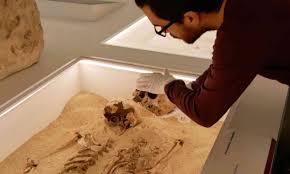

A girl buried in Italy more than 12,000 years ago has become the earliest person genetically diagnosed with a rare growth disorder.
The finding turns a famous Ice Age burial into evidence that rare disease and family ties were already shaping human lives.
An old grave
Inside Grotta del Romito in southern Italy, two bodies had lain in an embrace since the end of the Ice Age.
Using DNA preserved in the dense inner ear bone, Ron Pinhasi at the University of Vienna and colleagues settled the grave’s biggest argument.
Pinhasi’s team also showed that both skeletons were female and that the shorter one was a close relative, most likely a daughter.
The new kinship answer cleared away decades of guesswork and left one harder problem: why their heights differed so sharply.
________________________________________________________________________
One gene speaks
In the younger daughter’s DNA, two altered copies of NPR2 – a gene that helps bones lengthen – pointed directly to the diagnosis.
When NPR2 signaling breaks down, bones in the forearms, lower legs, hands, and feet do not reach usual length.
Romito 2 stood about 3 feet 7 inches tall (110 cm) and her limbs were strikingly short for her age.
Old bone studies had suspected a rare skeletal disorder, but the genetic result finally made the diagnosis secure.
Rare disorder explained
Doctors call the condition acromesomelic dysplasia, a rare disorder that shortens the middle and ends of the limbs.
Those classic limb changes matched the skeleton unusually well, from bowed forearm bones to compact hands and feet.
Severe cases usually appear only when both copies of NPR2 are altered, which fit the younger girl.
Once the pattern of two altered copies was clear, the older woman’s shorter height no longer looked like a separate mystery.
Mother and daughter differ
At about 4 feet 9 inches (145 cm), the older woman was noticeably short but far taller than her daughter.
The older woman’s DNA held one altered copy of the same gene, a pattern that can trim height without causing the full disorder.
Research on living families found that single-copy NPR2 changes can produce milder short stature over time.
With mother and daughter side by side, the burial told a family story, not just a diagnosis sealed inside one skeleton.
Evidence of care
Life with acromesomelic dysplasia would have limited walking, carrying, and balance in a rugged hunter-gatherer setting.
Yet Romito 2 survived into adolescence or young adulthood, meaning daily help was likely available for years.
Romito 2’s shared burial, with no sign of trauma and an embrace still visible, suggests she remained part of family life.
Ancient DNA could not measure affection, but it strengthened the case that survival depended on more than luck.
Rare disease history
More than the age of the bones, this work changed the field’s reach, from reading old skeletons to naming the exact altered gene.
“By applying ancient DNA analysis, we can now identify specific mutations in prehistoric individuals. This helps establish how far back rare genetic conditions existed and may also uncover previously unknown variants,” Pinhasi said.
Ancient human genetics is moving beyond ancestry alone and beginning to recover something closer to family medical history.
Ancient DNA matures
Because DNA survived in dense bone near the inner ear, the team could work at an unusually fine level.
The protected sample let researchers connect sex, kinship, and one disease in the same pair of people.
Earlier ancient DNA studies mostly tracked ancestry and movement, but this case pushed the field into direct diagnosis.
Once direct diagnosis becomes possible, prehistoric graves can reveal health histories as well as family trees.
________________________________________________________________________
Beyond ancestry alone
For years, ancient genetics was best known for tracing where people came from and whom they mixed with.
The Romito burial showed that the same tools can also capture how a harmful variant moved through one family.
Inside one grave, the mother and daughter carried different genetic burdens, one mild and one severe.
Ancient human genetics therefore gained a new kind of case study, one about inheritance and family differences.
Limits still remain
DNA answered the diagnosis, but it could not show how much pain the younger woman felt or how she moved.
Ancient bones also cannot record every small act of help, from shared food to slower travel.
Only rare graves preserve enough genetic material for this kind of answer, which keeps the evidence unusual.
Even with those limits, this burial no longer sits as a puzzle without names, kinship, or diagnosis.
A clear family story
Now the Romito grave reads as one linked story about family, unequal inheritance, short stature, and survival in harsh conditions.
Future finds may uncover other hidden disorders, but few will match this case for intimacy, age, and a clear genetic answer.
The study is published in The New England Journal of Medicine.
NOTE – This article was originally published in Earth and can be viewed here