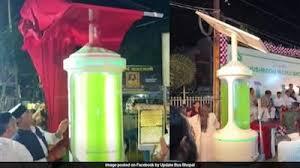
A single algae tree unit is claimed to be as effective as 25 adult trees in absorbing carbon dioxide and releasing oxygen.

India’s first “Algae Tree,” a revolutionary carbon-capturing technology designed to combat air pollution, has been installed in Bhopal’s Swami Vivekananda Park. Inaugurated on May 1, 2026, by Cabinet Minister Vishwas Sarang, this innovative, solar-powered unit has garnered significant attention for its ability to tackle environmental challenges in urban spaces. Developed by the Mushroom World Group after two years of research by a team of over 50 experts, the “Algae Tree” is not a traditional tree but a smart device that uses microalgae to purify the air.
________________________________________________________________________
Watch the video here:
Features and Impact
- A single algae tree unit is claimed to be as effective as 25 adult trees in absorbing carbon dioxide and releasing oxygen.
- The device can absorb approximately 1.5 tons of carbon dioxide annually and generate about 1 ton of oxygen.
- The system can reduce PM 2.5 particles by 45–55% within a 15-meter radius.
- The unit operates using solar energy.
- Designed for areas where traditional tree planting is difficult, such as busy roadsides and public spaces.
Boost for Green Innovation
This initiative is a significant step toward making cities greener and more sustainable. The technology is designed to complement existing trees rather than replace them, serving as a powerful support system, particularly in congested urban areas. It is especially practical for crowded city areas where planting traditional trees isn’t feasible.
________________________________________________________________________
With rising pollution, heatwaves, and smoke, eco-friendly solutions like this may soon roll out to other cities across India. The launch comes as Indian cities face rising temperatures, worsening air quality, and shrinking green cover. PM2.5 and PM10 remain the main pollutants, often staying high due to traffic, construction, and seasonal dust.
This development has sparked enthusiasm online as a promising, futuristic solution for urban pollution.
NOTE – This article was originally published in NDTV and can be viewed here