Prince William’s Earthshot Prize made its India debut with Bollywood stars and a £1 million win for Mahindra. We were part of its youth cohort. Contrary to our expectations of dialogue, it was rehearsals for proper conduct and etiquette that made up most of our time.
Prince William’s Earthshot Prize made its India debut with Bollywood stars and a £1 million win for Mahindra. We were part of its youth cohort. Contrary to our expectations of dialogue, it was rehearsals for proper conduct and etiquette that made up most of our time.
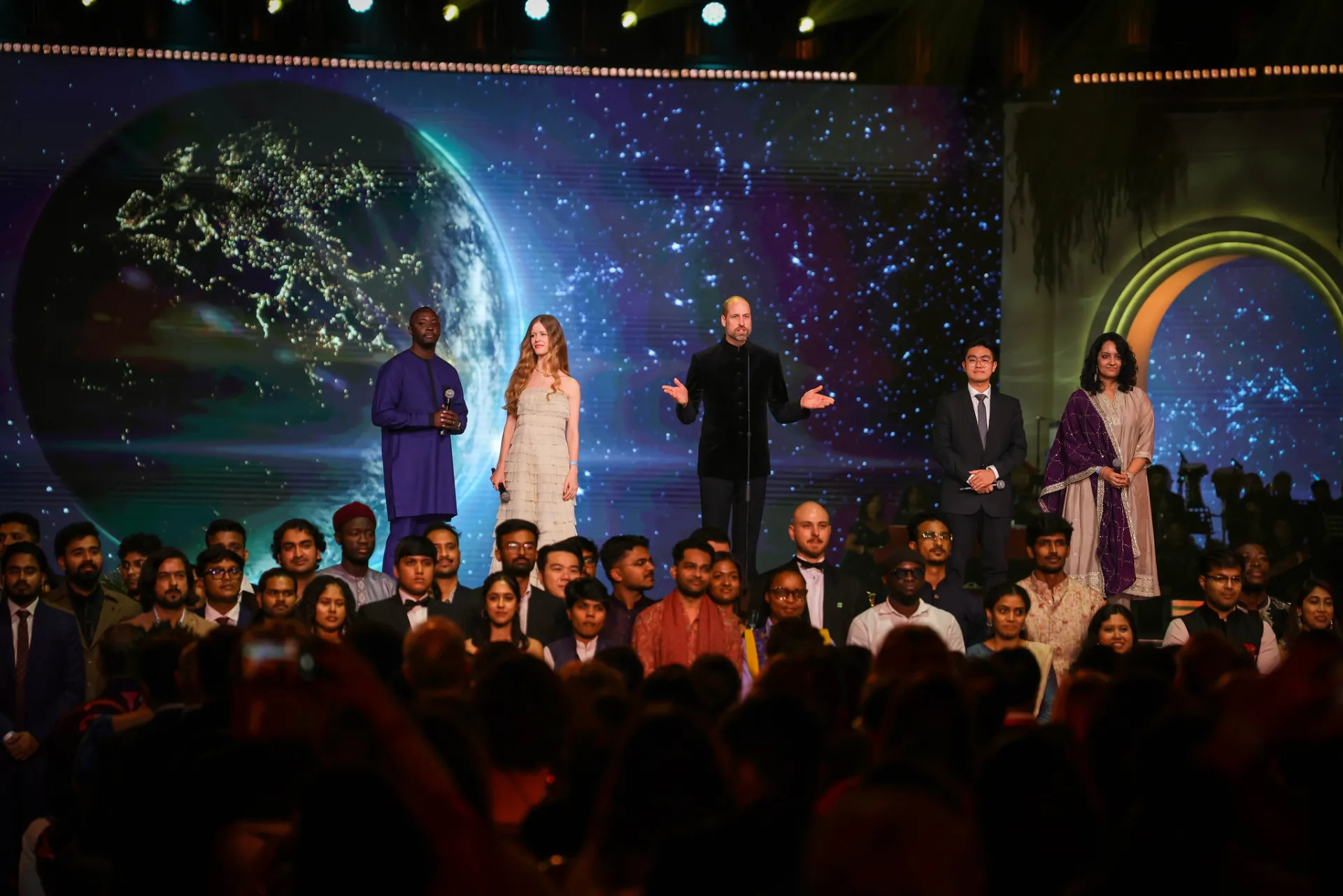
On my second day at the Earthshot Prize in Mumbai, we spent a long part of the afternoon learning how to sit. Inside the Jio World Convention Centre, organisers walked our Generation Earthshot cohort – of more than a hundred young climate leaders – through a rehearsal for Prince William’s entrance. We practised where to sit. We practised when to stand, how to walk to the front of the stage during his speech, and exactly where to stop.
The rehearsal did not finish that day. It continued on the third day, when some of my friends asked to use the washroom and were told no. We were also told not to use our phones.
Earlier on that second day, in a breakout session on “challenges and opportunities”, my friend from Northeast India and I waited almost the whole session to speak about the communities we represent. On our turn, we were only spared a couple of minutes to speak. Nobody responded to what we said. Then a facilitator announced that the session was over.
I keep coming back to this contradiction that was so on the face here. Hours to rehearse how we would be seen. Two minutes to say what our communities are living through.
In the old opera houses of Europe, a claque was a group planted in the audience to applaud on cue. We had come to Mumbai as a climate justice cohort. In that hall, we had become a claque.
This is an account of those four days: what we were promised, what I saw, and the questions I brought home. I am not writing it to dismiss the young people I met, many of whom care deeply about this planet. I am writing it because a programme that calls itself a home for climate leadership should be able to hear the people who live closest to the crisis.
The invitation
It started with a post on Common Purpose’s Instagram handle. The call read, in part: “For India’s next generation of climate leaders. This November, Generation Earthshot is coming to Mumbai as The Earthshot Prize comes to India for the first time. We are looking for 100 young people aged 18 to 30 from across India who are already making a difference, or have the ambition, ideas and passion to create change in climate action and sustainability. More than a 4-day programme… Completely free.”
It promised practical leadership skills, storytelling to amplify our impact, time with peers, environmental pioneers and experts, a place at the Earthshot Summit, and a seat at the Awards Night where the 2026 winners would be announced. The Earthshot Prize, founded by Prince William in 2020, had never been held in India, even though the country is home to more Earthshot winners and finalists than any other.
Generation Earthshot, in collaboration with Common Purpose, invited 130 young climate leaders from India, Africa, Asia-Pacific and Latin America to Mumbai from 14 to 17 November.
I come from Jhargaon, a village in Morigaon district on the Brahmaputra floodplain of Assam. Where I grew up, climate change is not a forecast. It is the flood that takes the school term, the riverbank that takes the field, and the families who rebuild every year without being asked what they need.
Since 2018, when young people from my community started the Save North-East campaign, I have been arguing for one thing: the climate movement needs the voices of the people it talks about. So when the selection email arrived, I was hopeful. I thought this might be a room where those voices could finally be heard.
Day one: a room full of hope
My flight landed around 12:30 in the afternoon on 14 November. I went straight from the airport to the hotel and walked into the introduction session, still carrying my bag.
We had three minutes each to meet one another. The room was full of young people from sustainability start-ups, from journalism, from business, and a few of us from grassroots climate activism and the climate justice movement. I liked that mix. I believed it could be a strength.
That afternoon, the Earthshot team explained how the Prize finds its winners. There is no open application. Solutions are put forward by Official Nominators, and becoming a nominator is by invitation only, though some nominators accept proposals from the public. This year the Prize drew almost 7,000 nominations, and Prince William and the Earthshot Prize Council chose the five winners. We also heard about “positive tipping points”, and about how the Prize began in 2020, during the pandemic.
Then in the Q&A round, a friend from Assam asked how nominations actually reach people on the ground: who maps them, and where Indigenous voices sit in that process. He also questioned the environmental and human impact due to the batteries, which are used by the initiatives that are being celebrated. Most of them are made in China; where do the minerals come from, and who pays the price of digging them up?
These are not fringe questions. The Business & Human Rights Resource Centre has logged 835 allegations of abuse linked to mining for transition minerals between 2010 and 2024, and finds Indigenous Peoples disproportionately affected. The questions were noted. The day ended with reflections and the next day’s announcements.
_______________________________________________________________________
Read Also : Climate science is supporting lawsuits that could help save the world
________________________________________________________________________
Day two: a climate summit in a marble hall
On 15 November, a bus took us to the Jio World Convention Centre in Bandra Kurla Complex. Reliance Industries opened it in 2022 as India’s largest convention centre. Reliance also runs Jamnagar, which the company calls the largest and most complex single-site refinery in the world, processing about 1.4 million barrels of crude oil a day.
I was not the only one uneasy about this. Before the event, The Guardian reported that conservationists had criticised the choice of venue over Reliance’s fossil fuel interests. Earthshot said it had not sought a philanthropic partnership, was paying the standard commercial rental rate, and chose the venue because it could hold an event of this size. I take them at their word on the contract. My question is about the message: what does it say when a prize for repairing the planet celebrates itself in the flagship of a fossil fuel giant?
I had never stepped into a place like it. It was big in size, but also big in what it consumed: marble everywhere, light everywhere, cooled air everywhere. For someone from a rural, marginalised community, and for several friends with me, it was an eye-opening scene.
The first session was on “cultural intelligence”. We talked about our “core”, the values we will not negotiate, and our “flex”, the things we adjust from place to place. It was a pleasant exercise. But we were sitting in India, and nobody mentioned caste. Nobody mentioned who owns land, who cleans the drains, or who is flooded out first. A conversation about culture in India that avoids caste is not intelligence. It is avoidance.
Next came a storytelling workshop with Meta. It was almost entirely about Instagram: finding your niche, choosing between a carousel and a reel, running trial reels, setting up a creator account. Three creators were invited to share their journeys. None of them came from Dalit, Adivasi or Indigenous communities, though India has many such creators telling powerful climate stories.
Storytelling matters to Earthshot. Its own 2023 accounts describe the Prize Ceremony as its “beachhead vehicle for storytelling-at-scale to young people”. We were taught how to make our stories travel. We were not asked whose stories were missing from the room.
After lunch, Earthshot’s chief executive, Jason Knauf, spoke with leaders working on sustainability. Then came the breakout on “challenges and opportunities”. An Earthshot observer joined my pod. My friend from Northeast India and I had questions ready: how businesses can be brought into real negotiation with affected communities, and what marginalised communities need from a platform like this.
Others in the pod filled the time, and nobody made room. We spoke only in the last two minutes, received no response, and were told the session was over. Common Purpose lists “empathy” and “openness” among what its programmes build, including openness to views people might deeply disagree with. In that pod, neither was practised.
Rehearsing for the prince
Straight after the breakout, we went to rehearsal. Every detail was fixed in advance: our exact seats, the moment to stand, the route to the front of the stage during Prince William’s speech, the spot where each of us would stop. We also had a dress code.
It took a long time, and it continued on the third day. During that second rehearsal, friends who asked to use the washroom were refused. We were not allowed to use our phones.
I understand that a royal visit brings heavy security. Mumbai Traffic Police closed roads and reserved stretches of South Mumbai for the VVIP convoy from 16 to 19 November. But security can explain a closed door. It cannot explain why adults were refused a toilet.
When we applied, the form told us we might be filmed or photographed for content shared by Common Purpose, Earthshot and their partners. The Awards Night will stream on Prime Video in more than 240 countries and territories. Earthshot says 38 million people have seen its awards ceremonies.
So the choreography was detailed because the picture mattered. Young climate leaders from the Global South, standing at the right moment, in the right place, around a future king. We were part of the set. While rehearsals for how we would look were long and careful, we had two minutes to say what we had to say.
Day three: mangroves behind checkposts
On 16 November we chose an “immersion” with an organisation or business working around Mumbai. I chose the Godrej mangroves in Vikhroli because I wanted to learn about mangroves.
We passed several checkpoints on the way into the forest. The Godrej representative spoke about wildlife as something to be guarded from people. The communities who depend on these mangroves, and who have lived alongside them for generations, were not part of the story. There was talk of livelihoods and opportunities, but no numbers on how the fishing families around the creek are doing today.
_________________________________________________________________
Read Also : Hummingbirds Are at Home When We Plant Native Plants,
________________________________________________________________________
Those families are not hard to find. The Kolis are the Indigenous fishers of Mumbai, and more than 25 fishing villages line Thane Creek, which these mangroves border. Researchers writing about the creek note that its coastline has been largely barricaded from public access, and that colonial and post-colonial governments alike have tried to enclose it.
The estate itself has a colonial-era history. Pirojsha Godrej bought land in Vikhroli at a public auction in 1943, under British rule. Business Today reported in 2019 that the family’s holding includes nearly 1,800 acres of mangroves that cannot be developed, and about 1,000 developable acres with an estimated revenue potential of ₹4.35 lakh crore.
The mangroves are also a selling point. A Godrej Properties brochure for Vikhroli calls the area “the largest mangrove belt in the city”, promising views and better air. I do not doubt the forest is better off standing; the family’s foundation has worked to conserve it since 1985. But this is fortress conservation: nature protected by fences and guards, with the people who lived with it kept outside.
India knows where that model comes from. The government’s own Forest Rights Act exists “to undo the historical injustice” done to forest-dwelling communities, whose relationship with forests colonial and post-colonial policy refused to recognise. I left Vikhroli sad, and with my eyes opened again.
A prize for a profitable company
That afternoon we returned to the convention centre for the Impact Assembly, where the 15 finalists were presented. Later, we were taken to a Bloomberg session in another part of the city, where Suman Mishra, CEO of Mahindra Last Mile Mobility, was interviewed about the company’s success and its push to go fully electric.
I had questions I wanted to ask her. Drivers in villages and small towns buy electric three-wheelers mainly because fuel is expensive and e-vehicles are cheaper to run. Mishra herself told The Week that the company’s vehicles help drivers earn 20 to 25 per cent more. That is a good thing. But it means the transition is being paid for by drivers’ own savings and loans, not by the climate goodwill of the people celebrating it.
Public support for those buyers is thin. The central subsidy for electric autos in the L5 category closed on 26 December 2025 once its target was met. For e-rickshaws and e-carts, only 5,267 vehicles had been subsidised against a target of 39,034 by the end of 2025. E-rickshaw drivers have described loans at 17 to 20 per cent interest.
Mahindra Last Mile Mobility is a subsidiary of Mahindra & Mahindra, one of India’s biggest automakers. Mahindra’s own press release called it the only corporate among the 15 finalists. Earthshot praised it for proving the switch to electric can be done “profitably, not just responsibly”.
On 17 November, the day of the ceremony, Prince William drove the Princess of Wales along the Bandra–Worli promenade in a Mahindra e-rickshaw decorated in Earthshot colours, on the way to meet the finalists. That evening, Mahindra Last Mile Mobility won the Clean Our Air prize and its £1 million. I am not saying the result was arranged. I am asking why a prize meant to find and scale solutions chose to reward a company that was already flourishing, and what that tells young people about whose climate work counts.
Day four: careers, capital and a missing curriculum
The last morning began with reflections on the immersions. Then came three masterclasses: sustainable careers, scaling solutions and finance, and climate entrepreneurship. These are popular topics, and I am sure some participants found them useful.
What was missing was a single session on community knowledge. There was no mentor, speaker or facilitator from the communities that already live with very little and still hold the land, the forests and the rivers together. Their wisdom was not treated as part of the solution.
The numbers make the absence sharper. In India in 2019, the poorest half of the population emitted about 1 tonne of CO2 per person, while the richest tenth emitted about 8.8 tonnes. The people who leave almost no carbon footprint were absent as teachers.
Where I come from, families have lived with the Brahmaputra’s floods for generations. Fishing there is not only a livelihood; it is a culture, a calendar and a way of reading the river. That knowledge was nowhere on the syllabus.
Climate leadership was presented to us as a career path and an investment pitch. For the communities I come from, it is about survival and dignity. Both can belong in one programme, but only one of them was in this one.
The green carpet and the billboards
On the final evening, the Awards Night filled the convention centre with about 5,000 guests. Karan Johar hosted. Alia Bhatt, Sonam Kapoor and Rami Malek were among the presenters, and Sachin Tendulkar handed Mahindra its award. The Chief Minister of Maharashtra was there, along with business leaders; the Serum Institute of India was the principal sponsor of the Summit.
The stars arrived in their sustainability looks: outfits drawing on the crafts and knowledge of particular communities, bags made from vegan materials. I kept asking myself which of these people have ever stood with those communities. What do they say when Adivasi land is taken for mining, when villages are drowned for mega-dams, when rare earths and weapons are made on someone else’s ground?
These struggles are not separate from climate change. In my own region, mega-dams planned on the Siang, and upstream on the Yarlung Tsangpo, frighten the fishing and farming communities downstream. None of that was in the room. Can the people who profit from extraction become climate solutions without ever facing those questions?
A few friends from Africa and Brazil were called up on stage; I do not know whether any of them were Indigenous. From India, only a handful of us in the cohort came from marginalised communities. To be fair, the finalists did include the Indigenous Desert Alliance from Australia and Mahila Housing Trust, an Indian grassroots organisation building women-led heat resilience. But Mahila Housing Trust’s category, Fix Our Climate, went to Ørsted, the Danish energy company. Two of the five winners were large companies.
Who paid for the picture?
Every day, the road from our hotel to the convention centre was lined with Earthshot advertising: digital billboards, bus shelters, hoardings. Each winner receives £1 million. How much went into promotion?
The Prize’s latest accounts do not say. They show that in the year to March 2026, Earthshot spent £22.1 million. Prize grants were £7.0 million, about a third. A single line called “The Earthshot Prize and platform”, covering convening the Prize, raising awareness and grant support, came to £14.3 million. Fourteen staff earned over £100,000, the highest in the £190,001–£200,000 band.
The same report puts the Prize’s footprint that year at 2,701 tonnes of CO2e before offsets, and guest travel was the largest share. That is roughly what 2,700 people from the poorest half of India emit in a year. Earthshot’s chief executive joined Kensington Palace as communications secretary in 2015 and later led the Royal Foundation. Communications is not a side activity here; it is the strategy.
To me, that evening did not feel like a place for climate conversations or solutions. It felt like a showcase: businesses, governments and celebrities across borders reassuring one another, while communities like mine carry the cost of the crisis. That is what I mean when I call it neo-colonial.
No dinner, and a lesson about tone
On the last night, we were not served dinner. In the afternoon we were handed a snack box and told to keep it for later. After 10 pm, with about five minutes’ notice, it was announced that there would be no dinner that night.
When we asked why, we were told we were using a “bad tone”. Then we were reminded that we were being given an opportunity.
The programme page had promised that “all programme costs including meals” would be covered. We spent that evening in a building whose kitchens, Reliance said when it opened, can serve more than 18,000 meals a day.
Many of us know this pattern well. When people from marginalised communities ask for something basic, the conversation moves from the request to the way we asked. Tone becomes the problem, so the hunger does not have to be.
And what was the opportunity? To be photographed. To stand in the right place at the right moment. To be the young, hopeful faces of “urgent optimism”. The opportunity we were given was to be seen. The opportunity we came for was to be heard.
________________________________________________________________________
Read Also : Melting glaciers release antibiotic resistance into rivers and other vital water sources
________________________________________________________________________
When the presence of marginalised young people is used to decorate a stage, while the same people are told to mind their tone, that is not opportunity. It is extraction of a different kind. Our communities have seen it before, under colonial rule and after it, and we recognise it when we see it again.
What a just Generation Earthshot would look like
I am not asking Earthshot or Common Purpose to stop working with young people. I am asking them to change how they do it. Here is where I would start.
-
Publish what Mumbai cost. Venue hire, production, advertising and travel, set beside the £5 million in prizes.
-
Open the door to frontline nominations. Recruit nominators from Dalit, Adivasi, fishing and forest communities and from small towns, and accept nominations in Indian languages.
-
Put caste, land and power on the curriculum. Bring in facilitators and mentors from those communities, and pay them as the experts they are.
-
Protect airtime. Train facilitators so that participants from marginalised communities speak first, not in the last two minutes.
-
Guarantee dignity. Meals, rest, washrooms and phone access should be written into the participant agreement, not left to the day.
-
Explain venues and partners. Say publicly why a venue or sponsor fits a climate prize, and which conflicts were weighed.
-
Stay after the cameras leave. Fund the youth groups in each cohort, follow up for a year, and measure what changed for them.
Back home in Morigaon, the next flood will come whether or not anyone films it. The people who rebuild after it are leading already, with no stage, no dress code and no rehearsal.
Climate leadership cannot be rehearsed. It grows in places of floods and droughts, among people who have no choice but to lead. If Generation Earthshot wants to find the next generation of climate leaders, it should come and listen to them. We are ready to speak. We have been ready for a long time.
Pritam Das is a a Dalit climate activist from Marigaon district, Assam, with over seven years of grassroots work across Northeast India.
NOTE – This article was originally published in maktoobmediaand can be viewed here