The Tropical Forest Forever Facility offers a new, budget-neutral model of nature financing that rewards countries yearly with $4 per hectare of forest protected

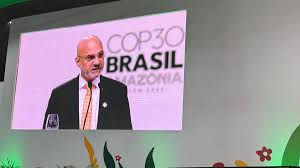
Indian Ambassador to Brazil Dinesh Bhatia delivers India’s statement at the Leaders’ Summit of COP30 in Belem. Credit: X/@indiainbrazil)
At the Leader’s Summit in Belem, Brazil, where heads of state have converged ahead of the climate conference beginning Monday, India said it would join the Tropical Forest Forever Facility (TFFF) as an ‘Observer’.
The TFFF is the latest measure drummed up to incentivise global finance to invest in limiting net global carbon emissions. The plan is that countries with tropical forests be paid annually for keeping their forests standing. A secretariat called the TFFF, and an investment fund called the Tropical Forest Investment Fund (TFIF), will invest sponsor money in emerging market bonds, and avoiding fossil fuels, coal, peat, and any sectors linked to deforestation.
The TFFF offers a new, budget-neutral model of nature financing that rewards countries protecting forests yearly with $4 per hectare protected. Investors’ initial contributions are invested by the TFIF, and the returns on those investments are used to pay back the original investors in full.
_______________________________________________________________________
Read Also : First Global Initiative for Information Integrity on Climate Change Grants Announced Ahead of COP30
________________________________________________________________________
Brazil, the COP30 host, has announced a $1 billion contribution; Colombia has pitched in with $250 million; Indonesia is contributing $1 billion; the Netherlands $5 million; Norway $3 billion over a decade; and Portugal 1 million euros.
France, China, and the UAE have expressed support but have not made financial commitments.
Brazilian President Luiz Inácio Lula da Silva called on world leaders to establish a global roadmap to end the dependence on fossil fuels, and honour international commitments by 2030 to triple renewable energy capacity and double energy efficiency.
It is essential for countries to leave Belém with NDCs (Nationally Determined Contributions) aligned with the 1.5°C mission committed to in Dubai, Mr. da Silva said. The ‘Roadmap to Mission 1.5°C’, which seeks to limit the increase in the global average temperature to 1.5°C above pre-industrial levels, resulted from the COP28 climate conference hosted in Dubai in 2018.
The Brazilian President also launched the Belém commitment to quadruple the use of sustainable fuels by 2035, and emphasised the need for debt-for-climate swaps to support developing nations.
Among the leaders in attendance at the Summit were President Emmanuel Macron of France, President Cyril Ramaphosa of South Africa, Prime Minister Keir Starmer and Prince William of the United Kingdom, European Commission President Ursula von der Leyen, President of the European Council António Costa, and Prime Minister Jonas Gahr Støre of Norway.
_______________________________________________________________________
Read Also : LGMA launches National Coordination group in Brazil to elevate subnational voices at COP30
________________________________________________________________________
Dinesh Bhatia, India’s Ambassador to Brazil, welcomed the TFFF, calling it a “significant step” towards collective and sustained global action for the preservation of tropical forests.
From 2005 to 2020, India reduced the emission intensity of GDP by 36%, the Indian Ambassador said. Non-fossil power currently constituted 50% of installed capacity, enabling India to reach the revised 2030 NDC target five years ahead of schedule, he said.
India, like other countries, is supposed to announce an updated NDC target, stating its plans to reduce fossil fuel emissions by 2035.
India had expanded its forest and tree cover, Mr. Bhatia said, and the additional carbon sink of 2.29 billion tonnes of CO₂ equivalent was created between 2005 and 2021. He reiterated India’s position that affordable finance, technology access, and capacity-building were essential for implementing ambitious climate targets in developing countries.