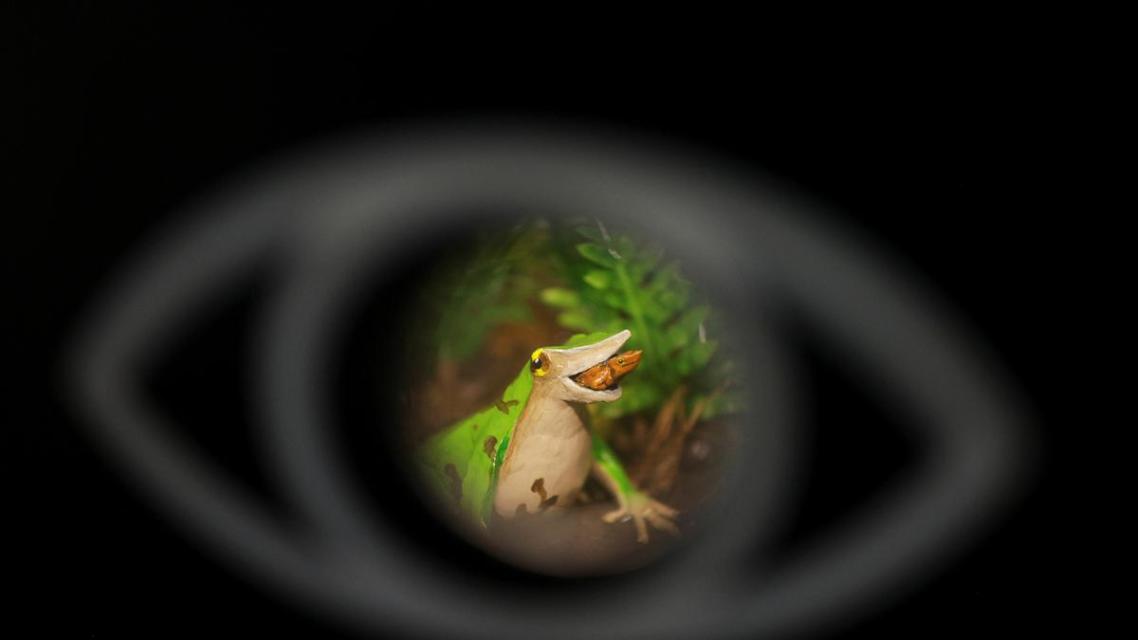
The frog, which measures 3 cm, was discovered in Chile’s southern Chiloe islands by Charles Darwin during his 1834 trip around the world
Chile has launched a new effort to save the endangered Darwin’s frog, a tiny amphibian with leaf-like skin whose males carry tadpoles within pouches in their mouths.
The initiative from the Chilean government’s climate change and sustainability committee seeks to protect habitats and reproductive areas, including by working with private landowners.
_______________________________________________________________________
Read Also : Most Polluted Major City on Earth – Delhi
________________________________________________________________________
The frog, originally thought to be a single species, actually comprises two: the endangered Rhinoderma darwinii (Southern Darwin’s frog) and the Rhinoderma rufum (Northern Darwin’s frog), which is categorized as “critically endangered” and has already virtually disappeared.
The frog, which measures 3 cm (1.18 inches), was discovered in Chile’s southern Chiloe islands by Charles Darwin during his 1834 trip around the world.
Forest fires, climate change, invasive species and urbanization have hurt the humid forests of southern Chile and Argentina where the Darwin’s frog typically lives.
Charif Tala, Head of the Environment Ministry’s Species Conservation Department, said the fragmentation of Chile’s forests has caused the number of populations in Chile and Argentina to decline to 62. The monitoring of frog populations only began in recent years, the ministry said, after a dramatic decline.
_______________________________________________________________________
Read Also : Climate science is supporting lawsuits that could help save the world
________________________________________________________________________
Andres Valenzuela, director of a Chilean advocacy nonprofit called NGO Ranita de Darwin, said he hoped the initiative would bring more awareness of the frog’s plight to people throughout Chile.
“We are very hopeful that this will allow us to improve conservation … and that the people of our country will begin to appreciate these unique and important species we have in our native forests,” Mr. Valenzuela said.
NOTE – This article was originally published in The hindu and can be viewed here
Tags: #climate, #climatechange, #discovered, #environment, #forest, #frog, #getgreengetgrowing, #gngagritech, #greenstories, #nature, #sustainability, #wildlife