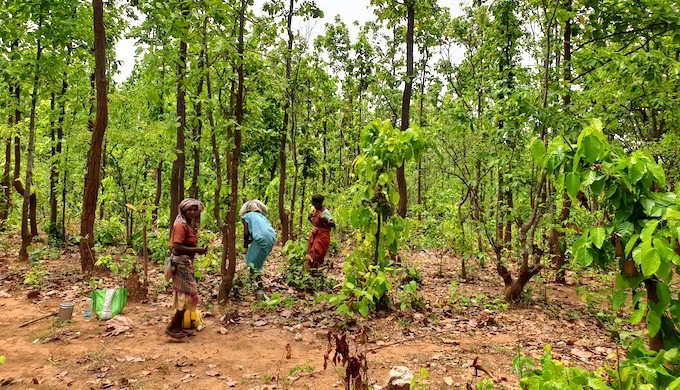
Locally managed forest areas are typically significantly more effective in combating climate change than compensatory afforestation programmes.
The subject of why India did not sign the “Glasgow Leaders’ Declaration on Forests and Land Use” during the 2021 United Nations Climate Change Conference discussions in Glasgow has been highlighted. The statement, which was signed by 138 nations, including India’s neighbours Bangladesh, Bhutan, China, Nepal, and Pakistan, pledged to “stop and reverse forest decline and land deterioration by 2030.”
________________________________________________________________________
Read Also : Yoga Vs Gym – Which you Should Opt for and Why?
________________________________________________________________________
It’s possible that we’re asking the incorrect question. When you look below the headlines, such announcements are frequently used as an excuse for corporate polluters and governments to continue greenwashing through forest carbon offsetting, postponing essential carbon reductions.
The underlying question is whether India is willing to take genuine climate action in order to alleviate the systematic disparities that rights holders and communities confront.
Despite anticipation that the Glasgow summit would be the most important UN climate conference since Paris, many individuals considered it failed to address the concerns and ambitions of those most impacted by climate change, such as forest-dependent communities, Native and rural women and girls.
Instead, the summit favoured corporate lobbyists and governments promoting dubious answers under the guise of “nature-based solutions,” which were high on the agenda.
One of India’s main climate programmes, the Green India Mission, is a glaring example of these bogus solutions, with funding from the Compensatory Afforestation Planning and Management Authority. This scheme permits mining and other industry companies to pay a certain sum for deforestation caused by their operation in order to fund compensatory afforestation.
________________________________________________________________________
Read Also : How to do Pranayam: Yoga Breathing Exercises You Must Include in Your Routine
________________________________________________________________________
The carbon emissions created by deforestation are expected to be countered by compensatory afforestation.
Afforestation as monoculture
This usually entails the growth of monoculture tree plantations in practise. Monoculture tree plantations, unlike natural forests that have been damaged by mining and other activities, are generally made up of non-native species, have detrimental consequences on biodiversity and the water table, and do not contribute to sustainable livelihoods as wild forests do.
According to a recent analysis from the Global Forest Coalition, afforestation and carbon offset projects like this one are fundamentally undercutting progress in India toward effective forest conservation, society forest governance, and gender equity. Indigenous Dhanwar women from Bakhai, a Chhattisgarh hamlet, explain how their communities faced Indian Forest Department authorities and successfully prevented the removal of trees in their woods to make room for a Green India Mission-linked commercial plantation.
The Forest Department retaliated by attempting to plant trees on land owned by rights holders without the villagers’ permission. This is a common practise among Forest Departments across the country as part of their afforestation and compensatory afforestation projects on behest of the Green India Mission and the Compensatory Afforestation Planning and Management Authority: land for such projects is frequently obtained from public land in villages or even agricultural lands.
Despite the fact that they are the least culpable for the issue and, in fact, have answers to provide, acts like these do not react to the needs and wellness of the groups most affected by climate change, notably Indigenous women.
Localised Solutions
The Forest Rights Act of 2006, also widely recognized as the Scheduled Tribe and Other Traditional Forest Dwellers (Recognition of Forest Rights) Act, acknowledges and revives the rights of forest communities in India, along with individual rights over farmsteads and agricultural areas, as well as rights of all people to resources within and around village boundaries. Indigenous Dhanwar women were able to oppose deforestation and monoculture plantings because to the provisions of this historic legislation, particularly the requirement requiring authorization from gramme sabhas.
- Through forest protection and innovative agro-ecological food systems, the indigenous Dhanwar women have been able to change their hamlet. Women in forest communities frequently have extensive knowledge about natural forests and conservation methods. Through representation on the village council, the Forests Rights Act provides women with a forum to contribute their viewpoint and expertise of conservation techniques and resource governance. In Bakhai, this is precisely what occurred.
________________________________________________________________________
Read Also : Five yoga asanas to strengthen the immunity and stave off coronavirus
________________________________________________________________________
- Bakhai’s women spearheaded an effort to identify the community’s forest resources and organise a communal forest management committee. Villagers constructed forest seed banks, and women developed nurseries for fruit-bearing trees. Bakhai women began producing annual crops in 2018 using no-till and organic methods, increasing nutritional content and locking carbon in soils.
- As part of three-tier farming approaches, root crops, seeds, and pulses are now cultivated in tiny areas. With millet, the ladies resurrected agro-ecological agricultural methods. Drip irrigation systems based on earthen pots with a tiny hole at the bottom to irrigate young plants in the summer are among their creations. This practise is ideally suited to Bakhai’s mountainous terrain, which does not easily store water, and it helps the community adapt to shifting rainfall patterns as a result of climate change.
- The ladies of Bakhai established a resource centre to display traditional rice types and tree seedlings, allowing them to share their traditional knowledge of forests and biodiversity with village youngsters.