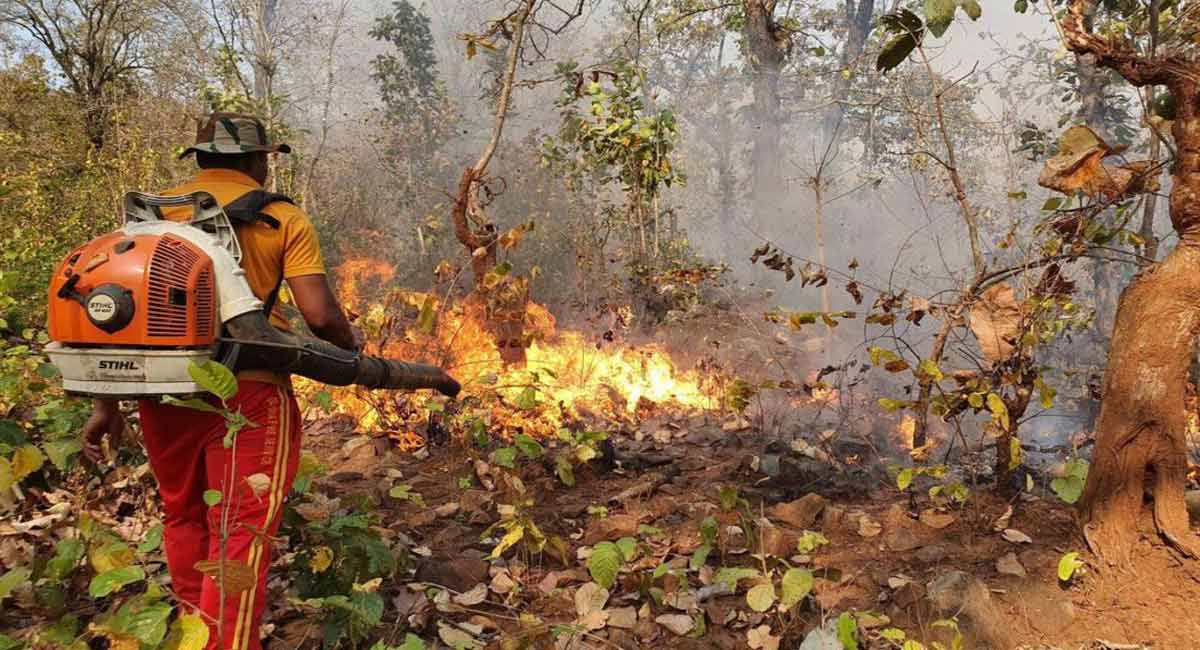
Hyderabad: The frequency and intensity of forest fires in India, as well as the number of months in which such fires occur, have increased in the past two decades, according to a study ‘Managing Forest Fires in a Changing Climate’ released by the Council on Energy, Environment and Water (CEEW), an independent, non-partisan, one of Asia’s leading not-for-profit policy research institutions. Read more about the report…
________________________________________________________________________
Read Also : Why climate change is still the greatest threat to human health
________________________________________________________________________
Increase in forest fires
There has been a ten-fold increase in forest fires in the past two decades and more than 62% of Indian states are prone to high-intensity forest fires.
Andhra Pradesh, Assam, Chhattisgarh, Odisha and Maharashtra are the most prone to high-intensity forest fire events caused by rapid change in climate. Mizoram has had the highest number of forest fire incidences in the last two decades, with more than 95% of its districts being forest fire hotspots.
Districts that were earlier flood-prone have now become drought prone due to a “swapping trend” as a result of climatic changes. More than 75 % of Indian districts are extreme climate event hotspots, and more than 30 % of districts are extreme forest fire hotspots.
________________________________________________________________________
Read Also : The Science of Climate Change Explained: Facts, Evidence and Proof
________________________________________________________________________
More incidences in the Northeast
Most of the northeastern region are witnessing an increased frequency of forest fire incidences in recent decades. Despite the region being a rain-fed area, it is witnessing more forest fire incidences during increased dry spells across March-May and due to the muddled rainfall distribution pattern.
Prolonged duration of incidences
Earlier, forest fires would take place during the summer months, that is between May and June. The duration that forest fires could take place was two to three months earlier, but it is now nearly six months.
Recent data on Forest Fires
• A total of 381 forest fires have been reported in India by 30th March, 2022, according to the Forest Survey of India. Madhya Pradesh has recorded the highest number of fires at 133.
• In March 2022, significant forest fires were reported in States such as Uttarakhand, Madhya Pradesh and Rajasthan.
• The recent fire at Rajasthan’s Sariska Tiger Reserve was also considered to have been unseasonal, with high temperatures exacerbating the spread of the fire.
Recommendations
Recognise as a Disaster: The forest fires should be treated as “natural disasters” and be brought under the National Disaster Management Authority. Moreover, by designating forest fires as natural disasters, there will also be a financial allotment made to manage them.
________________________________________________________________________
Read Also : Climate science is supporting lawsuits that could help save the world
________________________________________________________________________
Efforts to mitigate forest fires
Since 2004, the FSI (Forest Survey of India) developed the Forest Fire Alert System to monitor forest fires in real time. In its advanced version launched in January 2019, the system now uses satellite information gathered from NASA and ISRO. National Action Plan on Forest Fires (NAPFF) 2018 and Forest Fire Prevention and Management Scheme.
Alarming
States most prone to high-intensity forest fire- AP, Assam, Chhattisgarh
No of forest fires recorded in 2022 (till March 300): 381 forest fires
More than 62% of Indian states are prone to high-intensity forest fires
NOTE – This article was originally published in Telangana today and can be viewed here