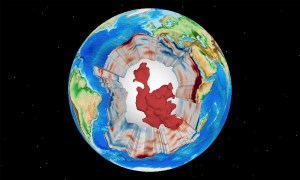
Deep within Earth’s mantle lie two enormous, continent-sized structures known as LLVPs. Scientists once believed these regions were similar, but groundbreaking research has revealed they have vastly different compositions and histories.
The Pacific LLVP is younger and enriched with oceanic crust due to its location near active subduction zones, while the African LLVP is older and more diffuse. These deep structures could influence Earth’s magnetic field, potentially affecting its stability. This discovery challenges long-standing assumptions and opens new questions about our planet’s inner workings.
Mysterious Mantle Structures Unearthed
A new study by researchers from Cardiff University, the Researchers have typically assumed that both LLVPs are similar to each other in nature, e.g. chemical composition and age, because seismic waves travel through them in similar ways. But a new study, co-authored by Dr. Paula Koelemeijer (Department of Earth Sciences, University of Oxford), has challenged this view by modelling the formation of the LLVPs through time. By combining a model of mantle convection, including a reconstruction of how tectonic plates have moved over the Earth’s surface over the last billion years, the study has been able to show that the African LLVP consists of older and better mixed material than the Pacific LLVP, which contains 50% more and younger subducted oceanic crust (and therefore is more different to the surrounding mantle). The resulting differences in density could also explain why the African LLVP is more diffuse and taller than its Pacific counterpart. “As numerical simulations are not perfect, we have run multiple models for a range of parameters. Each time, we find the Pacific LLVP to be enriched in subducted oceanic crust, implying that Earth’s recent subduction history is driving this difference,” explained Dr. James Panton (Cardiff University), Lead Author. The models of this study also show that the Pacific LLVP is consistently replenished by fresh oceanic crustal material since 300 million years ago, because it is surrounded at the surface by a circle of subduction zones, known as the Pacific Ring of Fire. By contrast, the African LLVP does not receive new material at the same rate, and the material has mixed more with the surrounding mantle, lowering its density. Until now, these differences have been overlooked because temperature is the dominant control on how fast seismic waves move through a material. The models presented in this study demonstrate that both LLVPs actually have the same temperature, which explains why they look seismically similar. This highlights the importance of combining different scientific disciplines to closely examine the inner workings of our planet. “The fact that these two LLVPs differ in composition, but not in temperature, is key to the story and explains why they appear to be the same seismically. It is also fascinating to see the links between the movements of plates on the Earth’s surface and structures 3000 km deep in our planet,” said Dr. Paula Koelemeijer (University of Oxford), Co-author on the study The high temperature of the LLVPs, and their positioning in the deep mantle on each side of the planet, means that they affect how heat is extracted from the Earth’s core. This impacts convection in the outer core – a process that drives the magnetic field and protects us at the surface from harmful cosmic rays. If the African and Pacific LLVP are different, heat may no longer be extracted symmetrically, which could lead to magnetic field instability. This makes it important to understand the structure of the LLVPs and how they influence heat extraction from the core. Scientists now need to account for this asymmetry in mantle density within their models of the deep Earth. This poses a challenge for observations, as the data that are used often only provide information on symmetric structures in the Earth. Dr. Koelemeijer adds: “We now need to look for data that can constrain the proposed asymmetry in density, for example using observations of Earth’s gravitational field.” 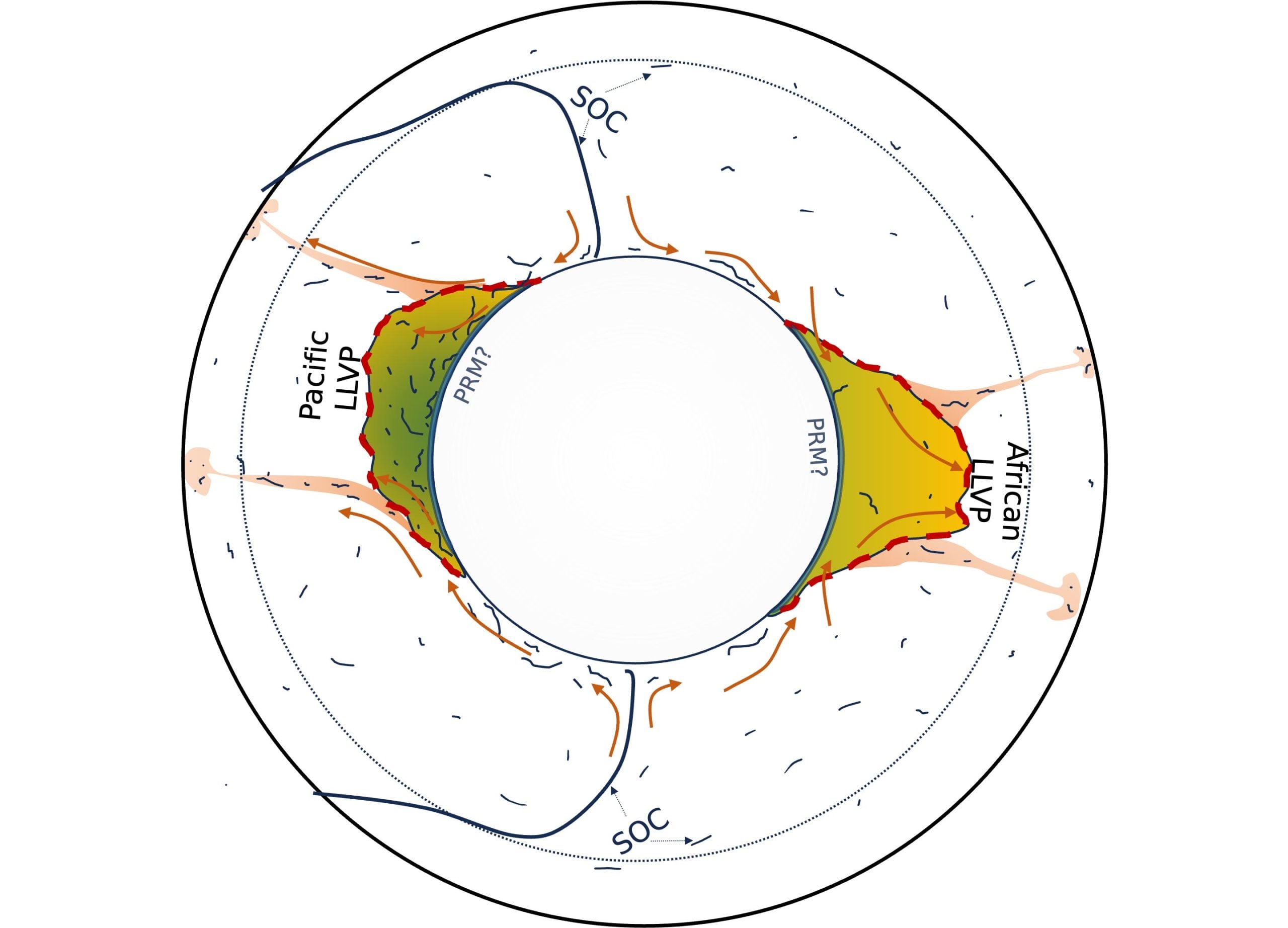
A Surprising Difference Between the Two LLVPs
Pacific vs. African LLVP: A Tale of Two Histories
The Deep Connection Between Mantle and Magnetic Field
A New Challenge for Earth Scientists