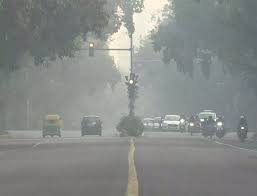
No respite for Delhi-NCR as air quality deteriorates further and the situation is likely to worsen in the next 48 hours due to poor wind speed, even as the contribution of farm fire emissions is expected to stay low, say forecasting agencies.
The PM 2.5 levels in Delhi as per SAFAR data was 355 (very poor) on Tuesday, while the PM 2.5 level was 216 (very pooor). However, it may shift towards the higher end of the very poor range (up to 400) in the next three days.
The Kejriwal govt, the Delhi announced the closure of physical classes in schools, colleges, and other educational institutions for a week from Monday.
All government offices, agencies, and autonomous bodies, except those involved in essential services, have been asked to work from home. No construction and demolition activity is allowed in the national capital till November 17.
________________________________________________________________________
Read Also : Strong immunity is a key weapon in the fight against Covid-19
________________________________________________________________________
Supreme Court has suggested a 2-day lockdown in view of the high pollution levels.
Narrative
Confusing claims over primary sources of pollution mar Delhi’s response, writes Saubhagya Kala
The prime culprit behind Delhi’s high pollution levels seem to be as hazy as the air. Centre’s affidavit to SC now gives, what amounts to, a clean chit to stubble burning.
‘The cat is out of the bag’, observed SC, saying in its order that “the major culprit of pollution” is industry, transport, and road dust and “some part” is stubble burning.
The Centre’s affidavit, in fact, cites a scientific study to say that only 4 per cent in PM 2.5 in Delhi is because of agricultural burning in winters and 7 per cent in summers.
This claim is in direct variance to SAFAR (System of Air Quality and Weather Forecasting and Research), which comes under the Central Ministry of Earth Sciences.
SAFAR maintains the share of stubble burning in the PM 2.5 concentration in Delhi’s heavily polluted air. Stubble burning touched a peak of 48 per cent on November 7, when the air quality index value clocked in at a severe 428. The primary pollutant that day was PM 2.5.
Vikas Singh, the lawyer for the petitioners, later accused the Centre of trying to protect farmers with an eye on upcoming state elections while Delhi’s Aam Aadmi Party (AAP) government accused the Centre of “misleading the Supreme Court”.
But street emissions have always been held up as Delhi’s chief suffocator.
Centre for Science and Environment (CSE) said that vehicles’ comprised half of Delhi’s pollution in the early phase of this year’s winter, from October 24 to November 8.
Vehicular effluents were followed by household pollution (12.5-13.5 per cent), industry (9.9-13.7 per cent), construction (6.7-7.9 per cent), waste burning and road dust, said CSE’s analysis based on real-time data.
The toxic air pollution levels underline the risks faced by India which recently made climate change a top priority at the COP26 summit in Glasgow. Prime Minister Narendra Modi pledged last week that the world’s third-worst emitter will aim to reach net-zero by 2070.
Debate
Lockdown may be temporary, but it will unlock the brains of the comatose governments and give our choked lungs respite, saysSandipan Sharma First they came for odd-even, I stayed silent — because I didn’t want to give up my car.
_________________________________________________________________________
Read Also : Case study: Mandi system of Punjab v/s Bihar, amidst the ongoing protest
_________________________________________________________________________
Then they came for stubble burning, I stayed silent — because I didn’t want to give up my votes. Then they came for fire crackers, I stayed silent — because I didn’t want to give up my tradition.
Then they came for a lockdown, I stayed silent — because I didn’t want to stay home.
Former prime minister Narasimha Rao famously believed in the policy that sometimes the best thing to do is to do nothing. In other words, he believed in twiddling thumbs while a crisis raged and hoped it would blow over.
A variation of this policy has become the blueprint of our response to the pollution crisis in Delhi: we will not do anything, and not let anyone intervene either. We will say no to everything. T
here is a phrase for people who are not aware of a life-threatening crisis evolving around them — it is called the boiling frogs syndrome.
But, there is a bigger problem than this frog-like ignorance — it is the inability to react to danger even when it is staring you in the face. By now almost everyone knows the main sources of air pollution in Delhi.
These include vehicle exhaust, soot from heavy industries, power plants using coal, brick kilns, dust on roads, construction activity and smoke from burning of stubble in adjoining states.
The only confusion is about how much each of these factors contribute to Delhi’s air quality. Yet, we try to do nothing to address these issues. Several years ago, when the Delhi government decided to try the odd-even formula for vehicles, it was panned for implementing a “Talibani” diktat. Facts were ignored to make it seem this was a novel experiment in dictatorship that would amount to nothing but misery.
In Sao Paulo, for instance, vehicle rotation system based on registration numbers has been prevalent for over a decade. Many Latin American governments have implemented the scheme to keep both the roads and environment clean. In 2008, Beijing tried a similar system before the Olympics. Spurred by the success, road-rationing based on licence plates was made mandatory in Beijing.
According to studies in Beijing, the emission levels came down to 40 percent after the system was introduced. But, when the Delhi government implemented it in December 2015, the critics cried so much that the intervention was ultimately phased out by Arvind Kejriwal’s government.
As a result, nobody even talks about affirmative action for controlling vehicular pollution. A similar pigheaded obduracy has marked our reaction to ban on crackers. Every year, the day after Diwali, it has been clearly documented that pollution levels go up in Delhi.
This year, after a night of revelry that saw the cracker ban go up in smoke, the Air Quality Index the morning after Diwali crossed 600 — indicating severe levels of pollution. But, people just don’t want to follow a ban on bursting crackers.
In the name of tradition, they want to create a toxic environment just to assert their religious identity. For years, burning of stubble was blamed for the pollutants in the Delhi sky. A good five years were spent arguing that farmers need to be stopped from clearing their fields by burning the leftovers before the next sowing season.
But, nothing was done on the ground to implement this strategy. Many states threatened punitive action, but refused to implement them for fear of anger among farmers, especially in poll-bound states.
On Monday, the Centre turned its previous arguments on the head by proferring some controversial data to suggest stubble-burning is just a minor irritant and not the environmental malaise it was made out to be.
Coal-fired plants are other source of pollution. On the use of coal, the government is torn between the need for energy (and development) and its cost to the environment. More than 70 per cent of India’s fuel demand is met by coal, bringing its use down would have a knock-on effect on the economy, and the country’s development.
________________________________________________________________________
Read Also : Which animals could have passed Covid-19 to humans?
________________________________________________________________________
Let’s recap. Controlling traffic on roads is out — because of politics. Crackers can’t be banned–because of religion. Burning of stubble can’t be stopped — because of elections. Coal can’t be phased out immediately — because of development.
The governments just won’t act. The Supreme Court has put another option on the table — a lockdown in the city till the air gets better. This is a welcome, but short-term remedy.
Instead of looking at the individual reasons behind the rise in pollutants, a blanket lockdown will ensure that all activities that produce toxins come to an end. If other environmental factors — an increase in air speed, a quick spell of showers — support the intervention, it would help deal with the immediate crisis.
The other advantage, of course, is that it will force the government to act — instead of twiddling its thumbs. The governments have failed us. For them pollution is not even on the agenda, unless it helps them electorally.
The long-term solutions will have to come from a SC-monitored plan that deals with the yearly menace. Enforcing a lockdown would be a good beginning — it would at least convey to the governments that the apex court will not be silent.
A 2-day lockdown to check Delhi’s toxic air is far too late, farcical and like providing a band aid to a gangrenous wound, saysSaubhagaya Kala.
While the Centre and the Delhi Govt make a poor fist of it, Delhi-NCR continues to gasp for breath, with no immediate relief in sight. Its proving to be a drama of the absurd, with claims and counter claims about the adverse effect of crop burning at this time of the year in the states of Punjab, Haryana, and Uttar Pradesh. So, who is actually the villain of the piece – Is it vehicular pollution, industry or, believe it or not, road dust? And so, we are back to Control-Alt-Delete – with the clarion call for a 2-day lockdown, as if 48-hrs of staying indoors will, in itself, miraculously make the toxic haze disappear and make the air pristine. Not to mention the hackneyed emergency measures put in place by Delhi Govt – closure of schools for a week, a ban on construction activities and work from home for government employees. This is a farce, akin to providing a band aid to a gangrenous wound.
A lockdown makes more sense as a peremptory measure rather than the go-to solution when the situation is already beyond control. The need of the hour is to have an action plan that is implemented through the year. What’s needed is a lockdown on construction activities, calibrating vehicular traffic through the odd-even scheme, strictly implementing ban on crackers, well ahead of the festive season. All of these measures have to fall in place together and not be implemented as silos. Let’s not even get into stubble burning – it’s the elephant in the room that no one wants to address.
And what next after the lockdown is lifted – those sources of pollution will return once again. The knee jerk reaction now makes no sense whatsoever. What’s the point in trying to close the stable door after the horse has bolted? The country is just limping back from the pandemic-enforced lockdowns which created havoc with businesses, labourers, and jobs. For how long can you keep people consigned at home like in a concentration camp and put the brakes on economic activity? The problem has to be nipped in the bud at the off-peak time and not at the on-peak time. There needs to be better pollution management in terms of cutting down pollution from every source as a year-on-year 365-day strategy — vehicles, construction, and better incentives by the governments for managing stubble. And it cannot be left to the Delhi government alone. The national capital’s pollution issue is too complicated, has far too many stakeholders and therefore needs direct intervention from the Centre.
But then what can be done immediately to get out of the mess created by political apathy, our own behavioural quirks and Delhi’s heavy traffic. Well, just lump it. There’s no other way – either leave the city for a while if you can afford to or grin and bear. A 2-day lockdown is not a solution at all but just a quick-fix which might just rebound. Let’s face it, there’s no way to redeem 2021 – plan well in advance for next year rather than wait for the SC to provide a rap on the knuckles. If vehicular pollution is the popular culprit now and the biggest internal contributor to pollution levels, then announce a month-long vehicular ban in the national capital region, that kicks off just before the festive season. A stop gap 2-day lockdown is certainly not the answer.
NOTE – This article was originally published in News9live and can be viewed here
Tags: #AirPollution, #climate, #climatechange, #delhi, #earth, #getgreengetgrowing, #gngagritech, #greenstories, #Pollution