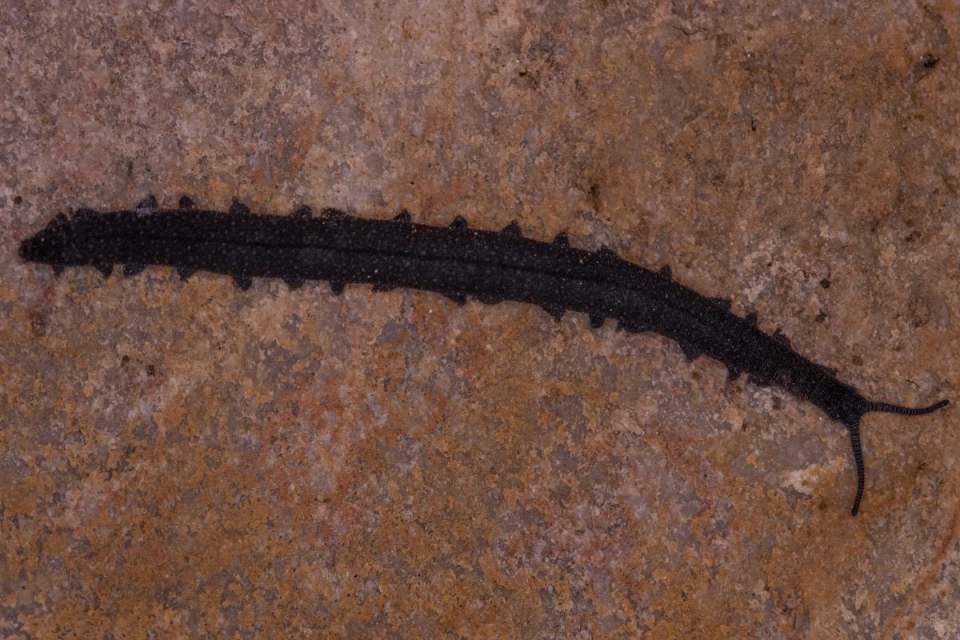
 Peripatopsis barnardi represents the first ever species from the little Karoo, which indicates that the area was historically more forested than at present. It is one of seven new species from the Cape Fold Mountains described by researchers from Stellenbosch University. Credit: Savel Daniels
A newly discovered velvet worm 18 Advantages and Disadvantages of Organic Farming in Modern Agriculture
________________________________________________________________________
“I had a basic knowledge of the Cape velvet worms, having found one for the first time on Table Mountain in 2019. My older brother was under assignment from his zoology lecturer, Prof. Savel Daniels, to collect velvet worms. With my interest in ants, I gladly assisted him in this task,” Rohan, now a third year BSc student in Conservation Ecology and Entomology, explains.
A living fossil from the Cambrian period
Velvet worms trace their lineage back more than 500 million years, making them living relics of the Cambrian period. With soft bodies and non-jointed legs, they have remained largely unchanged over time, earning the nickname “living fossils.”
At the time, Rohan had no idea he had discovered a new species of velvet worm, now fittingly named Rohan’s velvet worm, or Peripatopsis barnardi in scientific terms.
Rohan Barnard describes his excitement when finding the velvet worm, and what it means to him to have such a special animal named after him. Credit: Rohan Barnard
New species reveals ancient climate history
What makes the discovery even more remarkable is that it is the first velvet worm species ever found in the Little Karoo. This suggests that the region was once more forested than it is today. Over time, prehistoric climate changes and increasing aridity caused the species to become isolated, eventually leading to its evolution into a distinct species.
According to Prof. Daniels, an evolutionary biologist from SU’s Department of Botany and Zoology and one of South Africa’s foremost specialists on velvet worms, it is utterly remarkable that such a prehistorical lineage is still around today. After viewing this rare find on iNaturalist, he visited the same area in July 2022 and collected a paratype and another nine specimens for analysis.
________________________________________________________________________
Read Also: REGENARATIVE AGRICULTURE : SUSTAINABLE FARMING FASHION
________________________________________________________________________

The results of his analysis and the announcement of seven new species of velvet worms, were published in the journal Ecology and Evolution recently. Daniels, the first author on the paper, says South Africa’s velvet worms are mainly found in prehistoric Afro temperate forest patches that persist in deep gorges in the Cape Fold Mountains
Climate shifts shaped today’s biodiversity
“The origin of these forest patches can be traced to the early Miocene, about 23 to 15 million years ago, when the region used to be temperate and sub-tropical. During the late Miocene, however, the region underwent significant climatic changes, with a decrease in rainfall due to the advent of the proto Benguela current along the West Coast, and two geotectonic uplifting events. These events resulted in a complex mosaic of habitat connectivity and isolation, what we know today as the Cape Fold Mountains, driving the speciation of habitat specialists such as velvet worms,” he explains.
Daniels used new mitochondrial and nuclear THE TRASH MOUNTAINS BEING TURNED INTO SUSTAINABLE FASHION IN RUSSIA
________________________________________________________________________
Citizen scientists help uncover hidden diversity
Daniels welcomes the efforts of citizen scientists to share their findings on biodiversity apps: “It is thanks to citizen science data that we were able to identify the new species. In the Cape Fold Mountains, we now know that every mountain peak has an endemic species. This suggests that in unsampled areas there are likely to be additional novel diversity, waiting to be found.”
Most importantly, though, it means that we must conserve these prehistoric forest fragments to limit extinction.
To Rohan, it still feels surreal to have such a fossil-like creature named after him: “It is incredible to realize that I’ve uncovered a living fossil. It is as if I have found a missing link that we did not even know about. It gives me hope that there is still so much left to discover. But it also makes me worried for the future, that we will lose animals and plants to extinction that we did not even know existed,” he warns.
The seven new species are P. fernkloofi, P. jonkershoeki, P. kogelbergi, P. landroskoppie, P. limietbergi and P. palmeri. Apart from P. barnardi, all the new species were named after their places of origin.