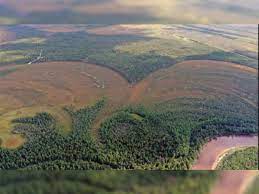
In what is being dubbed a groundbreaking archaeological discovery, an international team of archaeologists has found the world’s oldest known fort which dates back to 8,000 years in a remote region of Siberia. This indicates hunter-gatherers made complex defence structures, much before than once believed.
The findings of the study published in the journal Antiquity said that the new research reshapes our understanding of early human societies and challenges the popular belief that fortresses were built with the advent of agriculture.
The study titled, ‘The World’s Oldest-Known Promontory Fort: Amnya and the Acceleration of Hunter-Gatherer Diversity in Siberia 8000 Years Ago’ was published earlier this month.
The cluster of fortified structures found defies the “conventional stereotypes that depict such societies as basic and nomadic, unveiling their capacity to construct intricate structures,” said study co-author Tanja Schreiber, an archaeologist at the Free University of Berlin, told Live Science, in an email.
______________________________________________________________________
Read Also : Why Are Bees So Important To Our Ecosystem?
______________________________________________________________________
The team of researchers led by Professor Henny Piezonka and an archaeologist in Yekaterinburg, Russia, Dr Natalya Chairkina, conducted fieldwork at the fortified settlement of Amnya which is said to be the northernmost Stone Age fort in Eurasia in 2019.
What did they find?
It was through archaeological examinations at Amnya and following the analysis of the samples collected at the site by radiocarbon dating that the team was able to ascertain it as the world’s oldest-known fort, said Schreiber, in a statement.
“Our new palaeobotanical and stratigraphical examinations reveal that inhabitants of Western Siberia led a sophisticated lifestyle based on the abundant resources of the taiga environment,” the archaeologist at Berlin added.
The site is located along the Amnya River in western Siberia and includes around 20 scattered pit-house depressions which were divided into two sections – Amnya I and Amnya II.
The study also suggests that the prehistoric inhabitants caught fish from the Amnya River and hunted elk and reindeer using bone and stone-tipped spears.
_____________________________________________________________________
Read Also : Why Angelina Jolie Is Betting on Women to Save the Bees
_____________________________________________________________________
At the time when the structure was constructed, pit houses would be surrounded by earthen walls and wooden palisades, said the researchers, in a statement, adding that this would suggest “advanced architectural and defensive capabilities.”
It added, “This discovery challenges the traditional view that permanent settlements, accompanied by defensive structures, only emerged with farming societies, thus disproving the notion that agriculture and animal husbandry were prerequisites for societal complexity.”
The researchers noted that they don’t know what could have prompted hunter-gatherers to fortify structures in the first place but the location itself could be strategic since it overlooks a river and would be an ideal lookout point for potential threats. It would also allow them to keep a tab on the fishing and hunting grounds.
Schreiber, as per Live Science said that they are not sure who ordered the fort’s construction or if it was an authority or the entire community’s collaboration to protect people and valuables.
NOTE – This article was originally published in wionews and can be viewed here
Tags: #animal, #archaeological, #climate, #environment, #forest, #Fort, #getgreengetgrowing, #gngagritech, #greenstories, #humans, #nature, #river, #Siberia, #wildlife