- As India pushes itself forward for local electronics manufacturing, from semiconductor fabs to the Electronics Component Manufacturing Scheme (ECMS), e-waste recycling threatens to undercut the progress.
About e-Waste in India
- E-waste — discarded electronic and electrical equipment — contains valuable materials such as copper, aluminum, nickel, cobalt, lithium, gold, and rare earth elements (REEs).
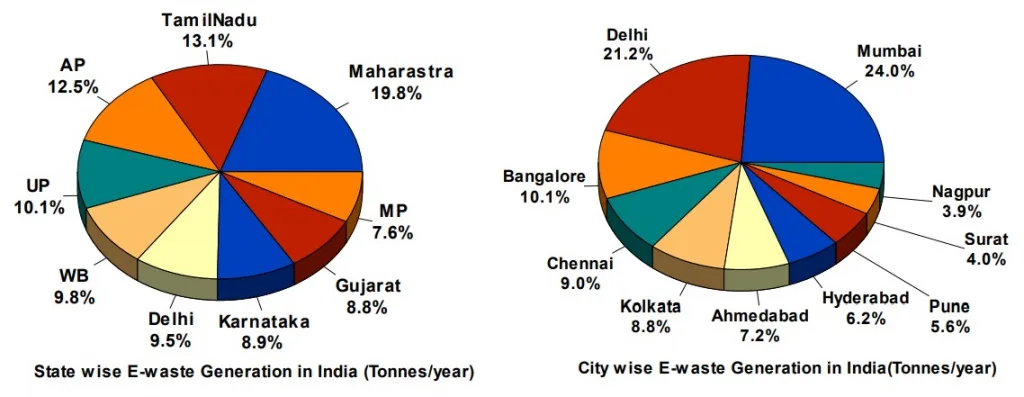
- India generated an estimated 4.17 million metric tonnes of e-waste in 2022, but only about one-third of this was processed through formal channels.
- It is driven by increased use of electronics, rapid obsolescence, and consumer upgrades.
- According to TRAI, India has over 93.9 crore mobile broadband connections, but accounts for only about 4% of global electronics consumption.
________________________________________________________________________
Gaps in Collection and Recycling
- A 2023 report by the Indian Cellular and Electronics Association highlights that e-waste recycling is largely dominated by the informal sector, which handles up to 90–95% of e-waste using unsafe methods such as open burning and acid leaching.
- Key Challenges:
- Low formal collection (less than 10%) and recycling rates;
- Health hazards for informal workers exposed to toxic substances;
- Traceability issues in recovered materials, leading to leakage back into informal streams;
- Fake reporting and malpractices in the EPR system — such as ‘paper trading’ of recycling credits — have raised concerns over credibility.
- Lack of standardized inventory systems and third-party audits.
Policy and Industry Response
- E-Waste (Management) Rules, 2022: These rules aim to ensure environmentally sound management of e-waste, and strengthen the Extended Producer Responsibility (EPR) regime, requiring manufacturers, producers, refurbishers, and recyclers to register on the CPCB portal. Key provisions include:
- Environmental compensation for violations;
- Verification and audit mechanisms;
- Circular economy promotion through scientific recycling.
- Formal Recycling Infrastructure (February 2025): India has 322 registered recyclers with a processing capacity of over 22 lakh metric tonnes per year.
- 72 registered refurbishers with a capacity of 92,000 metric tonnes per year.
- Public Awareness and Education: MeitY, in collaboration with industry bodies like MAIT and NASSCOM, has launched awareness campaigns across 31 states/UTs.
- Innovative models like ‘mandi-style’ aggregation systems are being piloted to link informal collectors with formal recyclers.
________________________________________________________________________
Road Ahead
- Scaling up formal operations;
- Curbing malpractices in the EPR system;
- Enhancing product life cycles through repair;
- Creating robust inventory systems;
NOTE – This article was originally published in NEXTIAS and can be viewed here
Tags: #conditioners, #electric, #environment, #ewaste, #getgreengetgrowing, #gngagritech, #greenstories, #humanhealth, #materials, #recycling, #refrigerators, #televisions