New research findings could explain biodiversity hotspots in tectonically quiet regions.
If we could rewind the tape of Now, an Things You Can Do to Reduce Global Warming
________________________________________________________________________

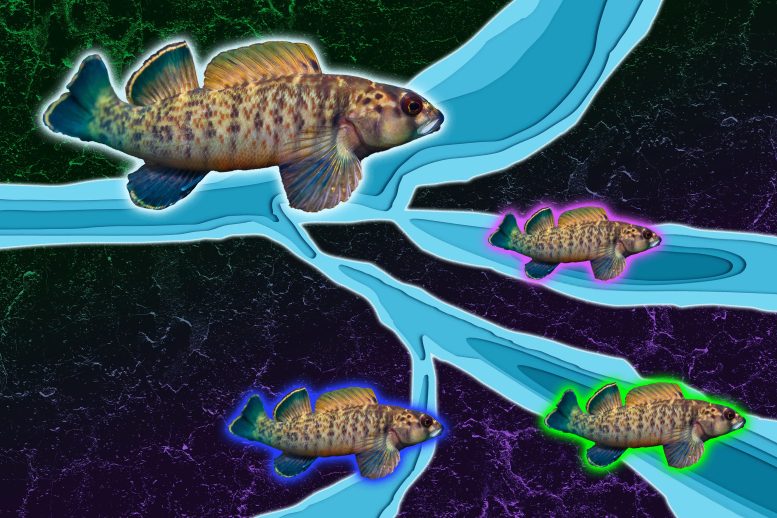
An MIT study of the freshwater greenfin darter fish suggests river erosion can be a driver of biodiversity in tectonically inactive regions. Credit: Jose-Luis Olivares/MIT with fish photo by Isaac Szabo
They make their case in the southern Appalachians, and specifically the Tennessee River Basin, a region known for its huge diversity of freshwater fishes. The team found that as rivers eroded through different rock types in the region, the changing landscape pushed a species of fish known as the greenfin darter into different tributaries of the river network. Over time, these separated populations developed into their own distinct lineages.
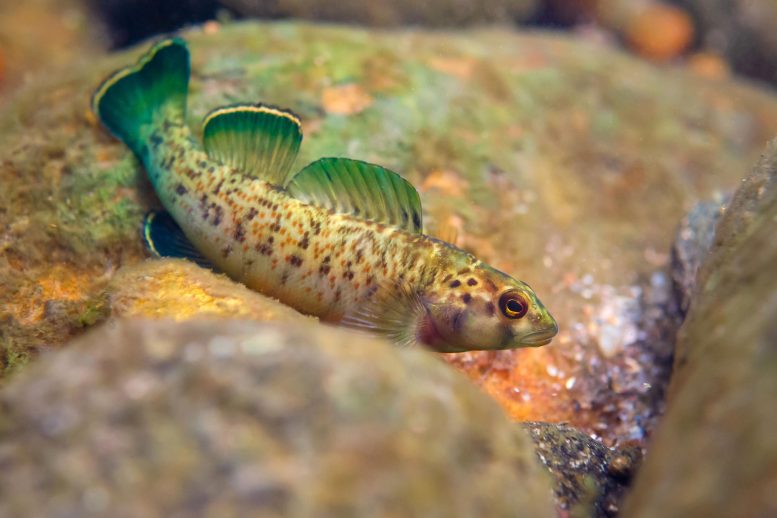
The team speculates that erosion likely drove the greenfin darter to diversify. Although the separated populations appear outwardly similar, with the greenfin darter’s characteristic green-tinged fins, they differ substantially in their genetic makeup. For now, the separated populations are classified as one single species.
“Give this process of erosion more time, and I think these separate lineages will become different species,” says Maya Stokes PhD ’21, who carried out part of the work as a graduate student in MIT’s Department of Earth, Atmospheric and Planetary Sciences (EAPS).
The changing landscape of the Tennessee River Basin pushed a species of fish known as the greenfin darter into different tributaries of the river network. Over time, these separated populations developed into their own distinct lineages. Credit: Isaac Szabo
_______________________________________________________________________
Read Also : Worst mass extinction event in Earth’s history was caused by global warming analogous to...
________________________________________________________________________
The greenfin darter may not be the only species to diversify as a consequence of river erosion. The researchers suspect that erosion may have driven many other species to diversify throughout the basin, and possibly other tectonically inactive regions around the world.
“If we can understand the geologic factors that contribute to biodiversity, we can do a better job of conserving it,” says Taylor Perron, the Cecil and Ida Green Professor of Earth, Atmospheric, and Planetary Sciences at MIT.
The study’s co-authors include collaborators at
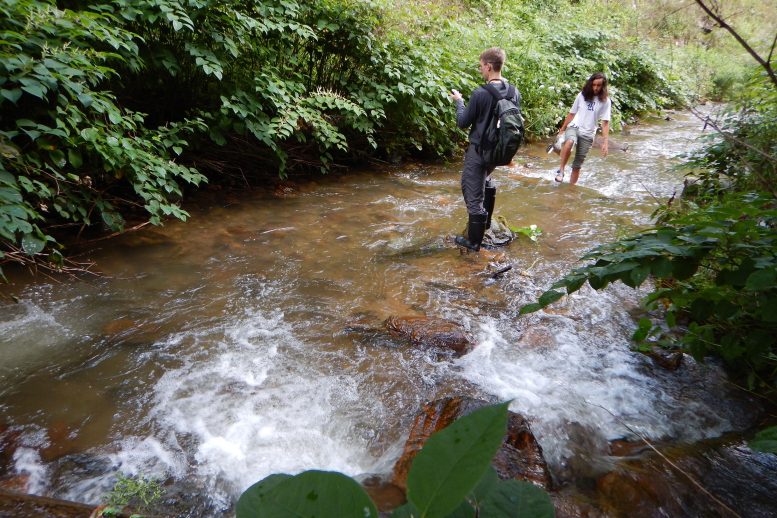
Taylor Perron and Maya Stokes sample stream sediments. “If we can understand the geologic factors that contribute to biodiversity, we can do a better job of conserving it,” says Perron. Credit: Sean Gallen
To investigate the reasons for this pattern, Stokes gathered greenfin darter tissue samples from Near’s extensive collection at Yale, as well as from the field with help from TVA colleagues. She then analyzed DNA sequences from across the entire genome, and compared the genes of each individual fish to every other fish in the dataset. The team then created a phylogenetic tree of the greenfin darter, based on the genetic similarity between fish.
From this tree, they observed that fish within a tributary were more related to each other than to fish in other tributaries. What’s more, fish within neighboring tributaries were more similar to each other than fish from more distant tributaries.
“Our question was, could there have been a geological mechanism that, over time, took this single species, and splintered it into different, genetically distinct groups?” Perron says.
A changing landscape
Stokes and Perron started to observe a “tight correlation” between greenfin darter habitats and the type of rock where they are found. In particular, much of the southern half of the Tennessee River Basin, where the species abounds, is made of metamorphic rock, whereas the northern half consists of sedimentary rock, where the fish are not found.
They also observed that the rivers running through metamorphic rock are steeper and more narrow, which generally creates more turbulence, a characteristic greenfin darters seem to prefer. The team wondered: Could the distribution of greenfin darter habitat have been shaped by a changing landscape of rock type, as rivers eroded into the land over time?
_______________________________________________________________________
_______________________________________________________________________
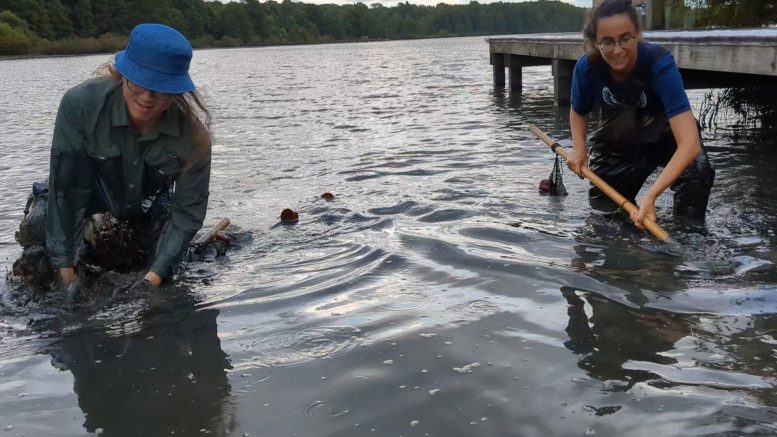
Daemin Kim and Maya Stokes are seen sampling for fish. “Give this process of erosion more time, and I think these separate lineages will become different species,” says Stokes. Credit: Dan MacGuigan
To check this idea, the researchers developed a model to simulate how a landscape evolves as rivers erode through various rock types. They fed the model information about the rock types in the Tennessee River Basin today, then ran the simulation back to see how the same region may have looked millions of years ago, when more metamorphic rock was exposed.
They then ran the model forward and observed how the exposure of metamorphic rock shrank over time. They took special note of where and when connections between tributaries crossed into non-metamorphic rock, blocking fish from passing between those tributaries. They drew up a simple timeline of these blocking events and compared this to the phylogenetic tree of diverging greenfin darters. The two were remarkably similar: The fish seemed to form separate lineages in the same order as when their respective tributaries became separated from the others.
“It means it’s plausible that erosion through different rock layers caused isolation between different populations of the greenfin darter and caused lineages to diversify,” Stokes says.
“This study is highly compelling because it reveals a much more subtle but powerful mechanism for speciation in passive margins,” says Josh Roering, professor of Earth sciences at the here
Tags:
#climate,
#climatechange,
#earth,
#environment,
#fish,
#getgreengetgrowing,
#gngagritech,
#greenstories,
#nture,
#river,
#RiverBasin,
#sustainability,
#trees