(Brian Choo / UC Berkeley)
_______________________________________________________________________
Read Also : Climate Change Performance Index 2021: India slips down by one position to 10th rank,…
_______________________________________________________________________
It was only in 2015 when one of the graduate students of the university stumbled across these specimens in a museum and was quick enough to spot something peculiar in the fossils.
“I love going to collections and just finding treasures there,” said Peter Kloess in an official university statement. He further added, “Somebody has called me a museum rat, and I take that as a badge of honour. I love scurrying around, finding things that people overlook.”
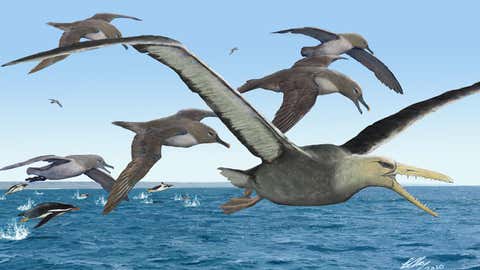
His intrigue to know more about the fossils has led to a discovery of one the oldest and biggest members of a bird species with a wingspan of whopping 21 feet—nearly double that of today’s largest birds, wandering albatross. These ancient giant birds once flew over the southern ocean—encircling Antarctica—for at least 60 million years.
_______________________________________________________________________
Read Also : Acid Rain: Causes, Effects, Solution | Everything You Need to Know
________________________________________________________________________
Giant birds of the sky
Many studies have highlighted how large birds dominated various landscapes of the Earth millions of years ago and eventually became extinct. In fact, that era has inspired many science fiction movies, as well. The well-preserved fossil remains from the museum are identified as a partial jaw bone and foot bone of two huge ancient birds. These extinct birds belong to the prehistoric family of pelagornithids, which are known to be large seabirds.
Pelagornithids species of bird dominated the world just after the mass extinction 65 million years ago and continued to live until about 2.5 million years ago. Before this pterosaurs with wingspans of 33 feet ruled the skies, while after Pelagornithids came bird species called teratorns which also possessed large sizes.
“In terms of time, teratorns come in second place with their giant size, having evolved 40 million years after these pelagornithids lived. The extreme, giant size of these extinct birds is unsurpassed in ocean habitats,” said the co-author of the study Ashley Poust from San Diego Natural History Museum.
The recent study describes various small fossils of the pelagornithid family dating back to nearly 62 million years ago. But one of the newly discovered fossils, estimated to be 50 million-year-old of a bird’s foot reveals that the larger species pelagornithids family came into existence just after the mass extinction that wiped out almost 80% of all living species about 65 million years ago—a time when life was slowly rebounding. This also coincides with the time, when the close relatives of the birds—the dinosaurs—became extinct.
The second fossil recovered from Antarctica—part of the jaw bone—belongs to the time of 40 million years ago. “Our fossil discovery, with its estimate of a 5-to-6-meter wingspan—nearly 20 feet—shows that birds evolved to a truly gigantic size relatively quickly after the extinction of the dinosaurs and ruled over the oceans for millions of years,” said Peter Kloess.
Moreover, the statement reveals that the 5 cm long preserved section of the jaw indicates that it belonged to a very large skull of up to 60 cm. Through these measurements, the team was able to estimate and decode that an individual bird’s size was huge.
________________________________________________________________________
Read Also : BLACK RICE: HOW IT CHANGED THE LIVES OF FARMERS IN ASSAM,
________________________________________________________________________
Warm Antarctica provided habitat for giant birds
The study paints a completely different picture of the white continent as it was not just dominated by penguins but many other animals millions of years ago. The study highlights that nearly fifty million years ago, Antarctica had a completely different climate than today. During the time the continent was not covered with ice, and therefore hosted an ideal condition for these birds to thrive.
Moreover, the family of Pelagornithids is also known to possess pseudo teeth, which was found preserved in the polar fossils. The pseudo tooth was found at the middle portion of the lower jaw and measures up to one inch. This helped the birds to easily grab fish, squid and other seafood from the southern ocean, which was yet to see the domination of whales and seals.
At that time pelagornithids along with other animals like marsupials and distant relatives of sloths and anteaters occupied the land, sea and air. Moreover, the southern ocean was dominated by early penguin species, as well as extinct species of living ducks, ostriches, petrels and many other bird groups.
The study states that these giant birds were part of the Antarctic ecosystem for over 10 million years. The last known pelagornithid fossil belongs to the time of 2.5 million years ago, this was the time when the Earth’s climate changed and led to the beginning of the ice age. The change in climatic conditions eventually wiped away these huge birds from the continent.
The study was published in the journal Nature Scientific Reports last week and can be accessed here.
NOTE – This article was originally published in weather and can be viewed here