In 1966, India underwent a drastic change to improve its stand on the well-established sector of agriculture. This change was pushed forward under the umbrella term of green revolution. The modernization & industrialization of the agriculture sector due to the adoption of modern technologies & methods can be considered as a technical definition of the green revolution. But when the process is judged from today’s standard, when it still influences a huge chunk of the modern agricultural sector, a question arises after examining the current scenario. Was the green revolution actually green?
Green revolution, in every sense, was a vital milestone towards the development of the nation along with it, the revolution was an unavoidable necessity at the same time. The pros & cons of the green revolution will be subjected to the test of time & the level of development India has achieved in these past years but one thing is for sure, you can’t ignore the need for a movement like this & you cannot bypass the need of judging it by today’s standards as it impacts our lives till date.
The need for a green revolution
As stated, this movement was a necessity at that time which enabled India to raise its voice against the ongoing problem of widespread hunger. This was a paramount shift in Indian policies pre & post-1966 in regards to agriculture & food management. This shift transformed the nation into an agricultural powerhouse, thereafter raising the standards by which the development of that particular sector was to be measured.
The basic need arose when India faced a huge shortage in its food grains supply during the mid-1960 when the nation faced some drought years which resulted in a famine-like situation. This resulted in massive imports of subsidized food grain (mainly wheat) from the USA. The major goal of the government of India post-1947 was to free itself from the setbacks given by its colonial overlord aka United Kingdom. For this major development in the agriculture sector was needed to increase the yield resulting in the overall self-dependency of the nation in matters of food supply.
India witnessed two major waves of the green revolution. First in 1960’s (starting from 1966) & second in 1980’s. The initial charge was taken over by IADP (Intensive Agriculture Development program) for experimentation in 1960 but the initial experiments failed in 12 districts when even after proper implementation, the increase was not desirable. In this experiment, IADP saw a rise from 12.7 tone to only 13.5 tonne which was disheartening but it proved a major point nevertheless.
The point was the India needed to part ways from its traditional agricultural practices & needed to adopt new technologies & practices if it were to become self-dependent & it did just that in the forthcoming years. The introduction of High Yielding Variety (HYV) of seeds was finally the point that tipped the scale of balance in India’s favor.
India post green revolution & its fight with hunger
The introduction of HYV’s in the agriculture sector was the key highlight of the Indian green revolution. HYV’s was developed in Mexico & the Philippines & they were very different from the traditional seeds Indian farmers used. They resulted in a 20% growth in total harvest & complimenting that was the reduced time required for harvest. That meant, Indian farmers could now cultivate three to four crops per year instead of two as the new seed required 130 to 100 days for development instead of 150 to 180 like traditional seeds.
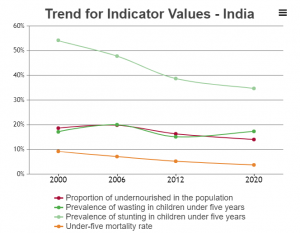
The added cost however was that of fertilizers, something local farmers rarely used as most of the produce was organic but HYV’s required proper use of fertilizers like urea & implementation of pesticides for protection to develop. After the implementation of modern practices, India saw a substantial rise in its agricultural sector which is reflected in the following figures:
- The growth rate of food grain output was increased from 2.4% per annum pre-1965 to 3.5% post-1965.
- The production of wheat was increased from 50 million tonnes in 1950 to 79 million tonnes in 1964 & was raised to 95.1 million tonnes in 1968.
- There was a massive decline in the import of crops, especially food grain
This combined with various changes in food supply structure enabled India to fight against the problem of hunger that persisted since the colonial era but even after such a revolution, the fight against hunger remains unfinished to date.
Questioning green revolution by modern standards
Anything which heavily impacts the current situation is meant to be questioned by today’s standards & the same applies to the green revolution as it still shapes the socio-political-economic diaspora of the Indian subcontinent. It’s evident fact that the movement made India a food exporter rather than an importer but the issue of hunger which it was supposed to fight still prevails heavily in the society.
India ranked 94th out of 107 countries in the global hunger index with a score of 27.2, indicating the severe hunger problem of the nation & that is after 50 years of the revolution that was supposed to curb it once & for all. The green revolution emphasized only food production & the sector of food distribution was left untouched which created many setbacks in its wake.
Apart from failing to achieve its basic goals here are some other areas which present a shady picture when it comes to the legitimacy of the green revolution in 2020:
- Overexploitation of water resources: the area affected by the revolution, i.e. Punjab, Haryana, western UP, Rajasthan now faces a daunting figure of decline in groundwater level. This happens because HYV’s require much more irrigation & new seeds in the market are not able to solve this issue.
- Rampart soil & water pollution level: due to over-dependency of crop upon fertilizers, pesticides & insecticides, the soil & water quality of the said region has plummeted down to worrisome figures.
- No or very little crop diversification: since much emphasis was put upon food grain crops like wheat, barley & rice, etc. crop diversification is very less or is non-existent in many pockets.

- Degrading soil quality: the soil gets practically no time to heal & re-nourish itself from the previous harvest & lack of crop diversification adds heavily to this issue sue to which very little nutrients are left in the soil leaving it dependent upon chemicals for the yield
- Nutrient deficient produce: the level of nutrients in a crop depends upon the soil condition & due to bad soil conditioning, the product is often deficient in essential nutrients.
- Expensive: the practices promoted via the green revolution were essentially expensive for small-scale farmers & in today’s time the price of various chemicals has gone up by a huge margin thus making the basic farm practices very expensive.
- High levels of food waste: 40 % of food loss occur post-harvest and 40 % of the remaining is lost at the retail or consumer level. In a report from FAO, it is stated that 1.3 billion tons of food waste occur & as high as 50% of root crops are wasted.
Read Also : Case study: Mandi system of Punjab v/s Bihar, amidst the ongoing protest
These points do raise a daunting concern over the legitimacy of set practices in 2020 when we are facing devastating issues such as climate change, pollution & global warming & we have to rush in to preserve every natural resource.
On an end note, it is advisable to move the focus from overproduction towards levels of sustainable development so that our future generations can enjoy the earthly resources just like us.
Reference links:
- https://www.globalhungerindex.org/india.html
- https://www.thehindubusinessline.com/opinion/the-paradox-of-indias-green-revolution/article27472671.ece
- https://journalofethnicfoods.biomedcentral.com/articles/10.1186/s42779-019-0011-9
- https://geographyandyou.com/a-critical-review-of-the-green-revolution-in-india/
- http://cpsindia.org/index.php/art/115-science-sustainability-and-indian-national-resurgence/e-science-and-technology-in-independent-india/163-e2-green-revolution-a-historical-perspective
- https://www.yourarticlelibrary.com/green-revolution/5-major-demerits-or-problems-of-green-revolution-in-india/20954
- https://vittana.org/16-significant-green-revolution-pros-and-cons
- https://futureofworking.com/6-advantages-and-disadvantages-of-the-green-revolution/
- https://greengarageblog.org/14-foremost-pros-and-cons-of-the-green-revolution
- https://greengarageblog.org/14-foremost-pros-and-cons-of-the-green-revolution
image links:
- https://journalofethnicfoods.biomedcentral.com/articles/10.1186/s42779-019-0011-9
- https://www.globalhungerindex.org/india.html
- https://thewire.in/agriculture/paul-ehrlich-norman-borlaug-green-revolution
Tags: #agriculturejobs, #agristudent, #bhfyp, #bhiwani, #bhu, #bihar, #bjp, #chandigarh#getgreengetgrowing, #gngagritech, #greenstories, #gurugram, #horticulture, #inc, #indianfarmer, #jaijawanjaikisan, #kaithal, #karnal, #khpetter, #kisandiwas, #kishan, #modi, #panipat, #rajesthan, #rohtak, #Tractor