By Julie Boudreau
In response to a question from a reader, here are some ground covers that are suitable for less sunny parts of the garden.
The shaded areas of the garden give many gardeners a hard time. And yet, the number of plants that grow well and flower there is considerable. Creating a shade arrangement is relatively simple.
But, in some cases, growth is more difficult. This is where ground cover plants become interesting. With minimal rooting in the soil, they travel, often using stolons, and fill large areas. Ground covers also serve as an effective way to replace lawn. Finally, ground covers are also a clever way to reduce maintenance time.
Define the Location to Better Choose Plants
Before falling in love with one or another of the plants proposed below, it is essential to carefully observe the site where the ground cover will be planted. If the soil is permanently cool and loose, the possibilities are limitless. On the other hand, shady ground under large trees presents its share of challenges! Indeed, small ground cover plants compete with aggressive tree roots. The choice then becomes more limited. It is good to remember that there is no point in trying to add new soil or create raised beds over the roots of trees. In less than a year, the roots will quickly invade the space. It’s better to work with plants adapted and capable of surviving in these soils filled with fibrous roots.
Then, there are also places in the shade, but where the ground is completely dry, almost dusty. This is often the case near the foundation of the house or in other places where rain is blocked by an obstacle. Here too, we will find a more limited list of plants, but still capable of filling the space well.
_______________________________________________________________________
Read Also : Five Principles for Soil Restoration: Revitalizing the Carbon Cycle
________________________________________________________________________
Ground Cover for Very Cool and Loose Soil
Of course, I present here a small selection of plants that I particularly like. However, this is not an exhaustive list. These are ground covers that have a little more difficulty developing in more difficult conditions. The absence of root competition and good regular watering help these plants remain beautiful and full.
That said, it is not impossible to see them growing in less optimal conditions. If I have learned one thing in 30 years of gardening, it is that what works very well for one gardener does not necessarily work well for others!
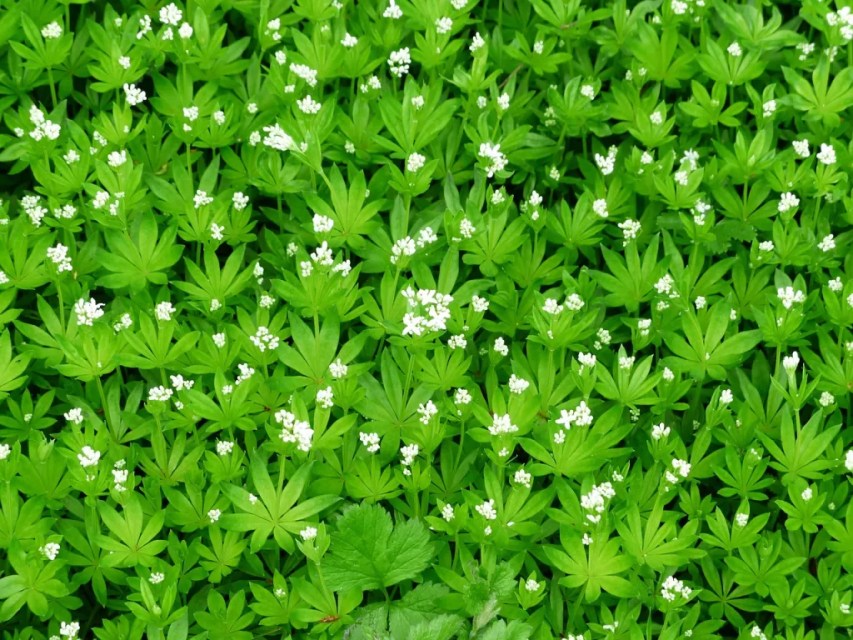
Sweet woodruff (Galium odoratum)
A ground cover that I particularly appreciate for its beautiful whorled leaves. This is a fairly unique form of foliage. In spring, the plant produces small, very fragrant white flowers. It is a good ground cover to install under shrubs in those small lost spaces that the sun does not reach. I am thinking in particular of the interior courtyards of city gardens.
USDA zone 4; H.: 20 cm (8”); L.: 30 cm (12”); Flowering: White and May and June

Creeping Bugle (Ajuga reptans)
We mainly grow cultivars with dark brown or tricolor foliage of this perennial. It is indeed a very good ground cover for bringing color contrasts to the garden. As a ground cover, I recommend the Geneva bugle (Ajuga genevensis) which is significantly more vigorous and more resistant than the creeping bugle. But for a nice pop of color, the cultivars ‘Burgundy Glow’, ‘Variegata’ and ‘Catlin Giant’ are tried-and-true classics.
USDA zone 3-5; H.: 15 cm (6”); L.: 25 cm (10”); Flowering: Mauve, pink or white in June

Spotted Dead-nettle (Lamium maculatum)
Quite comparable to the bugle, dead nettles more often have variegated white or cream foliage. This is the kind of ground cover that I have never managed to cultivate properly in my garden, but which grows wonderfully with gardening friends! I have even observed it under large trees!
_______________________________________________________________________
Read Also : WHAT’S BIOCHAR? HOW TO STABILIZE CARBON IN YOUR SOIL
________________________________________________________________________
USDA zone 3-4; H.: 20 cm (8”); L.: 50 cm (20”); Flowering: Pink, white or purple in May and June

Shade Ground Cover for Dry Soil or at the Base of Large Trees
Whether to combat tree roots or to survive extreme drought, the choice of ground cover is much the same for both situations. These are plants that have better resistance. Also, in the worst conditions, and only if the space is contained, we can turn to very invasive plants, such as the Canadian anemone (Anemonastrum canadense) or gouty weed (Aegopodium podagraria). The great vigor of these garden undesirables is slowed down by the difficult growing conditions. The plant becomes more docile. But I insist: in a contained space only!
The qualities which allow ornamental ground cover plants to spread in shady or dry areas of our garden also make them potential invasive exotic species: aggressive growth and spreading mechanisms, high adaptability to various environmental conditions, and lack of natural predators in non-native areas. They often outcompete native species for resources and can physically suppress other plants with their dense growth.
In some cases, these traits enable ornamental ground covers to dominate and alter ecosystems, reducing biodiversity. Select ground cover plants, and other ornamentals, that are known to be non-invasive in your area. Avoid planting aggressive species near natural areas, waterways, or other vulnerable ecosystems. Use barriers like landscape fabric or edging to contain the spread of ground covers.
Instead, let’s discover other ground cover plants that are less ferocious, but still capable of growing in very dry soil or under trees.
False cutterbar (Lamium galeobdolon, formerly Lamiastrum galeobdolon)
The plant closely resembles spotted dead nettle with good reason, as they are two plants of the same botanical genus. The false deadnettle has slightly larger leaves and its long stems are more vigorous. In summer it bears small, upright clusters of bright yellow flowers. Since its roots are superficial, the plant can cover large areas with great ease.
USDA Zone 3; H.: 25 cm (10”); L.: 60 cm (24”); Flowering: Yellow in June

Japanese Pachysandra (Pachysandra terminalis)
It is a dense ground cover with dark green, evergreen foliage. In summer, the plant produces small white flowers. Its ability to adapt to several growing conditions is astonishing. This is the plant to use for the worst places!
USDA Zone 3; H.: 30 cm (12”); L.: 50 cm (20”); Flowering: White in June

English ivy (Hedera helix)
It is a plant that we see everywhere in Europe. In the north of America, we see it less often, firstly because of its somewhat limited hardiness. Despite everything, in places well sheltered from the wind, ivy works miracles. It forms a dense mat and covers a large area.
________________________________________________________________________
Read Also : 20 Most Beautiful Places On Earth Worth Adding To Your Bucket List
________________________________________________________________________
USDA zone 5; H.: 15 cm (6”); L.: 75 cm (30”); Flowering: Discreet

Lesser periwinkle (Vinca minor)
This is one of my favorite ground covers. Beautiful shiny dark green foliage, large blue flowers in May. When the plant is well established, there is practically no more weeding to do. Little periwinkle produces trailing stems that root at each node (the point where the leaves meet on the stem).
USDA zone 4; H.: 20 cm (6”); L.: 50 cm (24”); Flowering: Mauve blue in May

Each of these ground covers brings a little distinctiveness to the garden. The shape of the leaves, their color and the color of the flowering are criteria that must be taken into consideration when the time comes to choose a ground cover for a shady area.
My best advice for difficult growing locations is to do a test. Planting a ground cover over a large area in one go can be risky. This can be costly if the plant refuses to take hold. This is why I suggest planting 3 specimens of 5 or 6 different species. This allows you to observe the plants and see which ones have survived best. Then you can rob the garden center!
Tags: #CreepingBugle, #fertilizer, #garden, #gardening, #getgreengetgrowing, #gngagritech, #greenstories, #plant, #plants, #soils, #trees