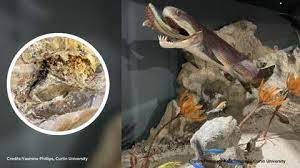

For the longest time, palaeontologists believed that the possibility of finding fossilised organs would be one in a million because of the decaying properties of soft tissues. After digging countless prehistoric creatures, this one 113 million-year-old heart of a fish belonging to the genus Rhacolepis was unearthed back in 2016, making it the first-ever fossilised heart to be discovered.
__________________________________________________________________________________________________________________________________
Read Also: How to Eat a Healthy, Balanced Diet Without Overthinking It
__________________________________________________________________________________________________________________________________
Now, as if the community of ancient fish decided to make another splash in science, the second mineralised heart was recently retrieved from a rock formation in Kimberley, Australia — originally a reef — preserved in rare three dimension without flattening.
This heart is 380 million years old, which makes it the oldest to ever be found! It belongs to the class of armoured jawed fish called Arthrodires or the Gogo fish, but what’s more astonishing is that it was found beside a fossilised stomach, intestine and liver.
The specimens were scanned using neutron beams and synchrotron x-rays, and three-dimensional images of the soft tissues were then constructed without the need to remove them from the surrounding rock matrix.
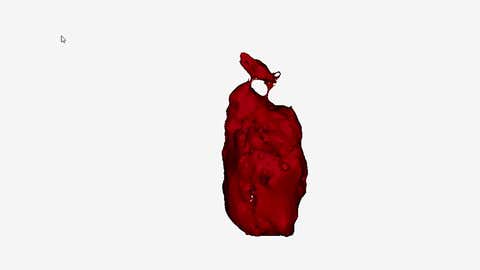
The scans showed that the heart had two chambers, one on top of the other, just like the positioning of chambers found in higher vertebrates. The intestines spiralled like a cinnamon bun, and the stomach was glandular with a layer of muscles, indicating that the fish used digestive juices. Further, the large liver helped the fish to remain buoyant.
________________________________________________________________________________________________________________________
Read Also: High-Protein Diet: Give The Traditional Appe A Healthy Spin With Moong Dal Appe
_________________________________________________________________________________________________________________________
“For the first time, we can see all the organs together in a primitive jawed fish, and we were especially surprised to learn that they were not so different from us,” said study author Professor Kate Trinajstic. “These fish literally have their hearts in their mouths and under their gills, just like sharks today,” she noted.
This finding also provides insights into how the head and neck region must have altered their structure to accommodate jaws, in the process revealing a lot about the formation of human anatomy as well.
While evolution is imagined to be a slow process involving baby steps, this discovery suggests that the leap from jawless to jawed vertebrates was a big one.
____________________________________________________________________________________________________________________________
Read Also: Americans Are Sneaking Healthy Food Into Their Loved Ones’ Diets, According to a New…
____________________________________________________________________________________________________________________________
This find, in addition to previous finds of muscles and embryos, makes the Gogo arthrodires the most fully understood jawed species and clarifies the evolutionary line of all Gnathostomes (jawed vertebrates), including humans.
The research was recently published in Ecological Entomology and can be accessed here.
NOTE – This article was originally published in weather and can be viewed here
Tags: #climate, #environment, #fish, #fossilised, #getgreengetgrowing, #gngagritech, #gogofish, #greenstories, #heart, #nature