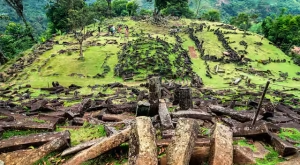
In a new research paper, the researchers made a stunning claim that a layer of the Gunung Padang pyramid in Indonesia was built in 25,000 BC while raising doubts about whether the construction was man-made at all.
With this claim, the oldest pyramid of Egypt – the Djoser Step pyramid – has found itself in a controversial position. The pyramid which is around 2,630 BC has been listed officially in the Guinness World Records.
The research was headed by Danny Hilman Natawidjaja of the Indonesian Institute of Sciences and the paper was published in the journal Archaeological Prospection.
In the paper, the academics stated that “the pyramid’s core consists of meticulously sculpted massive andesite lava” and that the “oldest construction” element of the pyramid “likely originated as a natural lava hill before being sculpted and then architecturally enveloped”.
________________________________________________________________________
Read Also: OCEAN CURRENTS REGULATING CLIMATE GLOBALLY COULD COLLAPSE MID-CENTURY: STUDY
________________________________________________________________________
“This study sheds light on advanced masonry skills dating back to the last glacial period. This finding challenges the conventional belief that human civilisation and the development of advanced construction techniques emerged only … with the advent of agriculture approximately 11,000 years ago,” they wrote.
“Evidence from Gunung Padang and other sites, such as Gobekli Tepe [in Turkey], suggests that advanced construction practices were already present when agriculture had, perhaps, not yet been invented,” the researchers added.
No hallmarks of human activity in 27,000-year-old soil samples of Gunung Padang pyramid: Study
The academics further said that the builders “must have possessed remarkable masonry capabilities”, but one UK archaeologist has rubbished the paper, saying he is “surprised [it] was published as is”.
Speaking to the journal Nature, Cardiff University’s Flint Dibble said that there is no clear evidence which suggests that humans built the buried layers.
________________________________________________________________________
Read Also: PLASTIC WASTE FROM INDIA, SRI LANKA AND INDONESIA IS OVERWHELMING THE ISLANDS OF SEYCHELLES
________________________________________________________________________
Watch: India’s First sunken museum opens at Humayun’s Tomb site
“Material rolling down a hill is going to, on average, orient itself,” Dibble said, adding that no evidence suggests “working or anything to indicate that it’s man-made”.
Meanwhile, Southern Connecticut State University’s archaeologist Bill Farley said that “the 27,000-year-old soil samples from Gunung Padang, although accurately dated, do not carry hallmarks of human activity, such as charcoal or bone fragments”.
Responding to the criticism, Natawidjaja said, “We are really open to researchers around the world who would like to come to Indonesia and do some research programme on Gunung Padang”.
NOTE – This article was originally published in wionews and can be viewed here