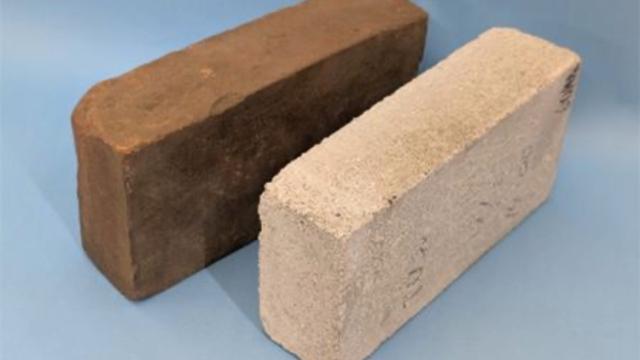
These new concrete blocks are strong enough to build houses and pavements.

Concrete often ends up in landfills after its lifespan. And its production accounts for roughly 8% of worldwide carbon emissions.
Researchers at the University of Tokyo have discovered an innovative way to transform old concrete into something new. Interestingly, these new concrete blocks are strong enough to build houses and pavements.
This innovative approach not only recycles waste but also helps combat climate change by capturing carbon dioxide. And the best part? This process can be repeated, making it a truly circular economy solution.
_______________________________________________________________________
Read Also : How to Eat a Healthy, Balanced Diet Without Overthinking It
________________________________________________________________________
“We are trying to develop systems that can contribute to a circular economy and carbon neutrality,” said professor Ippei Maruyama, who led the material development.
“In Japan, the current demand for construction material is less than in the past, so it is a good time to develop a new type of construction business, while also improving our understanding of this vital material through our research.”
How the new block was made
The process is surprisingly simple. Old concrete is crushed into a fine powder, reacted with atmospheric carbon dioxide, shaped into layers under pressure, and heated to solidify into new concrete blocks.
_______________________________________________________________________
Read Also : Americans Are Sneaking Healthy Food Into Their Loved Ones’ Diets, According to a New…
________________________________________________________________________
For this development, the heat-trapping carbon dioxide was captured from the atmosphere or industrial emissions. Moreover, the demolished concrete from the school building was used for recycling.
As per the press release, the concrete underwent a three-month carbonation procedure. Carbonation is a gradual natural process where concrete components like portlandite and calcium silicate hydrate react with atmospheric carbon dioxide to produce calcium carbonate. The carbonated powder was then crushed using a calcium bicarbonate solution before drying.
This allowed them to build a robust new material called calcium carbonate concrete bricks. Moreover, the procedure increased the strength of the blocks for usage.
“The blocks could theoretically be remade again and again, through the same process,” the press release noted.
“These blocks can theoretically be used semipermanently through repeated crushing and remaking, a process which requires relatively low energy consumption. Now, concrete in old buildings can be thought of as a kind of urban mine for creating new buildings,” said Maruyama.
_______________________________________________________________________
Read Also : High-Protein Diet: Give The Traditional Appe A Healthy Spin With Moong Dal Appe
________________________________________________________________________
Scarcity of limestone
Limestone is a crucial ingredient in concrete. It provides concrete with strength and durability.
Despite its importance, limestone is a finite resource, and countries like Japan have limited reserves. As a result, there’s a growing emphasis on recycling and reusing materials rather than creating new ones.
“As part of the C4S project, we intend to construct a real two-story house by 2030,” said Maruyama.
“Over the next few years, we also plan to move to a pilot plant, where we can improve production efficiency and industrial application, and work on creating much larger building elements, as we move towards making this material commercially available,” Maruyama concluded in the press release.
NOTE – This article was originally published in interestingengineering and can be viewed here
Tags: #carbon, #climate, #climatechange, #CO2, #concretebricks, #environment, #getgreengetgrowing, #gngagritech, #greenstories, #Japan, #recycleswaste, #recycling