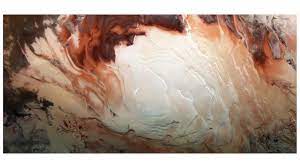
Mars has always evoked curiosity and is the closest planet that human-made machines have ventured to investigate life beyond Earth. While the search for ancient microbial life continues, new research indicates the presence of subsurface ‘lakes’ in the Martian south pole.
________________________________________________________________________
“Buy Organic Products Online at best prices at http://www.getgreen.co.in “.
Based on radar signals, researchers have said that many of these lakes might be in areas too cold for water to remain in liquid state. The study carries forward work from 2018 when signals from a radar instrument reflected off the Red Planet’s south pole appeared to reveal a liquid subsurface lake.
Published in the journal Geophysical Research Letters, the research states that there are multiple areas throughout the south polar region where the energy reflected from the base is unexpectedly higher than that of the surface. “Previous analyses of one such region suggested that these stronger reflections could be caused by the presence of an underground lake,” the paper said.
Led by Aditya R Khuller and Jeffrey J Plaut from the Jet Propulsion Laboratory (JPL), the research was conducted by studying radar signals beamed from the European Space Agency’s Mars Express orbiter flying over the Red Planet. The radar signals were first found in the South Polar Layered Deposits region, which has alternating layers of water ice, frozen carbon dioxide, and dust that has settled there for millions of years.
________________________________________________________________________
Read Also : Climate Change Tracker: Dust is worsening the melting of Himalayan snow
________________________________________________________________________

BEAMING SIGNALS ON THE SURFACE
Scientists beamed radio waves from the orbiter’s Mars Advanced Radar for Subsurface and Ionospheric Sounding (MARSIS) instrument, which maps the subsurface layers by peering through the icy layers, on to the surface. Radio waves lose energy in transmission as they pass through material in subsurface. They have a weaker signal when reflected back to the spacecraft.
However, in some cases, the returning signals were brighter than those from the surface, which was interpreted as to “imply the presence of liquid water, which strongly reflects radio waves”.
The two doctoral researchers studied the data spanning over 15 years taken from the MARSIS instrument onboard the spacecraft that revealed dozens of additional bright reflections over a far greater range of area and depth than ever before.

A view of Mars clicked by China’s Tianwen-1. (Photo: CNSA)
A FROZEN TIME CAPSULE
The radar reflections provide an understanding of the unexplored region and the subsurface layers that have a record of how the tilt in Mars’ axis has shifted over time. The changes could be similar to that seen on Earth when its tilting created ice ages and warmer periods through the course of the planet’s history.
________________________________________________________________________
Read Also : Magnetism of Himalayan rocks reveals the mountains’ complex tectonic history
________________________________________________________________________
“When Mars had a lower axial tilt, snowfall and layers of dust accumulated in the region and eventually formed the thick layered ice sheet found there today,” JPL said in a statement.
The analysis reveals that in some places, the depth was less than a mile from the surface where temperatures are estimated to be minus 63 degrees Celsius.
The researchers also detail the topography of the region that contains clues to the climate history of the Red Planet.
Tags: #climate, #climatechange, #earth, #getgreengetgrowing, #gngagritech, #greenstories, #history, #mars, #marsis, #planet, #redplanet, #water