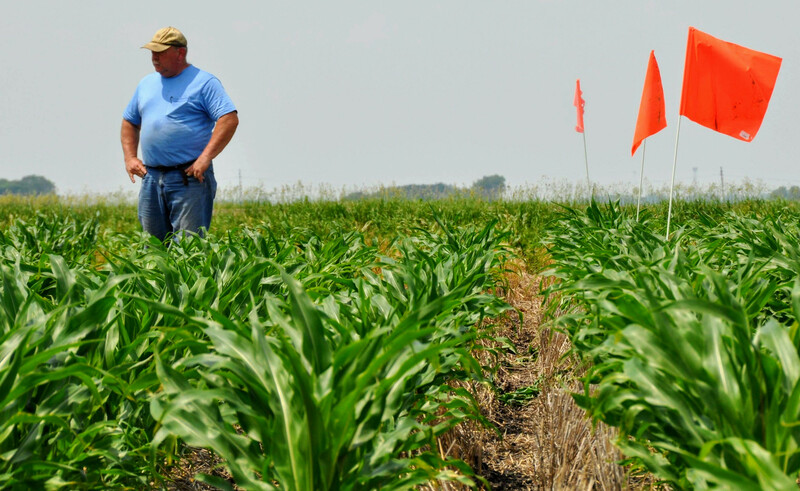
With regenerative agriculture gaining traction, the organic industry is positioning itself as leading the way on carbon sequestration. The research is promising—but inconclusive.

As the climate crisis intensifies, a growing number of consumers have begun to see healthy soils as a potential solution. As a result, soil-building techniques like cover crops and diverse crop rotations are increasingly in the limelight. But for many dyed-in-the-wool organic farmers, they’re old hat.
_______________________________________________________________________
Buy Organic Products Online at best prices at https://www.getgreen.co.in .
________________________________________________________________________
“These are practices that have been part of organic certification for decades now,” said Laura Batcha, CEO of the Organic Trade Association (OTA), during a September media briefing to kick off a campaign positioning organic farming as a climate solution.
And while the farming techniques aren’t new, the framing certainly is. For the last two decades, shoppers have primarily chosen organic foods to avoid pesticides and safeguard the health of their families. The industry has largely traded on those concerns to create today’s $50 billion organic market: The Environmental Working Group’s popular Dirty Dozen shoppers’ guides emphasize the potential dangers of pesticide residue for consumers (without mentioning the crops with the highest environmental impact), and a 2018 OTA ad campaign shared a long list of chemicals banned in organic.
Now, consumers’ concerns are increasingly shifting toward agriculture’s potential impact on climate change. In 2019, Nielsen found 73 percent of global consumers said they would change their habits to reduce their environmental footprint. At the same time, the incoming Biden administration has made climate action a top priority, prompting farm groups from all over the landscape to storm the Hill angling for dollars they anticipate will be available via expanded conservation programs and carbon markets. In addition to OTA, other organic food and agriculture groups—including the National Organic Coalition, the Organic Farming Research Foundation (OFRF), and the Rodale Institute—have all amped up their climate advocacy this year.
“It looks like agriculture as a whole is going to be engaged,” Batcha noted during the briefing. “We’re poised and ready to participate in that conversation.” So far, OTA’s efforts have included a research report, policy priorities, and meetings with more than 30 lawmakers.
And yet, it’s not just organic groups vying for federal money and consumer interest. One recent alliance to advance climate policy in agriculture includes the American Farm Bureau Federation, a longtime fossil fuel industry ally that has actively fought against climate-related regulation.
_______________________________________________________________________
Read Also : What is Organic Farming If Not Sustainable?
________________________________________________________________________
While there is some evidence pointing to organic farming’s climate benefits, there are a wide range of approaches, and some worry that industrial-scale organics haven’t maintained a focus on soil health. Additionally, some of the soil-building practices that science currently shows have the potential to make the biggest difference in the face of the climate crisis are now being used by farmers practicing regenerative agriculture, an approach that has emerged as the farm darling of the climate movement and is often framed as “beyond organic.” The Soil Carbon Initiative, for example, is notably agnostic on the value of organic certification.
So what does the research say on how organic farming reduces greenhouse gas emissions? As usual, it’s complicated.
Organic Farming and Emissions
In early November, a study published in Science found that it would be impossible to meet the Paris Agreement’s global warming goals without major reductions in emissions from food and agriculture. Weeks later, the World Resources Institute released a report that echoed those findings across industries and found that emissions from agricultural production need to drop 39 percent by 2050.
Healthy soil is the foundation on which the U.S. Department of Agriculture (USDA) organic standards were established in 2000. And many proponents claim that organic farmers can attack climate change on multiple fronts, since they undoubtedly reduce greenhouse gas (GHG) related to the use of chemical fertilizers and pesticides like fumigants, which are manufactured using fossil fuels.
Critics argue that those savings are offset by reductions in yields, leading to greater land use. For example, this widely cited study found that a 100 percent shift to organic farming in England and Wales would increase GHG emissions, because more land would need to be cleared for production. But the model assumes that conventional yields would remain steady as the climate changes and soil degrades.
In addition, controlled trials at the Rodale Institute have shown it’s possible to get the same yields in some organic systems over the long term, and it’s possible that more research will help more farmers achieve those yields in the fields of the future. “Conventional yields are high because there have been decades of research and billions of dollars invested,” said Jessica Shade, the director of science programs at the Organic Center. “Organic is a pretty nascent field, and it gets a pretty limited amount of funds. Even with that small amount of funding, we’ve seen dramatic increases in yield.”
Another major source of agricultural emissions from farming is nitrous oxide, a gas with 300 times the warming potential of carbon dioxide. Nitrogen is a primary nutrient in fertilizers, and when farmers apply them to crops, nitrogen that is unused can be released into the air as nitrous oxide. Conventional farmers use synthetic nitrogen fertilizers, while organic farmers use natural sources of nitrogen including compost and manure (and nitrogen-fixing crops like legumes). The question is: Do those natural fertilizers release less nitrous oxide? One meta-analysis that included field measurements from 43 sites in 12 countries found that organic fields released just over half the nitrous oxide that conventional fields did.
_______________________________________________________________________
Read Also : ‘UN Report Says Small-Scale Organic Farming Only Way To Feed The World’
________________________________________________________________________
Shade also pointed to the fact that organic farmers create significantly less new reactive nitrogen—a category of nitrogen that includes nitrous oxide and other harmful forms like nitrate, which pollutes groundwater—compared to conventional farmers. “Organic is recycling things that are already in our environment by taking manure or compost that would otherwise be polluting and applying it” toward a purpose, she added. In other words, manure that loses some nitrous oxide as fertilizer in a field would have emitted the gas elsewhere, and food waste transformed into compost to feed crops would have emitted methane, another potent greenhouse gas, in a landfill.
Still, multiple experts said the nitrous oxide question is not resolved and that different management practices lead to a wide variety of outcomes. “It’s a very tricky greenhouse gas to manage because it tends to come out in big bursts,” said Mark Schonbeck, a researcher who spearheaded a series of reports on organic farming and climate change for OFRF. Schonbeck said that factors like the type and amount of organic fertilizer used and the amount of precipitations have a significant impact on nitrous oxide emissions.
“It’s just a matter of needing more research and more practical advice based on organic systems to help organic farmers know how to manage nitrogen,” he said.
Emissions from organic and conventional livestock operations may be the most difficult to compare. It starts with the debate over whether grass-fed or grain-finished beef is better for climate outcomes. While grass-fed cows produce more methane per unit of milk or meat due to longer lives, some research has that shown careful, managed grazing may sequester enough carbon in soil to offset those emissions. Of course, farms don’t have to be organic to use managed grazing, and not all organic livestock is grass-finished. Organic certification requires that cows are on pasture for 120 days a year, but some producers keep the animals confined, eating grain, for the rest of the year.
The Soil Carbon Question
Overall, when it comes to organic soils’ ability to sequester more carbon, Schonbeck said that the studies available point to promising benefits. “You don’t see these huge night-and-day differences because both conventional and organic agriculture can be done well, or they can be done not so well,” he said. “But there is a pretty consistent trend.”