What keeps ozone layer a trending issue globally!
Have you all ever wondered why ozone layer depletion is such an important issue, but before that, do you all know what exactly ozone layer is?
The ozone layer or ozone shield is a region of Earth’s stratosphere that absorbs most of the Sun’s ultraviolet radiation. It contains a high concentration of ozone in relation to other parts of the atmosphere, although still small in relation to other gases in the stratosphere.

https://images.app.goo.gl/ghB6xDHQscWYVTtk7
The ozone layer is a thin part of the Earth’s atmosphere that absorbs almost all of the sun’s harmful ultraviolet light. “Ozone holes” are popular names for areas of damage to the ozone layer. This is inaccurate. Ozone layer damage is more like a really thin patch than a hole. The stratosphere gets its name because it is stratified, or layered: as elevation increases, the stratosphere gets warmer. The stratosphere increases in warmth with elevation because ozone gases in the upper layers absorb intense ultraviolet radiation from the sun.
________________________________________________________________________
“Buy Organic Products Online at best prices at http://www.getgreen.co.in “.
________________________________________________________________________
Ozone is only a trace gas in the atmosphere—only about 3 molecules for every 10 million molecules of air. But it does a very important job. Like a sponge, the ozone layer absorbs bits of radiation hitting Earth from the sun. Even though we need some of the sun’s radiation to live, too much of it can damage living things. The ozone layer acts as a shield for life on Earth.
In the 1970s, people all over the world started realizing that the ozone layer was getting thinner and that this was a bad thing. Many governments and businesses agreed that some chemicals, like aerosol cans, should be outlawed. There are fewer aerosol cans produced today. The ozone layer has slowly recovered as people, businesses, and governments work to control such pollution.
Experts say any rise in atmospheric ozone levels brings major benefits. Ozone blocks ultraviolet radiation from the sun, which can cause health problems ranging from cataracts and other eye problems to premature skin aging and potentially fatal skin cancers.

https://images.app.goo.gl/47qgLaHB9VSYvh9B8
________________________________________________________________________
Read Also : A science teacher explains: Ozone, the earth’s invisible protective shield
________________________________________________________________
How is Ozone created?
When the sun’s rays split oxygen molecules into single atoms, Ozone is created in the atmosphere. These single atoms combine with nearby oxygen to form a three-oxygen molecule — Ozone.
Why is Ozone Layer important?
Ozone protects the Earth from harmful ultraviolet (UV) rays from the Sun. Without the Ozone layer in the atmosphere, life on Earth would be very difficult. Plants cannot live and grow in heavy ultraviolet radiation, nor can the planktons that serve as food for most of the ocean life. With a weakening of the Ozone Layer shield, humans would be more susceptible to skin cancer, cataracts and impaired immune systems.
What is ‘Ozone Layer depletion’?
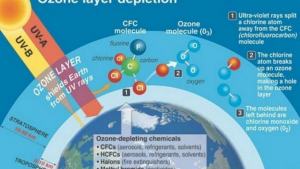
Chemicals containing chlorine and bromine atoms are released in the atmosphere through human activities. These chemicals combine with certain weather conditions to cause reactions in the Ozone Layer, leading to ozone molecules getting destroyed. Depletion of the Ozone Layer occurs globally, but the severe depletion of the Ozone Layer over the Antarctic is often referred to as the ‘Ozone Hole’. Increased depletion has recently started occurring over the Arctic as well.
https://images.app.goo.gl/LaKvxijQeSXUkiuNA
Ozone layer depletion –
The depletion of the ozone layer has harmful effects on the human health, animals, environment and marine life.
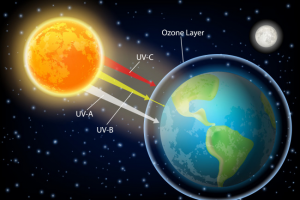
Studies demonstrate that an increase in UV-B rays causes a higher risk of skin cancer, plays a major role in malignant melanoma development, sunburns, quick ageing, eye cataracts, blindness and weekend immune system.
Direct exposure to ultraviolet radiations also leads to skin and eye cancer in animals.
UV-B rays negatively affect plants, crops. It may lead to minimal plant growth, smaller leaf size, flowering and photosynthesis in plants, lower quality crops for humans. And decline in plant productivity would in turn affect soil erosion and the carbon cycle.
Planktons and zooplankton are greatly affected by the exposure to UV-B rays. These are higher in the aquatic food chain. If the planktons decline, it would likely have wide-reaching effects for all marine life in the lower food chain.
https://images.app.goo.gl/wnoEBu2uDhtf9QCN6
Human activities cause ozone depletion and global warming-
Ozone (O3) depletion does not cause global warming, but both of these environmental problems have a common cause: human activities that release pollutants into the atmosphere altering it.
Global warming is caused primarily by putting too much carbon dioxide into the atmosphere when coal, oil, and natural gas are burned to generate electricity or to run our cars.
Carbon dioxide spreads around the planet like a blanket, and is one of the main gases responsible for the absorption of infrared radiation (felt as heat), which comprises the bulk of solar energy.
Ozone depletion occurs when chlorofluorocarbons (CFCs) and halons—gases formerly found in aerosol spray cans and refrigerants—are released into the atmosphere (see details below).
Ozone sits in the upper atmosphere and absorbs ultraviolet radiaton, another type of solar energy that’s harmful to humans, animals and plants. CFCs and halons cause chemical reactions that break down ozone molecules, reducing ozone’s ultraviolet radiation-absorbing capacity.
https://images.app.goo.gl/vutp8bisj38DKv5P6
How ozone works-
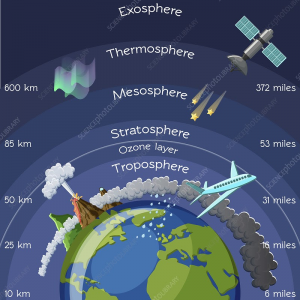
The sun emits electromagnetic radiation at different wavelengths, meaning energy at different intensities. The atmosphere acts like a multi-layer shield that protects Earth from dangerous solar radiation.
Ozone is found in two different parts of our atmosphere. Ground level or “bad” ozone is a human health irritant and component of smog. It is found in the lower atmosphere (troposphere) and has nothing to do with the “ozone hole.”
High level or “good” ozone occurs in the stratosphere and accounts for the vast majority of atmospheric ozone. The stratospheric ozone layer absorbs ultraviolet (UV) radiation, preventing dangerous UV rays from hitting Earth’s surface and harming living organisms. UV rays cannot be seen or felt, but they are very powerful and change the chemical structure of molecules.
UV radiation plays a small role in global warming because its quantity is not enough to cause the excess heat trapped in the atmosphere. UV radiation represents a small percentage of the energy from the sun, and is not highly absorbed or scattered in the atmosphere—especially when compared with other wavelengths, like infrared. But, ozone depletion is also concerning because it directly impacts the health of humans, and other living organisms.
The ozone hole-
The term ‘ozone hole’ refers to the depletion of the protective ozone layer in the upper atmosphere (stratosphere) over Earth’s Polar Regions. People, plants, and animals living under the ozone hole are harmed by the solar radiation now reaching the Earth’s surface—where it causes health problems, from eye damage to skin cancer.
Stratospheric ozone is constantly produced by the action of the sun’s ultraviolet radiation on oxygen molecules (known as photochemical reactions). Although ozone is created primarily at tropical latitudes, large-scale air circulation patterns in the lower stratosphere move ozone toward the poles, where its concentration builds up.
In addition to this global motion, strong winter polar vortices are also important to concentrating ozone at the poles. During the continuously dark polar winter, the air inside the polar vortices becomes extremely cold, a necessary condition for polar stratospheric cloud formation.
Polar stratospheric clouds create the conditions for drastic ozone destruction, providing a surface for chlorine to change into ozone-destroying form. They generally last until the sun comes up in the spring.
Scientists also discovered that the thinning in the ozone layer was caused by increasing concentrations of ozone-depleting chemicals – chlorofluorocarbons or CFCs (compounds with chlorine and/or fluorine attached to carbon) and to a lesser extent halons (similar compounds with bromine or iodine). These chemicals can remain in the atmosphere for decades to over a century
At the poles, CFCs attach to ice particles in clouds. When the sun comes out again in the polar spring, the ice particles melt, releasing the ozone-depleting molecules from the ice particle surfaces.
Once released, these ozone-destroying molecules do their dirty work, breaking apart the molecular bonds in UV radiation-absorbing ozone.
________________________________________________________________________
Read Also : Nature Reclaims Its Glory, Ozone Layer Heals, Amidst Coronavirus Lockdown
________________________________________________________________________
Solutions to Ozone Layer Depletion-
Montreal Protocol was proposed in 1987 to unite the world to cut out production and import of ozone-depleting substances. The Montreal Protocol phases down the consumption and production of the different ozone depleting substances (ODS) in a step-wise manner, with different timetables for developed and developing countries.
Every individual should also take steps to prevent the depletion of the ozone layer. One should avoid using pesticides and shift to natural methods to get rid of pests instead of using chemicals. The vehicles emit a large amount of greenhouse gases that lead to global warming as well as ozone depletion. Therefore, the use of vehicles should be minimized as much as possible. Most of the cleaning products have chemicals that affect the ozone layer. We should substitute that with eco-friendly products. Maintain air conditioners, as their malfunctions cause CFC to escape into the atmosphere.
Tags: #bbnaija, #bbnaijalockdown, #coronavirus, #covid, #erica, #getgreengetgrowing, #gngagritech, #greenstories, #kiddrica, #kiddwaya, #laycon, #nengi, #ozo, #ozon, #ozone, #ozonelayer, #ozonetherapy, #ozono, #paragliding, #sanificazione, #water