Campaigners are taking legal action to stop four palm oil companies from clearing vast tracts of forest for plantations.
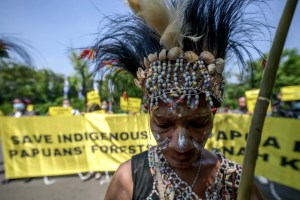
Indigenous activists from the Indonesian province of West Papua have held traditional ceremonies outside the country’s Supreme Court in Jakarta calling for their traditional land and forests to be protected from palm oil plantations.
Representatives of the Awyu and Moi communities held prayers and performed dances in front of the Supreme Court building on Monday as the court was reviewing an appeal in relation to their efforts to revoke permits for four palm oil companies whose proposed plantations threaten their customary forests. Indonesia began legally recognising customary forests in 2016.
“We have taken the long, difficult and expensive path from Tanah Papua [Papua homeland] to end up here in Indonesia’s capital Jakarta, asking the Supreme Court to restore our rights, and the land that was snatched from us when these palm oil companies were issued permits over it,” said Hendrikus “Franky” Woro, an Awyu Indigenous man.
_______________________________________________________________________
Read Also : Traditional Agriculture: An Efficient and Sustainable Farming Method
________________________________________________________________________
Woro filed an environmental and land rights lawsuit in the Papuan capital of Jayapura challenging the plan by a Malaysian-owned palm oil company to clear tens of thousands of hectares of previously untouched West Papuan forest, including traditional Indigenous land.
Environmental campaign group Greenpeace said the potential emissions from clearing the 26,326 hectares (65,053 acres) of primary forest in its concession would amount to about 23 million tonnes of CO2, equivalent to 5 percent of Indonesia’s annual carbon emissions expected in 2030.
The Awyu have also intervened in appeals taken by two other palm oil companies against a decision by the minister of environment and forestry to cancel permits that it had previously issued for them to clear Indigenous lands. The revocation has the potential to save 65,415 hectares (161,644 acres) of pristine rainforest, six times the area of the city of Paris, Greenpeace said.
The Supreme Court is the communities’ last chance to defend their customary forest and generations of ancestral heritage.
“We have been tormented for years by the threat of our traditional forests being replaced by palm oil plantations. We want to raise our children with the help of nature, and the food and materials we harvest from the forest. Palm oil will destroy our forests, we reject it,” said Rikarda Maa, an Awyu Indigenous woman.
The Moi Indigenous community, meanwhile, is fighting to protect thousands of hectares of customary forest that has also been earmarked for palm oil. The company involved had its permits revoked amid community opposition but lower courts later ruled in favour of the planter.
“The judicial panel needs to prioritise aspects of the case that relate to environmental and climate justice, the impact of which will not only be felt by the Awyu and Moi but the entirety of the Indonesian people,” Tigor Hutapea, a member of the legal team from Pusaka Bentala Rakyat, said in a statement.
_______________________________________________________________________
Read Also : Home Advice Vegetables to plant in August: top 10 crops to sow and grow…
________________________________________________________________________
Global Forest Watch, a monitoring platform run by the World Resources Institute, said last month that since 1950, more than 74 million hectares (183 million acres) of Indonesian rainforest — an area twice the size of Germany — had been logged, burned or degraded for the development of palm oil, paper and rubber plantations, nickel mining and other commodities.
Indonesia is the world’s biggest producer of palm oil, and Malaysia number two. Indonesia is also a major exporter of commodities such as coal, rubber and tin.

The Indigenous communities were joined in Jakarta by environmental activists. [Jurnasyanto Sukarno/Greenpeace]

Representatives of the Awyu and Moi hold a traditional dance outside the Supreme Court building. [Jurnasyanto Sukarno/Greenpeace]

The Indigenous representatives also brought soil from their customary land to hand over to the Supreme Court. [Jurnasyanto Sukarno/Greenpeace]

________________________________________________________________________
Read Also : Organic Farming Solve the Climate Crisis
________________________________________________________________________
Hendrikus Woro, who filed one of the cases, holds a letter for the court. Greenpeace estimates that if the plantation is allowed to go ahead and the forest is cleared the CO2 emissions will reach some 23 million tonnes. [Jurnasyanto Sukarno/Greenpeace]

Representatives from the Awyu and Moi in West Papua meet a court official in Jakarta. This is their last chance legal effort to stop the development of plantations on their customary land. [Jurnasyanto Sukarno/Greenpeace]

Indonesia began the legal recognition of customary land in 2016. [Bay Ismoyo/AFP]
NOTE – This article was originally published in aljazeera and can be viewed here