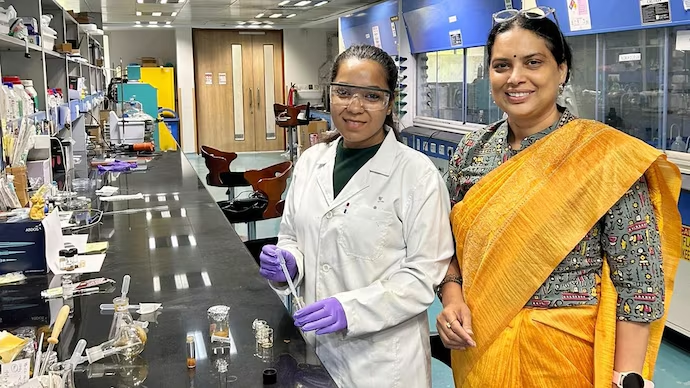
By harnessing elemental sulfur from petroleum refining industries and cardanol extracted from cashew nut industry waste as raw materials, these polymers offer a sustainable alternative.
In Short
- The synthesis of the polymer requires minimal technical complexity
- These polymers belong to the emerging class of vitrimers
- They are characterised by their ability to be reshaped and reused without disposal
In an effort to combat the global plastic pollution crisis, researchers at Shiv Nadar University have pioneered an innovative solution – developing sustainable polymers derived from industrial waste.
Professor Bimlesh Lochab and Dr Sangeeta Sahu from the Department of Chemistry have introduced a novel category of waste-derived polymers with the ambitious aim of achieving carbon neutrality.
_______________________________________________________________________
Read Also : A Soil-Science Revolution Upends Plans to Fight Climate Change
________________________________________________________________________
By harnessing elemental sulfur from petroleum refining industries and cardanol extracted from cashew nut industry waste as raw materials, these polymers offer a sustainable alternative to conventional petrochemical-based plastics.
Remarkably, their synthesis requires minimal technical complexity, making it easier to adopt across various industries.
The team said that these polymers belong to the emerging class of vitrimers, characterised by their ability to be reshaped and reused without disposal, similar to the regenerative properties observed in human skin.
2356581
They showcase the ability to self-heal when exposed to specific temperatures, mimicking temperature-responsive wound healing processes.
Guided by the principles of green chemistry, the research team envisions a myriad of applications for these waste-derived polymers, ranging from flexible coatings to robust adhesives and flame-resistant materials for battery technology.
_______________________________________________________________________
Read Also : Why climate change is still the greatest threat to human health
________________________________________________________________________
The hallmark attributes of the developed cardanol benzoxazine-sulfur polymer—Recycling, Reprocessing, Self-Healing, and Shape Recovery (R2S2)—underscore its versatility and transformative potential across diverse industries.
Notably, its rebondable adhesive properties, impressive load-bearing capacity, and shape recovery highlight the revolutionary impact these polymers could have in addressing sustainability challenges. “The material demonstrates excellent adhesion to metal surfaces, such as aluminium-aluminium, steel-steel, and aluminium-steel hybrid substrates, with remarkable strength,” Dr Bimlesh Lochab said.
Upon application and subsequent use of the respective adhesive, these metal substrates are retrieved undamaged, minimizing waste and enhancing reuse potential.
_______________________________________________________________________
Read Also : CARBON EMISSIONS WILL CHANGE OCEAN SURFACE CLIMATE BY 2100 BY 95 PERCENT: STUDY
________________________________________________________________________
Embracing Innovation for a Sustainable Future
Professor Lochab pointed to the urgency of embracing innovation and reimagining traditional approaches to meet the evolving needs of society. By investing in sustainable solutions and fostering collaboration among academia, industry, and policymakers, we can chart a course towards a more resilient and eco-friendly future.
NOTE – This article was originally published in indiatoday and can be viewed here