The World’s Fastest Shrinking Countries and Territories
See visuals like this from many other data creators on our Voronoi app. Download it for free on iOS or Android and discover incredible data-driven charts from a variety of trusted sources.
Key Takeaways
- Many Eastern European countries (e.g., Moldova, Poland, Hungary) show negative growth, reflecting a widespread demographic trend in the region.
- Larger economies such as Germany, Japan, China, and Italy are also shrinking, signaling that population decline is no longer limited to smaller or developing nations.
Population growth has long been viewed as a sign of prosperity, but the world is beginning to see a new trend: decline.
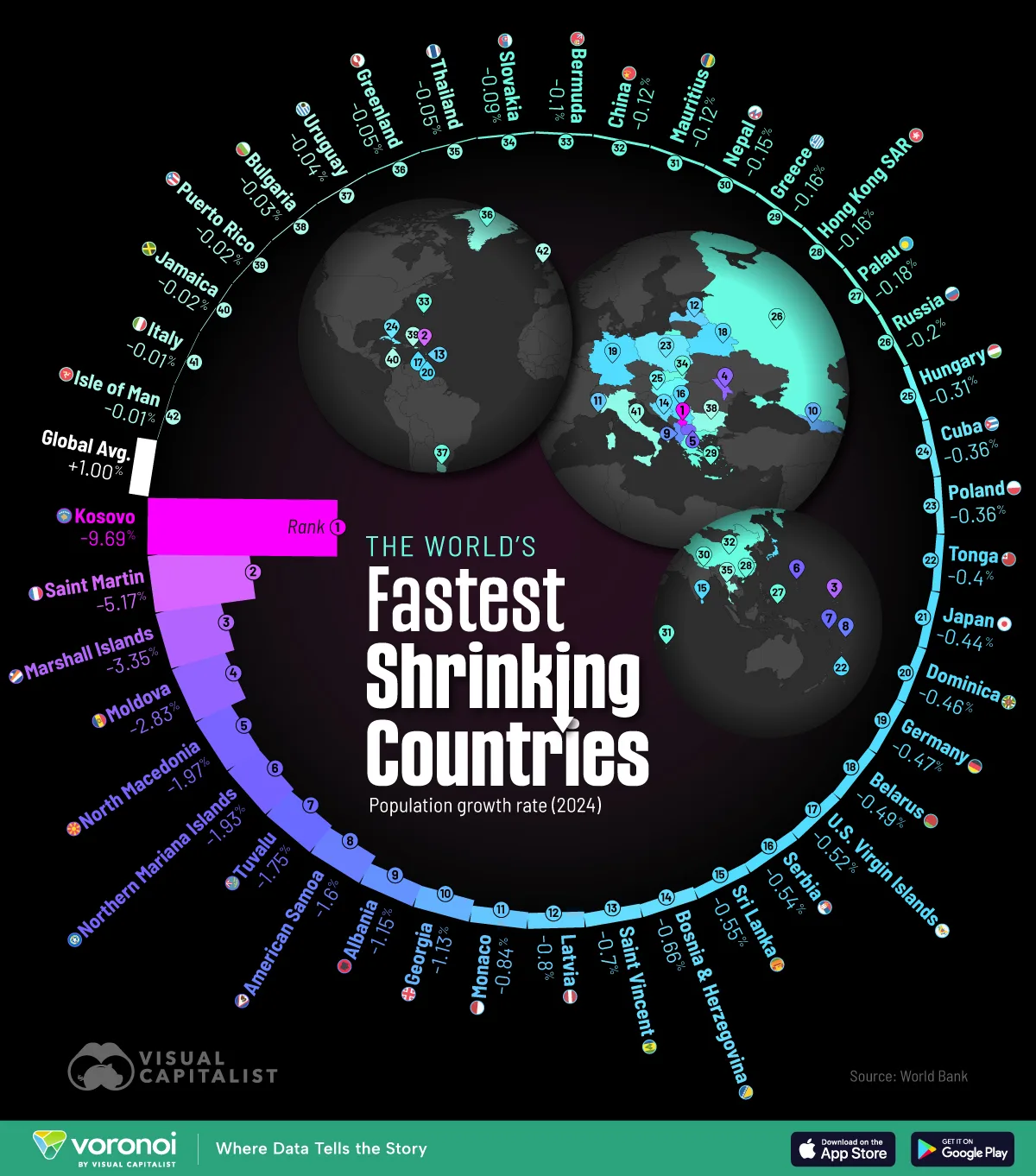
According to World Bank data, 42 countries and territories are now shrinking, with some experiencing quicker declines than others. In this infographic, we highlight where the fastest contractions are happening, as of 2024.
________________________________________________________________________
Read Also : Is population decline good for nature? Japan shows that may not be the case
________________________________________________________________________
Data & Discussion
The data for this visualization comes from the World Bank, measuring each country’s annual population growth rates for 2024. Note that the world’s overall population is still rising at an average rate of 1%.
| Rank | Country Name | Region | Pop Growth Rate 2024 (%) |
|---|---|---|---|
| 1 | 🇽🇰 Kosovo | Europe | -9.69% |
| 2 | 🇲🇫 Saint-Martin | Caribbean | -5.17% |
| 3 | 🇲🇭 Marshall Islands | Pacific/Oceania | -3.35% |
| 4 | 🇲🇩 Moldova | Europe | -2.83% |
| 5 | 🇲🇰 North Macedonia | Europe | -1.97% |
| 6 | 🇲🇵 Northern Mariana Islands | Pacific/Oceania | -1.93% |
| 7 | 🇹🇻 Tuvalu | Pacific/Oceania | -1.75% |
| 8 | 🇦🇸 American Samoa | Pacific/Oceania | -1.60% |
| 9 | 🇦🇱 Albania | Europe | -1.15% |
| 10 | 🇬🇪 Georgia | Europe | -1.13% |
| 11 | 🇲🇨 Monaco | Europe | -0.84% |
| 12 | 🇱🇻 Latvia | Europe | -0.80% |
| 13 | 🇻🇨 Saint Vincent | Caribbean | -0.70% |
| 14 | 🇧🇦 Bosnia & Herzegovina | Europe | -0.66% |
| 15 | 🇱🇰 Sri Lanka | Asia | -0.55% |
| 16 | 🇷🇸 Serbia | Europe | -0.54% |
| 17 | 🇻🇮 Virgin Islands | Caribbean | -0.52% |
| 18 | 🇧🇾 Belarus | Europe | -0.49% |
| 19 | 🇩🇪 Germany | Europe | -0.47% |
| 20 | 🇩🇲 Dominica | Caribbean | -0.46% |
| 21 | 🇯🇵 Japan | Asia | -0.44% |
| 22 | 🇹🇴 Tonga | Pacific/Oceania | -0.40% |
| 23 | 🇨🇺 Cuba | Caribbean | -0.36% |
| 24 | 🇵🇱 Poland | Europe | -0.36% |
| 25 | 🇭🇺 Hungary | Europe | -0.31% |
Eastern Europe Leads in Population Decline
A significant share of shrinking countries are in Eastern Europe, with Kosovo, Moldova, and North Macedonia seeing the steepest drops.
A major reason for this trend is emigration, the act of leaving one’s country to settle in another.
Eastern Europe has experienced high rates of emigration in recent decades due to wage gaps with Western Europe, as well as EU integration (which creates a legal pathway for labor mobility).
________________________________________________________________________
Read Also : Climate change and a population boom could dry up the Great Salt Lake in 5 years
________________________________________________________________________
Major Economies Join the List
Another interesting trend is the inclusion of major economies like Germany, Japan, China, and Italy. While their declines are modest, the sheer size of these countries means the demographic shift could have wide-ranging global effects.
Governments are taking action to lift birth rates, but it’s too early to gauge their effectiveness.
In Japan, for instance, the government has launched a Children and Families Agency, a new administrative body that oversees things like child welfare and nursery access. Meanwhile, in China, the government has rolled out a nationwide subsidy of 3,600 yuan (roughly $500) per year for every child under the age of three.
NOTE – This article was originally published in VISUAL CAPITALIST and can be viewed here