Photo Source: ETEnergyworld.com
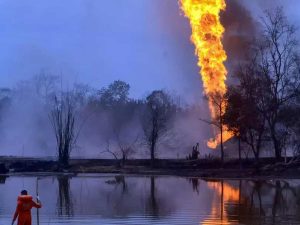
On the 27th of May this year, a small village named Baghijan in Assam experienced a catastrophic environmental disaster when an uncontrolled oil and gas spill occurred due to failing oil pressure systems in an oil well run by the state-owned Oil Indian Limited.(REFINERY FIRE)
Soon this leakage turned into a violent blowout in well number five of the refinery, endangering the livelihoods of people living nearby.
It took almost a hundred and ten days to completely douse the fire. But it had several environmental repercussions and is still hampering the environment, several months after the incident.
The initial blowout not only forced more than 2500 people to evacuate from the neighboring area and move to relief camps, but it also destroyed local tea gardens and water bodies in Assam, leading to widespread protests by the residents and environmentalists all over the country.
________________________________________________________________________
“Buy Organic Products Online at best prices at http://www.getgreen.co.in “.
________________________________________________________________________
What is Happening Now?
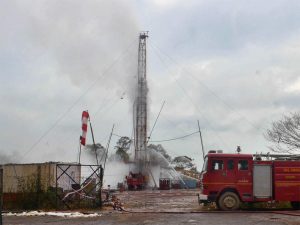
Photo Source: Economic Times
Even though it has been months since the fire has doused and the gas and oil leak contained, this incident is still affecting the environment. According to a report by the Wildlife Institue of India (WII), the toxins released due to the oil spill will have a long term persistence in soils and sediments which will not only affect current life conditions but pose serious health and environmental risks due to sustained release over a long period.
________________________________________________________________________
Also Read : Hope for a Healthy World Rests on Re-establishing the Harmony in the Soil
________________________________________________________________________
Another matter of concern is the proximity of this refinery to the Dibru Saikhowa National Park and the Maguri-Motapung Beel wetlands.
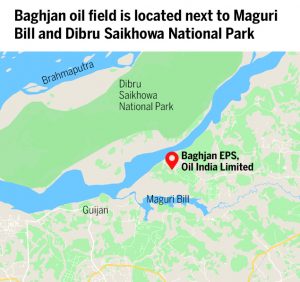
Photo Source: The Times of India
Magura Motapung is a wetland that serves as a crucial habitat to numerous species, notably resident and migratory birds, a fisheries resource, a flood buffer, and a sediment regime regulator. Thus, this makes Maguri Motapung a critical part of the Dibru-Saikhowa Biosphere Reserve, which is acts as an ecological corridor to Namdhapa National Park and sustains the ecological integrity of the Indo Burma Biodiversity Hotspot.
Today, after more than six months after this incident occurred, the fire is doused, but the environment as well the people are still suffering from its repercussions. An expert panel of the National Green Tribunal has fixed compensations of Rs. 25 lakhs to severely affected families and Rs. 20 lakhs to families less affected. But money cannot fix everything.
This blowout also poses a threat to the health of the locals. Some research suggests that prolonged exposure to toxic constituents of natural gas can lead to a host of long-term diseases such as cardiovascular, respiratory, as well as neurological effects in humans. At a time when the whole world is struggling with the Corona Virus, jeopardizing one’s respiratory increases the damage caused by this virus.
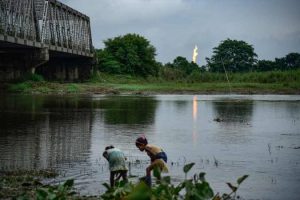
Photo Source: Outlook India
Further, this blowout has not only displaced many people, but it has also affected their livelihoods. Most of the people living in nearby areas are farmers. The oil spill has polluted the soil making it unsuitable for farming. Soon after the blowout, droplets of condensate that contain highly toxic and carcinogenic chemicals settled on tea gardens, grasslands, and water bodies nearby. Many also had to abandon their cattle.
________________________________________________________________________
Read Also : Breathing Highways and Sponge Cities
________________________________________________________________________
The State-owned Oil India Limited (OIL) that owns the oil-well where the fire broke out continues to deny any long-term impact from the spill. They claim that due to the nature of the gas and the condensate, it is easily evaporated and washed away by the rains.
But research carried out by several organizations suggest otherwise. According to an expert committee set up by the Assam State Government to assess the disaster, some trees and grasslands might look okay right now, but no one knows the kind of psychological impacts they have withstood. Further, the people displaced and livelihood lost will have a long-term effect on the overall economy of the state as well as the nation. It is high time that the ones responsible for such incidents are brought to justice, and better guidelines and penalty implemented introduced to prevents such incidents in the future.
Tags: #AirPollution, #climatechange, #ecofriendly, #environment, #getgreengetgrowinng, #globalwarming, #gngagritech, #greenstories, #nature, #plastic, #plasticfree, #plasticpollution, #pollution#, #savetheplanet, #sustainability, #zerowaste