CHENNAI: In a major breakthrough, researchers at the Indian Institute of Technology, Madras (IIT Madras) have developed a packaging material from agricultural waste, presenting a sustainable alternative to traditional plastic foams used in packaging.
The technology will provide a solution to dispose of agricultural residues from open burning and a compostable packaging option. The research was funded by the central government and the New Faculty Initiation Grant of IIT Madras.
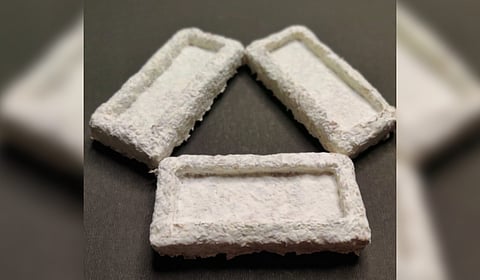
Researchers have demonstrated that mycelium-based biocomposites, grown on agricultural and paper waste, provide high-quality packaging that is also biodegradable. This innovation has the potential to significantly impact both society and the environment by addressing two major issues: plastic pollution and the disposal of agricultural waste.
________________________________________________________________________
The researchers cultivated fungi such as Ganoderma lucidum and Pleurotusostreatus, which are different types of mushrooms, on agricultural and paper wastes. They investigated optimal combinations of fungal strains and substrates to produce composites with mechanical properties and tune in the features of conventional plastic foams.
By converting agricultural residues into high-strength biodegradable packaging materials, this research contributes to reducing plastic waste generated in India, which currently exceeds 4 million tonnes annually, while also utilizing the 350 million tonnes of agricultural waste produced each year.
The researchers have established a start-up called NatureWrks Technologies, co-founded by Lead Researcher Dr.Lakshminath Kundanati, a faculty member at IIT Madras.
This start-up focuses on developing and commercializing innovative products, pursuing technology transfer in collaboration with industry partners, and exploring licensing agreements to facilitate broader adoption of these solutions. Additionally, the researchers aim to secure government funding to accelerate development and ensure that this research has a tangible, positive impact on society.
The findings were published in June 2025 in the reputed, peer-reviewed journal Bioresource Technology Reports.
The research paper was co-authored by research scholars Ms. Sandra Rose Biby and Mr. Vivek Surendran, and Dr.Lakshminath Kundanati from IIT Madras.
Elaborating on the significance of this Research, Dr.Lakshminath Kundanati, Assistant Professor, Department of Applied Mechanics and Biomedical Engineering, IIT Madras, said, “In India, over 350 million tons of agricultural waste are generated annually, much of which is burned or left to decay, causing air pollution and wasting valuable resources. Our Research aimed to address both challenges—plastic pollution and agricultural waste—by developing mycelium-based biocomposites as sustainable, biodegradable packaging materials.”
Ultimately, the research targets reducing the ecological footprint of packaging industries and promoting sustainable alternatives that can contribute to a cleaner, healthier planet.
________________________________________________________________________
“This approach not only diverts agricultural residues from open burning but also creates fully compostable packaging solutions, aligning with circular economy principles,” said Smruti Bhat, a researcher.
Experts say replacing plastic foams like EPS and EPE (Expanded polystyrene) with mycelium-based biocomposites can significantly reduce landfill burden, prevent microplastic formation, and cut greenhouse gas emissions associated with plastic production and waste incineration. The technology also promotes rural development by creating demand for agricultural by-products, potentially generating new income streams for farmers and rural communities. The use of local, low-cost substrates aligns well with India’s circular economy.
NOTE – This article was originally published in New Indian Express and can be viewed here