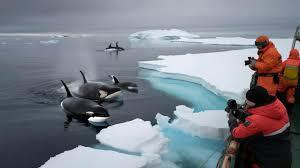

On a gray Antarctic morning, the sea looked oddly still. No wind, no birds, just the slow creak and groan of ice shifting on itself. A group of researchers stood on the deck of a small vessel, squinting at a long, milky sheet of sea ice that, a decade ago, would have been thick enough to land a helicopter on. Now it flexed like thin glass under the faint swell.
Then the orcas arrived.
Black fins sliced through the water just a few meters from the edge, their bodies slipping under slabs of ice that trembled as though hollow. A scientist raised their camera, then froze. The whales were *too* close. Too close to a surface that could crumble in seconds. And that’s exactly what they were there to warn us about.
Orcas at the edge of a breaking world
From the air, the scene looks almost abstract: black shapes moving through a patchwork of white, channels of dark water snaking through fractured floes. Up close, it feels very different. You can hear the ice crack, hear the orcas blow, hear the unease in the researchers’ voices as they watch these apex predators cruise the margins of ice that didn’t use to be margins at all.
This isn’t just wildlife footage with dramatic music. It’s a live broadcast from a planet that’s running out of ice in slow motion.
On one recent expedition off the Antarctic Peninsula, marine biologists logged a string of encounters that made even seasoned polar scientists go quiet. Pods of orcas were pushing far into zones that used to be locked tight with multi-year sea ice until late in the season. Some were seen surfacing through slushy, collapsing floes, their backs scraping ice so thin it bent around them like wet cardboard.
Satellite records show that Antarctic sea ice hit record lows in 2023 and stayed unnervingly low in 2024. Those melt lines create new open water corridors, and orcas are following them like highways carving into a melting city.
For the researchers watching, the concern isn’t just “orcas are adapting.” It’s what their behavior says about everything else. Orcas are opportunists: they go where the hunting is good and the access is easy. When they’re suddenly turning up near zones of unstable, breaking ice, it means the old frozen barriers are gone or going fast.
The whales are like moving sensors, tracing the outline of a shrinking ice map. **Where they can swim today, ice failed yesterday.** And that means the ecosystems that depended on those solid platforms are already being rearranged, whether we’re watching or not.
What scientists actually do when the ice won’t hold
On the water, adaptation isn’t a press release, it’s a scramble. Researchers who used to step off the boat, drill a core, and set up camp on firm sea ice now find themselves testing every move. Some expeditions deploy small drones first, sending them over suspiciously gray stretches to spot cracks and slush holes. Others lower weighted ropes through boreholes to measure thickness before a single boot touches down.
When the orcas surface near a weak edge, the team sometimes backs off, quite literally. If the whales can nose through, the ice might not tolerate a group of humans stomping around.
There’s also a quiet shift in how data is gathered. More teams rely on instruments anchored to the seafloor or drifting buoys that can relay information for months without anyone needing to set foot on ice. It sounds clever until you remember why. That thick, stable winter platform that made polar research possible for decades is fragmenting. The “field” is literally falling apart under people’s feet.
We’ve all been there, that moment when a familiar place suddenly feels unsafe, like a childhood pier with rotting boards. That’s the vibe a lot of scientists now describe when they talk about their study sites.
And yet, there’s a trap in how we picture all this. It’s easy to imagine a clean shift: orcas move in, scientists move to boats and satellites, nature simply remixes itself. Reality is messier. When ice breaks earlier, seal pups lose hiding spots. When floes thin, algae living in the underside of the ice get less time and space to bloom, which affects krill, which ripples up to fish, penguins, whales.
Let’s be honest: nobody really understands every domino that falls when a single ice shelf weakens, never mind a whole coastline. **What they do see, day after day, is a pattern that’s no longer random.** Thinner ice. Earlier melt. More open water. And orcas gliding into the gaps like punctuation marks at the end of an urgent sentence.
How orcas are rewriting the rules under the ice
When orcas push into collapsing-ice zones, they don’t just pass through; they change the script. Some Antarctic orcas use a hunting trick called wave-washing: they line up, charge in unison, and throw a coordinated wave at a floe to knock seals into the water. On sturdy ice, the floe shudders but holds. On slushier, thinning ice, that same move can shatter the platform entirely.
Researchers watching this up close adjust their notes: hunting tactic, same. Environmental impact, suddenly bigger.
One team in the Weddell Sea filmed a moment that still nags at them. A small seal had hauled out on what looked, from a distance, like a safe patch. As orcas circled, the floe didn’t behave like the solid tables they’d seen in old documentaries. It flexed, cracked in three, and partly flipped, even before the full force of the wave hit. The seal escaped that day, slipping through a gap and vanishing under the broken pieces.
The scientists replayed the footage later and noticed something else: the ice around the scene was riddled with melt ponds and hairline fractures, a sign that the structure had been weakening for weeks.
*Orcas weren’t just responding to that weakness, they were exploiting it.* They’re quick learners. Where ice is fragile, less force is needed, and smaller floes can be used as temporary platforms or traps. That means places that used to be safe haul-out zones for seals are now riskier, especially for young or inexperienced animals.
“From a distance, it looks like a stunning wildlife moment,” one marine ecologist told me. “Up close, you’re watching a top predator test the limits of ice that shouldn’t be this thin, this early. The whales are adapting. The ice is losing.”
- Orcas are extending their hunting range into newly opened water corridors.
- Collapsing ice changes the balance between hunter and prey in real time.
- Shifts in orca behavior can hint at deeper changes in sea-ice stability.
- Each close encounter near crumbling ice is a data point, not an isolated drama.
- For readers, this is a window into how climate change looks and feels in motion.
________________________________________________________________________
A warning sign you can’t unsee
Once you’ve watched orcas surfacing beside ice that looks tired, you stop thinking of climate change as an abstract curve on a chart. It becomes the tilt of a floe, the sharp breath on deck when a crack races out under someone’s boots, the way a whale’s dorsal fin appears where, not so long ago, there was nothing but white. **The alarm researchers are sounding isn’t theatrical. It’s practical.**
If the ice that shaped these ecosystems is failing, everything built on top of it has to renegotiate its place, from krill to whales to people planning coastal futures thousands of kilometers away.
There’s no neat ending to this story yet. Some years, a cold season lingers and the ice seems to recover a little, and the old-timers allow themselves a cautious smile. Other years strip that hope away in a few brutal weeks, with records broken so often the word “record” starts to feel cheap.
What keeps many of these scientists going isn’t certainty, but witness. They log every encounter, every strange approach by a curious orca, every crack that forms earlier than their notebooks say it should. They know these details can guide policy, shipping routes, fishing limits, even the stories we tell our kids about what polar seas are like.
So the next time a clip of orcas lunging at the edge of a collapsing floe pops up in your feed, you’ll know there’s more there than a dramatic thumbnail. Behind that three-second moment is a long line of measurements, headaches, icy fingers, and quiet recalculations. There’s a sense that we are living through the last decades of a certain kind of polar world, and that these whales are, unintentionally, drawing our eyes exactly where the change cuts deepest.
What we do with that attention is the part of the story that isn’t written yet.
| Key point | Detail | Value for the reader |
|---|---|---|
| Orca behavior tracks ice loss | Whales are moving into zones that used to be locked in thick sea ice | Helps you see wildlife as a living indicator of climate shifts |
| Collapsing ice reshapes hunting | Fragile floes make some seal haul-out spots far more dangerous | Reveals how quickly food webs can be rewritten |
| Field science is being forced to adapt | More drones, buoys, and remote sensors as sea ice becomes unstable | Shows how research, safety, and policy are changing in real time |
FAQ:
- Question 1Are orcas in danger because they’re getting close to collapsing ice?Right now, orcas are mostly benefiting from the new access, not being harmed by it. The real risk is to the species they hunt and the larger balance of the ecosystem they depend on.
- Question 2Does orca behavior actually prove that climate change is speeding up?On its own, no. Combined with satellite data, temperature trends, and sea-ice records, shifting orca patterns support the broader evidence that polar change is accelerating.
- Question 3Why are scientists so worried about sea ice, not just glaciers?Sea ice is seasonal habitat and a key platform for algae, krill, seals, penguins, and research work. When it thins or vanishes early, an entire seasonal “stage” disappears.
- Question 4Are orcas learning new hunting techniques because of weaker ice?They’re mainly tweaking existing tactics, like wave-washing, to fit softer, more fractured ice. Those small changes can have big consequences for prey survival.
- Question 5What can someone far from the poles do about this?You can’t fix sea ice directly, but you can push for emissions cuts, support science funding, and pay attention to how often these “unusual” polar stories now appear. They’re early signals of shifts that won’t stay polar forever.
NOTE – This article was originally published in Bottle Bureau and can be viewed here