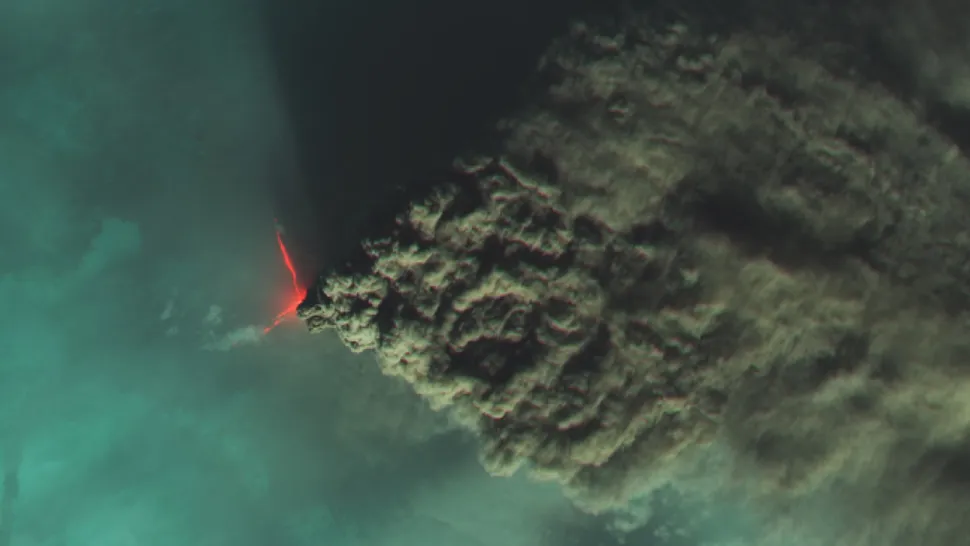
A false-color satellite photo from 2023 shows a devilish pair of lava flows and an enormous plume of smoke spewing from Klyuchevskoy, the tallest volcano in Europe and Asia.

This eerie satellite photo shows a “devilish” Russian volcano spewing out a 1,000-mile-long river of smoke into Earth’s atmosphere. It is a striking reminder of the volcanic power trapped within the Pacific “Ring of Fire.”
________________________________________________________________________________
Read Also: 10 signs one should look around to ascertain the impacts of Climate Change
________________________________________________________________________________
The volcano, known as Klyuchevskoy (or sometimes Klyuchevskaya Sopka), is an active stratovolcano in Russia’s Kamchatka Peninsula, which is home to more than 300 volcanoes. Klyuchevskoy’s peak stands at 15,597 feet (4,754 meters) above sea level, making it taller than any other volcano in Asia or Europe, according to the Smithsonian Institution’s Global Volcanism Program.
The satellite image was snapped by NASA‘s Aqua satellite during a particularly active point of an eruptive phase, which lasted between June 22 and Dec. 31, 2023. The sudden flurry of activity released twin lava flows, shaped like a pair of horns, and a giant plume of smoke, ash and toxic gases that temporarily halted air traffic in the area.
The eruption plume reached a maximum height of 7.5 miles (12 km) above Earth’s surface and stretched more than 1,000 miles (1,600 kilometers) across the Pacific Ocean, according to NASA’s Earth Observatory.
________________________________________________________________________________
Read Also: Three key habitat-building corals face worrying future due to climate crisis
________________________________________________________________________________
The satellite snap featured above is a false color image. The lava flows have been enhanced using infrared radiation to help make them visible, while the clouds surrounding the volcano have been given a blueish hue to help distinguish them from the eruption plume.

Klyuchevskoy is one of the most active volcanoes in the Kamchatka Peninsula. It has experienced at least 18 different eruptive phases since the turn of the 21st century and blown its top more than 60 times in the past 100 years, according to the Global Volcanism Program.
The lofty mountain’s most recent eruptive phase began in April 2025 and is still ongoing, although volcanic activity had diminished by May.
Klyuchevskoy is closely flanked by Bezymianny, a smaller volcano standing at around 9,900 feet (3,000 m) tall. The nearby mountain is less active than Klyuchevskoy and was previously assumed to be extinct until an eruption in 1955. It has since erupted multiple times.
________________________________________________________________________________
Read Also: World’s “Most Important” Organisms Are On The Move. Reason: Climate Change
________________________________________________________________________________
Four other volcanoes — Ushkovsky, Tolbachik, Zimina and Udina — are located within a 20-mile (32 km) radius of Klyuchevskoy. All of these mountains, including Klyuchevskoy and Bezymianny, are believed to have formed within the last 10,000 years, which is relatively young for volcanoes.
The Kamchatka Peninsula is a hotspot for volcanoes due to its position along the Ring of Fire — a roughly 25,000-mile-long (40,000 km) arc encircling large parts of the Pacific Ocean basin, where tectonic plates intersect one another. This giant ring, which also runs beneath Indonesia, Japan and Tonga, contains around two-thirds of the world’s terrestrial volcanoes and is the site of around 90% of all earthquakes.
NOTE – This article was originally published in livescience and can be viewed here