A 183-million-year-old fossil with preserved skin and scales is rewriting everything we thought we knew about how ancient sea monsters looked, moved, and evolved.
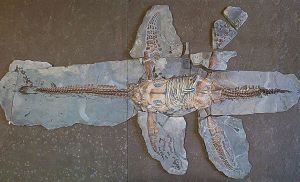
The ancient seabeds of modern-day Germany have yielded a rare discovery that is reshaping scientific views on how marine reptiles once moved, looked, and evolved. As detailed in anew study published in Current Biology, an extraordinarily preserved specimen of Plesiopterys wildi, discovered in Holzmaden, offers a glimpse into the rarely seen soft-tissue anatomy of plesiosaurs. The fossil, cataloged as MH 7, includes patches of skin, scale, and even keratin, delivering what paleontologists are calling a game-changing perspective on the biomechanics and evolutionary development of these long-necked predators.
____________________________________________________________________________
Read Also : List Of 50 Extinct Animals On Planet Earth
___________________________________________________________________________
A Fossil Frozen In Time: How MH 7 Defied 183 Million Years Of Decay
Found in 1940 but only prepared in 2020, the specimen MH 7 had remained a sleeper discovery—its surrounding limestone obscuring what lay beneath. Once technicians at a German collection removed the matrix, they found preserved skin on the tail and flipper—a discovery almost unheard of for Jurassic reptiles. Microscopic analysis revealed two types of keratin: beta-keratin along the scaly flipper, and alpha-keratin on the smoother tail skin, indicating functional differences across the body surface. The flipper scales were tiny and triangular, suggesting a reinforced structure for precise aquatic propulsion.
Lead author Miguel Marx from Lund University highlighted its significance:
“The Holzmaden specimen gives us an unprecedented look at Plesiopterys wildi in a more mature stage of development, allowing us to refine our understanding of this species and its place in plesiosaur evolution.”
This detailed preservation was made possible by the fossil’s entombment in the Posidonia Shale, a low-oxygen seabed that slows decomposition and occasionally fossilizes soft tissue. For plesiosaurs, which are mostly known from skeletal remains, this fossil is a rare exception to the rule.
______________________________________________________________________________
Read Also : Climate Change and how can YOU fix it
____________________________________________________________________________

What The Skin Reveals: Camouflage, Hydrodynamics, And Evolution
The tail’s skin showed a smooth, layered surface filled with melanosomes—pigment granules that hint at potential mottled coloring. This contradicts the long-standing assumption that marine reptiles like plesiosaurs were monochrome and pale. Instead, this reptile may have had visual camouflage or social signaling traits akin to modern aquatic animals.
The flippers’ structure goes beyond passive locomotion. Lined with scales and keratin, they appear built for thrust and nuanced steering—comparable to the forelimbs of modern sea turtles. The variation in skin type across the body aligns with biomechanical specialization, combining agility with endurance.
As Marx and his colleagues observed:
“It also suggests that distinct plesiosaur communities may have evolved in different regions of the European seas during the Early Jurassic.”
______________________________________________________________________________
Read Also : Meganeura : The largest insect ever existed was a giant dragonfly
______________________________________________________________________________
This is more than biological trivia—it implies parallel evolution among geographically isolated groups, adapting their bodies and behaviors to slightly different marine environments.
The Plesiosaur’s Secret Weapon: A Tail That Steered And Accelerated
Fossilized evidence of a fleshy tail fin—extremely rare among plesiosaurs—adds yet another dimension. This structure, broad and flexible, likely acted as a rudder or an auxiliary propulsor, helping the animal make sharp turns or achieve bursts of speed. Combined with the four signature flippers and a long, snake-like neck, Plesiopterys may have been far more maneuverable than its reputation suggests.
These insights cast light on a new niche strategy: not to outswim predatory ichthyosaurs or ancient crocodilians, but to outmaneuver them. Agile turning, subtle control, and silent gliding would have given Plesiopterys wildi an edge in hunting and evasion.
NOTE – This article was originally published in indiandefencereview and can be viewed here