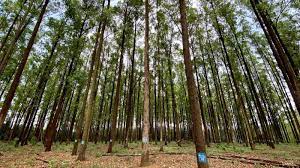
JAKARTA — A vast tree plantation run by Japanese trading house Marubeni in the mountains of southern Sumatra has grown beyond its main purpose of pulp production to become a testing ground for efforts to reduce and capture carbon emissions.
Roughly 287,000 hectares — bigger than the size of Tokyo — of red mahogany trees extend as far as the eye can see from the top of one of the area’s 40-odd fire lookout towers.
Marubeni manages the forest, located a three-and-a-half-hour drive from Palembang, under a concession from the Indonesian government taken over from a local company.
____________________________________________________________________________
Read Also: How Hydroponics May Be Essential for Urban Agriculture
_____________________________________________________________________________
Red mahogany trees reach maturity in about six years, growing as tall as 25 meters. Marubeni plants about 20,000 hectares a year. Mature trees are felled and delivered to a nearby pulp mill run by the trading house. The company has been taking steps to boost productivity, such as introducing fast-growing, disease-resistant cloned trees in 2021.
Workers manage the forest for the pulp business, while at the same time sowing the seeds of new carbon-cutting projects. While demand for pulp and paper products is solid now, the industry is vulnerable to swings in the market, and Marubeni seeks other ventures to complement it.
One is emissions trading. The Indonesian government is setting up a trading scheme as part of its push to achieve net-zero greenhouse gas emissions by 2060. Marubeni, anticipating widespread adoption, has set aside part of the plantation for environmental purposes, essentially selling the trees’ function as a carbon sink instead of their timber.
______________________________________________________________________________
Read Also: How Hydroponics May Be Essential for Urban Agriculture
______________________________________________________________________________
Reuters reported in August that Indonesian regulators have released rules on establishing a carbon exchange — which will enable cross-border trading — with an eye toward a launch by the end of this year.
Indonesia is home to one of the world’s largest areas of tropical rainforest. But managed forests are believed to be more effective at absorbing carbon dioxide. Forests need to be thinned to let in more light to be internationally recognized as carbon sinks.
Marubeni also plans to develop biomass fuels and materials that emit less carbon dioxide when burned. Although all of the trees harvested in the Sumatra forest now go to the paper mill, the trading house expects to have a surplus supply as early as 2028 that could be used for biomass.
Projects under consideration include biochar that can sequester carbon dioxide long-term and biomass feedstocks for chemical products.
____________________________________________________________________________
Read Also: How Hydroponics May Be Essential for Urban Agriculture
____________________________________________________________________________
Carbon capture, utilization and storage technology shows promise as well. Marubeni signed a memorandum of understanding with state-run Indonesian energy company Pertamina in February 2022 to partner on decarbonization projects in the country. The two companies are exploring capturing carbon emissions from biomass burned during pulp production.
Demand for pulp made from cultivated trees is still going strong, as population growth in emerging markets creates more of a need for necessities like tissues and toilet paper. Demand is expected to grow 2% to 3% annually through 2026, according to RISI, a U.S.-based commodities information provider.
But the global shift toward paperless work is putting pressure on production. The market is also swayed by economic trends in China, which accounts for 40% of global demand.
Marubeni sees establishing decarbonization businesses as an urgent need to keep its forest products business stable.
The forest gets abundant sunlight, being near the equator, and a Marubeni executive noted that the area’s 2,000 milliliters to 2,500 ml of annual rainfall make for “ideal conditions for industrial forestry.”
Marubeni is looking to deploy the forestry know-how it gleans from Indonesia in other countries as well. The company in February signed a memorandum of understanding on a carbon credit and reforestation program in the Philippines with the Department of Environment and Natural Resources and other partners. It transferred personnel to the country from Sumatra this month.
A challenge of managing forests on the scale of the one in Sumatra is dealing with encroachment by local populations. Marubeni aims to coexist with the local community through by offering schooling and job opportunities.
NOTE – This article was originally published in asia.nikkei and can be viewed here
Tags: #biomass, #carbon, #carbondioxide, #climate, #climatechange, #environment, #getgreengetgrowing, #gngagritech, #greenstories, #jakarta, #Japans, #nature, #net-zero, #solid, #tree