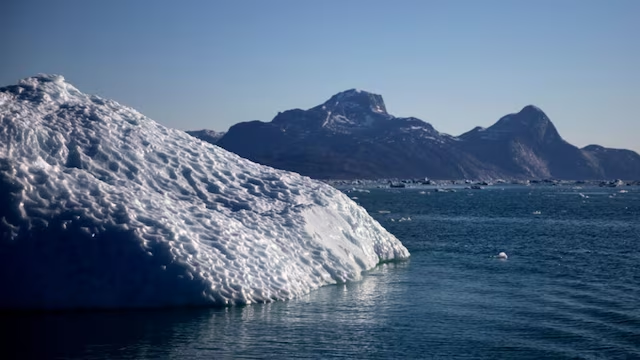
In a new study, researchers from the University of Oxford revealed that this unusual phenomenon was caused by a massive glacier-driven landslide in eastern Greenland
A baffling seismic event that puzzled scientists across the globe in 2023 has finally been explained, nearly two years later. For nine consecutive days, sensitive instruments recorded rhythmic vibrations in the Earth, occurring like clockwork every 90 seconds. The tremors mimicked the pulse of an earthquake, but with no apparent epicentre, no volcanic activity, and no visible natural disturbance. It was just a scientific enigma until now.
________________________________________________________________________
Read Also : Research reveals 45,000 marine species are at risk due to climate change, pollution
________________________________________________________________________
In a new study published in Nature Communications, researchers from the University of Oxford revealed that this unusual phenomenon was caused by a massive glacier-driven landslide in eastern Greenland, which unleashed a towering tsunami with waves reaching up to 650 feet.
The strange seismic signals, first noticed in mid-2023, spread across monitoring stations worldwide. The vibrations bore the signature of tremors but came without any precursor events typically linked to such activity – no tectonic shifts, volcanic eruptions, or asteroid impacts.
Even satellite systems failed to detect anything out of the ordinary at the time. With no immediate clues, the mystery was shelved, until advanced satellite data and retrospective analysis offered the breakthrough.
According to the Oxford study, the culprit was a sudden, catastrophic landslide in the remote Dickson Fjord in eastern Greenland. A staggering 25 million cubic metres of rock and glacial ice, destabilised by rapidly melting permafrost, collapsed into the sea.
The impact displaced an enormous volume of water, triggering a phenomenon known as a “seiche”, a powerful, sloshing, bathtub-like motion of water trapped in a narrow body like a fjord.
________________________________________________________________________
Read Also : 30 Ocean Pollution Facts, Stats, and Solutions
________________________________________________________________________
These seiche waves bounced back and forth between the steep walls of the fjord with such intensity that they caused rhythmic ground shaking, every 90 seconds, for over a week. Researchers estimate that the energy released by these oscillating waves equaled 500 gigawatts, comparable to launching 14 Saturn V rockets simultaneously.
What makes this event even more astonishing is that there were no eyewitness accounts or direct recordings. A Danish military vessel that arrived at the site three days later observed no evidence of abnormal wave activity.
So how was the mystery unravelled?
Enter SWOT (Surface Water and Ocean Topography) satellite launched by NASA and France’s CNES. SWOT carries a cutting-edge instrument called the Ka-band Radar Interferometer (KaRIn), designed to map water surfaces with unprecedented precision. Unlike older satellites that struggle to measure water heights in narrow channels like fjords, KaRIn technology excelled.
Using SWOT data, scientists noticed subtle yet telling signs: the land on either side of the fjord appeared to be moving in opposite directions, an unmistakable sign of a seiche at work. When this data was matched with ground-based seismic recordings and tidal readings, the picture became clear.
_______________________________________________________________________
Read Also : Moon ‘wobble,’ climate change may drive coastal flooding in 2030s: Nasa scientists
________________________________________________________________________
Professor Thomas Adcock, lead author of the Oxford study, hailed the discovery as “a remarkable example of how next-generation satellite technology is enabling us to decipher the hidden forces shaping our planet.”
Beyond solving a two-year-old mystery, the study carries grave warnings. It illustrates that the melting of glaciers – a hallmark of climate change – can trigger not only rising sea levels but also massive geological events with global resonance. Landslides, mega-tsunamis, and associated seismic disturbances could become increasingly common as the Earth’s frozen frontiers continue to thaw.
NOTE – This article was originally published in news18 and can be viewed here