The findings suggest a way to rescue “doomed” animal hybrids.(new species)
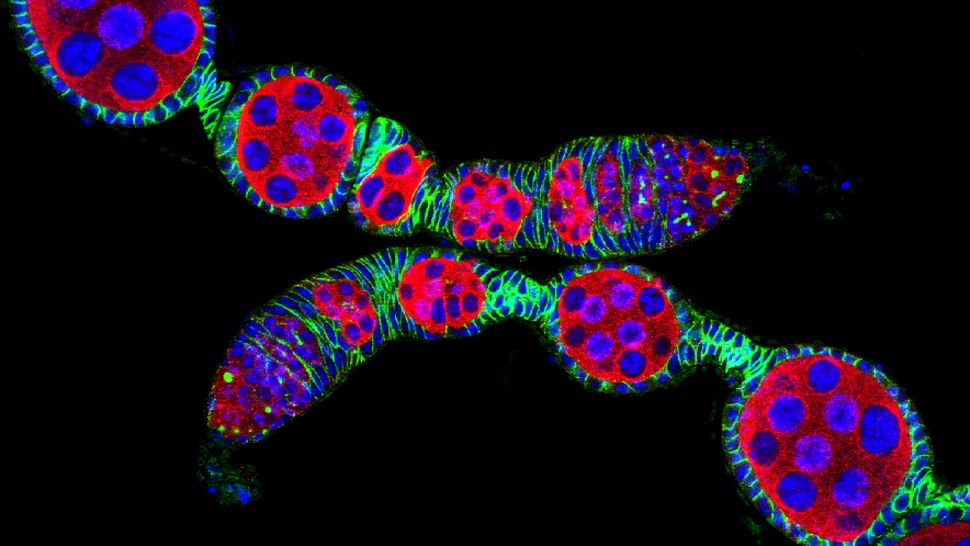
Ovarioles, or tubes that carry egg cells, in the fruit fly species Drosophila melanogaster. (Image credit: Daniel Kirilly in the Ting Xie Lab, Stowers Institute for Medical Research, and the 2004 Olympus BioScapes Competition)
Genetic “dark matter” may drive the emergence of new species, new research finds.
_______________________________________________________________________
Read Also : New species of African violets found in Mizoram
________________________________________________________________________
These long, repeating stretches of the genome, called satellite DNA, may ultimately prevent incompatible animals from mating by scrambling the chromosomes in their hybrid babies, according to the study. And if animals from different populations can’t mate, they will diverge over time, leading to speciation.
Just 1% of the 3 billion letters, or nucleotides, in the human genome make the proteins that determine traits such as eye color and height. Other stretches of DNA may tell the body how many copies of a protein to make, or turn genes on or off in different tissues, among other functions. Yet nearly 10% of the human genome is composed of long, repeating stretches of satellite DNA that, for many years, scientists didn’t think did much of anything, said study co-author Madhav Jagannathan, currently an assistant professor at the ETH Zurich Institute of Biochemistry in Switzerland.
“Satellite DNA repeats were very abundant in species and widely observed in eukaryotes,” or life-forms with cell nuclei, Jagannathan told Live Science in an email. “Despite this, they were largely dismissed as junk DNA.”
However, in a 2018 study, Jagannathan, who was then at the Massachusetts Institute of Technology (MIT), and his former postdoctoral adviser, biologist Yukiko Yamashita, also at MIT, discovered that some of this DNA served a critical purpose: It organizes DNA within a cell’s nucleus. That study found that certain proteins grab DNA molecules and arrange them in densely packed bundles of chromosomes called chromocenters. Satellite DNA, they found, tells these grabby proteins how to bundle and organize chromosomes.
In the newest study, published July 24 in the journal Molecular Biology and Evolution, Jagannathan and Yamashita found another role for satellite DNA: driving speciation. The team was investigating fertility in the fruit-fly species Drosophila melanogaster. When the researchers deleted a gene that codes for a protein called prod, which binds to satellite DNA to form chromocenters, the flies’ chromosomes scattered outside the nucleus. Without the ability to correctly organize chromosomes, the flies died.
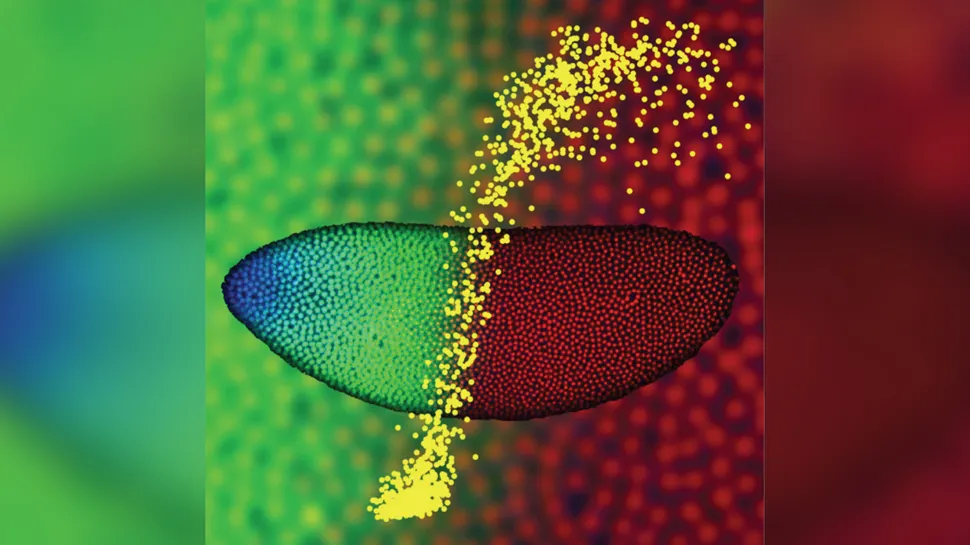
This was fascinating, Jagannathan said, because the deleted protein is unique to D. melanogaster. That meant that these rapidly evolving satellite DNA sequences must also have rapidly evolving proteins that bind to them.
_______________________________________________________________________
Read Also : India discovers new plant species in Antarctica
________________________________________________________________________
To test this idea, Jagannathan bred D. melanogaster females with males of a different species, Drosophila simulans. As expected, the hybrids did not live long. When the researchers looked into the flies’ cells, they saw misshapen nuclei with DNA scattered throughout the cells, just as they had when they deleted the prod protein in previous experiments.
So why does that mean satellite DNA could drive speciation? The team suspects that, if satellite DNA evolves quickly and two creatures make different satellite-DNA-binding proteins, they won’t produce healthy offspring. As chromocenter binding proteins and satellite DNA segments evolve differently in separate populations or species, this incompatibility could arise rather quickly.
To test this hypothesis, they mutated satellite DNA-binding genes that led to the incompatibility in both parents. When they rewrote the flies’ genomes to be compatible, they produced healthy hybrids.
_______________________________________________________________________
Read Also : New Alpine Plant Species in India: Know all about Cremanthodium indicum discovered in Arunachal…
________________________________________________________________________
Such satellite DNA disagreements could be a big factor in the evolution of new species, Jagannathan suspects. He hopes further research can test their model of hybrid incompatibility with other species. Ultimately, this research could lead to a way for scientists to rescue “doomed” hybrids, or hybrids that don’t survive long after birth. This could pave the way for using hybridization as a method for rescuing critically endangered species, such as the Northern White Rhino, of which only two females survive.
Ultimately, the new research confirmed Jagannathan’s hunch that satellite DNA served a purpose.
“I thought that there was no way evolution could be so wasteful,” Jagannathan said.
Originally published on Live Science.
NOTE – This article was originally published in livescience and can be viewed here
Tags: #customclothing, #customization, #custommade, #cwmalls, #freeshipping, #getgreengetgrowing, #giftsforhim, #gngagritech, #greenstories, #menstyle, #mnswr, #nature, #newspecies, #personaltailor, #plussize, #shearlingcoat, #sheepskincoat, #species, #streetstyle, #tagwagai, #vertebrate, #vesteenpeaudemouton